

TreeTake Network
Atmospheric monitoring networks operating across major metropolitan areas have detected a dangerous environmental feedback loop that significantly magnifies urban air pollution hazards. New data harvested from high-fidelity urban atmospheric sensors reveals that the intensified "urban heat island" effect is fundamentally altering the micro-climate of modern cities, changing how vehicular and industrial emissions disperse.
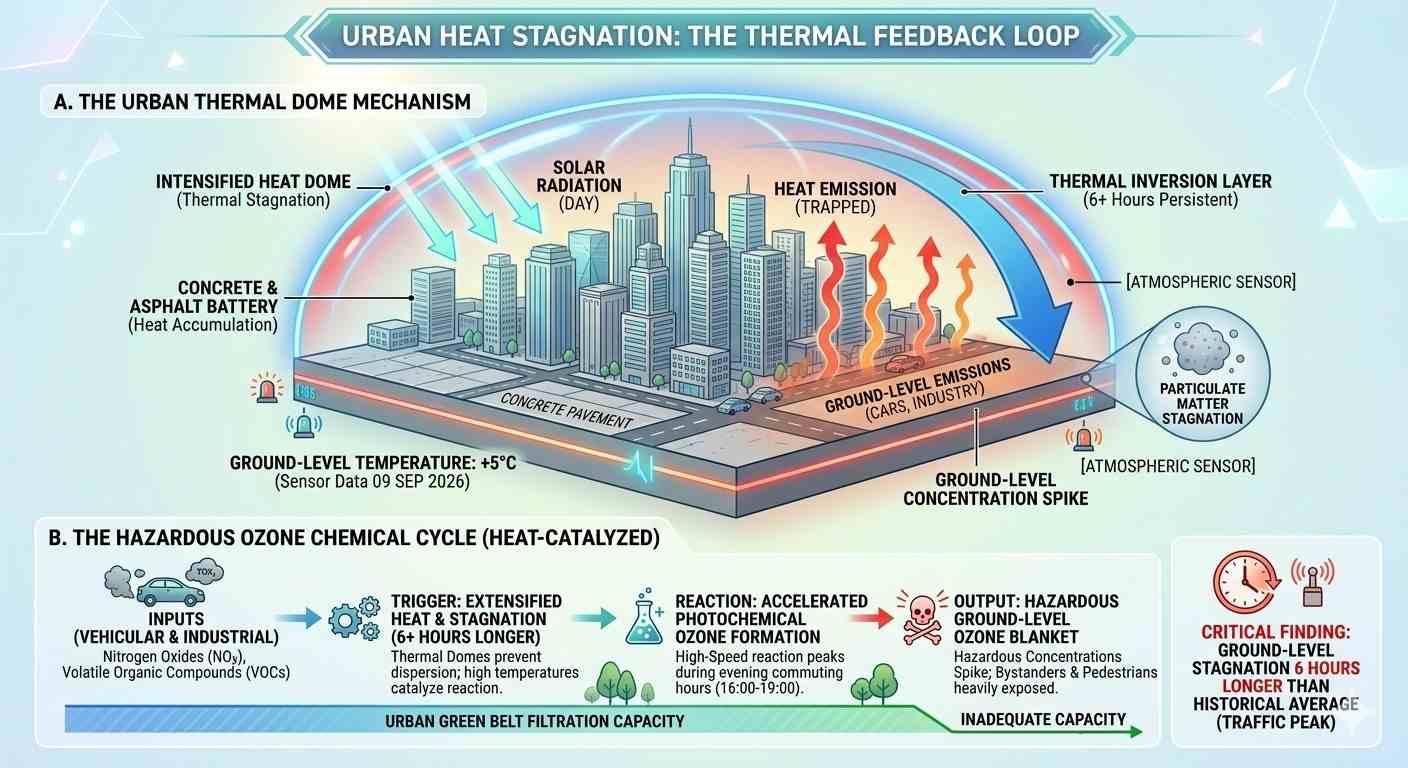
The phenomenon centres on structural thermal trapping. The massive concentration of asphalt, concrete, and high-rise architecture absorbs immense solar radiation during the day, creating an artificial thermal dome over the city. Instead of allowing emissions to rise and dissipate into the upper atmosphere during late afternoon cooling, this heat dome holds vehicular exhaust and industrial particulate matter at ground level for up to six hours longer than historical seasonal averages.
The prolonged ground-level stagnation triggers an accelerated, heat-catalysed chemical reaction between nitrogen oxides and volatile organic compounds. This rapid reaction causes toxic ground-level ozone concentrations to spike to hazardous levels precisely when pedestrian traffic peaks. Atmospheric scientists warn that this thermal feedback loop renders standard city air-purification buffers and green belts entirely ineffective, creating an invisible, highly concentrated public health crisis that persists long after the afternoon sun sets.
Fact Check & Official Stances
Elaborating on the severe public health metrics recorded by the metropolitan tracking network, Lead Urban Climatologist Dr Aris Georgiou warned that traditional green buffers are failing under the pressure of expanding concrete landscapes.
"Our newly deployed sensors indicate a highly disturbing micro-climatic shift within major metropolitan zones," Dr Aris Georgiou observed on 9 September 2026. "The massive accumulation of concrete and asphalt acts as a giant thermal battery, trapping vehicular toxins at the breathing line for up to six hours longer than documented historical averages. The resultant heat-catalysed chemical reactions create a toxic ozone blanket exactly during peak evening commuting hours, completely bypassing the filtration capacity of standard urban green belts."
Offering a policy-driven municipal perspective, City Planning Commissioner Elena Rostova emphasized the complex systemic challenges involved in re-engineering existing urban centers.
"We recognize the gravity of the thermal trapping data, but completely retrofitting highly dense, established commercial infrastructure requires extensive capital and long-term zoning overhauls," Elena Rostova noted during a municipal environmental council meeting. "Immediate policy focus must be directed toward fast-tracking electric mass transit and deploying localized vertical green walls rather than enforcing sudden halts on essential urban construction works."



Leave a comment