

The Biosphere-Body Connection: An Environmental Introduction
TreeTake Network
The human body does not exist in isolation; it is a micro-ecosystem operating within the broader Earth biosphere. As the global environment faces unprecedented stress from industrial pollutants, agricultural chemicals, and microplastics, the delicate biological systems of living organisms are responding in real time. Endometriosis—a chronic, systemic inflammatory condition affecting roughly 10% of women and individuals assigned female at birth globally—stands as a stark indicator of these external pressures.
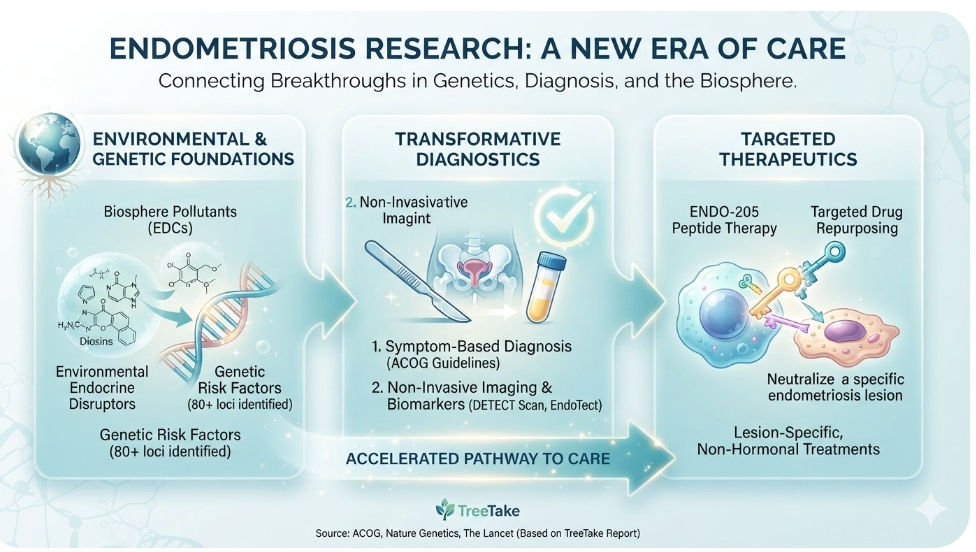
Emerging epidemiological and ecotoxicological frameworks reveal a strong link between endometriosis and widespread environmental endocrine-disrupting chemicals (EDCs), such as dioxins, polychlorinated biphenyls (PCBs), and phthalates, which have permeated global water systems and food chains. By altering cellular signalling, mimicking reproductive hormones, and inducing chronic oxidative stress within the body, these biosphere contaminants exacerbate the severity and prevalence of the disease. Examining the latest breakthroughs in endometriosis research is not merely an exploration of isolated clinical updates; it is a critical look at how human biology is adapting to a changing planet, and how modern medicine is evolving to treat systemic diseases forged at the intersection of genetics and the environment.
Endometriosis is a progressive, chronic inflammatory disorder characterised by the growth of endometrial-like tissue outside the uterine cavity, causing debilitating chronic pelvic pain, severe dysmenorrhea, and infertility. For decades, clinical management was severely bottlenecked by a standard 7-to-10-year diagnostic delay, driven by the historic requirement of invasive laparoscopic surgery for a definitive diagnosis.
Recent clinical guidelines and major scientific studies have fundamentally shifted how the medical community understands and treats the disease. Key transformations include new non-surgical diagnosis frameworks, massive multi-ancestry genomic profiling mapping the systemic nature of the condition, and a distinct pivot toward lesion-specific, non-hormonal therapeutics.
The Diagnostics Revolution: Moving Past the Laparoscopy Standard
The historical prerequisite of surgical verification left hundreds of thousands of patients in managed backlogs without an official diagnosis. A major paradigm shift altered this pathway.
The Symptom-Based Diagnostic Framework
The American College of Obstetricians and Gynaecologists (ACOG) released landmark updated clinical guidelines. ACOG officially declared that surgery is no longer a mandatory threshold for a definitive diagnosis or the commencement of care. The new guidance empowers clinicians to establish a clinical diagnosis and initiate empirical medical treatment based entirely on a structured symptoms-based assessment, physical examination, or both. Key indicators prioritised in this clinical framework include:
- Chronic pelvic pain lasting six months or longer
- Severe period pain (dysmenorrhea) non-responsive to over-the-counter NSAIDs
- Deep pain during or after intercourse (dyspareunia)
- Painful elimination (dyschezia and dysuria)
Non-Invasive Biomarkers and Imaging Trials
Parallel to clinical guidelines, innovative diagnostic tools are moving through late-stage testing to eliminate exploratory surgery completely.
- The DETECT Scan Study: Published in The Lancet, Oxford researchers successfully validated specialised advanced imaging utilising 99mTc-maraciclatide. This molecular imaging scan targets integrins—specific proteins heavily expressed on active tissue surfaces—allowing clinicians to visualise previously undetectable superficial peritoneal lesions non-invasively.
- EndoTect Urine Biomarkers: Developed by Dr Barbara Guinn and her research team at the University of Hull, EndoTect functions as a non-invasive urine test designed to distinguish deep infiltrating endometriosis from superficial variants, potentially collapsing a multi-year diagnostic pipeline into a matter of days.
Genomic Breakthroughs: Expanding the 1.4 Million Cohort
A massive international study published in Nature Genetics has fundamentally rewritten the biological understanding of endometriosis. Led by Dr Renato Polimanti of Yale University and Dr Dora Koller of the Sant Pau Research Institute, an international consortium analysed the DNA of more than 1.4 million women, including over 105,000 confirmed endometriosis cases.
[ 1.4 Million Cohort Genome Analysis ]
├──► 80 Distinct Genomic Risk Regions Identified
│ (37 represent entirely new discoveries)
├──► 5 Overlapping Genetic Loci with Adenomyosis
└──► Systemic Pathways Discovered:
Immune Dysfunction • Cellular Transport • Inflammation
Key Discoveries from the Multi-Ancestry Mapping
- Landscape Expansion: The study identified 80 distinct genomic regions tied directly to an increased risk of developing endometriosis, 37 of which were entirely unknown to science before this mapping.
- Ancestral Representation: Crucially, the multi-ancestry methodology successfully integrated data from diverse cohorts—including individuals of African ancestry who have been historically underrepresented in gynaecological genomic datasets—ensuring future precision therapies scale equitably across populations.
- Adenomyosis Co-Expression: The team uncovered 5 genetic loci that are directly shared between endometriosis and adenomyosis (a condition where the tissue grows directly into the uterine muscular wall), demonstrating a shared underlying genetic pathology.
Reclassifying Endometriosis as a Systemic Condition
A key outcome of this genomic data is the validation that endometriosis is far more than a localised pelvic disease. Many of the mapped genes dictate cell differentiation, tissue remodelling, cell movement, and immune regulation rather than simple estrogen reception.
The findings explain why the condition displays high comorbidity with other central nervous system hypersensitivities and inflammatory disorders, including severe migraines, chronic fatigue, depression, and anxiety. Real-world data underscores this, demonstrating that up to 35% of the endometriosis patient population actively suffers from clinically managed depression.
Therapeutics Evolution: The Rise of Non-Hormonal Precision Care
For over half a century, the primary pharmacological defense against endometriosis has been systemic hormonal ovulation suppression (via oral contraceptives, progestins, or GnRH agonists). While often effective at stopping menstruation, these drugs induce stark side effects mimicking medical menopause, such as accelerated bone density loss and vasomotor symptoms, and they are inherently incompatible with patients seeking pregnancy. Current pipelines have shifted decisively toward lesion-directed, non-hormonal alternatives.
One of the frontrunners in this category is ENDO-205 by EndoCyclic Therapeutics. This non-hormonal peptide therapy is designed to target and eliminate endometriosis lesions directly at the source, actively preventing tissue growth and fibrosis. It has recently received FDA Investigational New Drug (IND) clearance and is entering active human clinical trials.
Simultaneously, researchers are exploring targeted drug repurposing by utilising multi-omic data profiles to identify existing FDA-approved compounds capable of interrupting specific tissue remodelling and cell-adhesion pathways. This involves pre-clinical and computational modelling leveraging existing breast cancer, contraception, and preterm birth therapies. Furthermore, a hormonal re-evaluation study at the University of Edinburgh has identified a distinct cellular "fingerprint" showing the disease operates on multi-pathway mechanics, challenging the 100-year-old assumption that it is purely estrogen-driven and driving the identification of novel non-estrogenic compound targets.
Conclusion and Future Outlook
The landscape of endometriosis care is moving away from invasive surgeries and broad, blunt hormonal suppression. Armed with symptom-based diagnostic guidelines from ACOG, non-invasive imaging markers like maraciclatide, and precise genetic data from over a million profiles, modern medicine is transforming endometriosis management. The ongoing development of targeted non-hormonal medications like ENDO-205 signals an upcoming era of precision medicine where the disease can be managed directly at the cellular level without disrupting a patient’s wider reproductive health or systemic well-being.
Editor's Note
At TreeTake, our editorial focus covers the intersection of human wellness and the broader biosphere. The accelerating global incidence of inflammatory and endocrine-driven disorders reminds us that environmental health is human health. By shedding light on systemic diseases like endometriosis—which are heavily influenced by environmental endocrine-disrupting pollutants—we aim to highlight how deeply interconnected our biological systems are with the planet we inhabit. Resolving these medical crises requires not only clinical innovation but a commitment to cleaning our living environments.



Leave a comment