

TreeTake Network
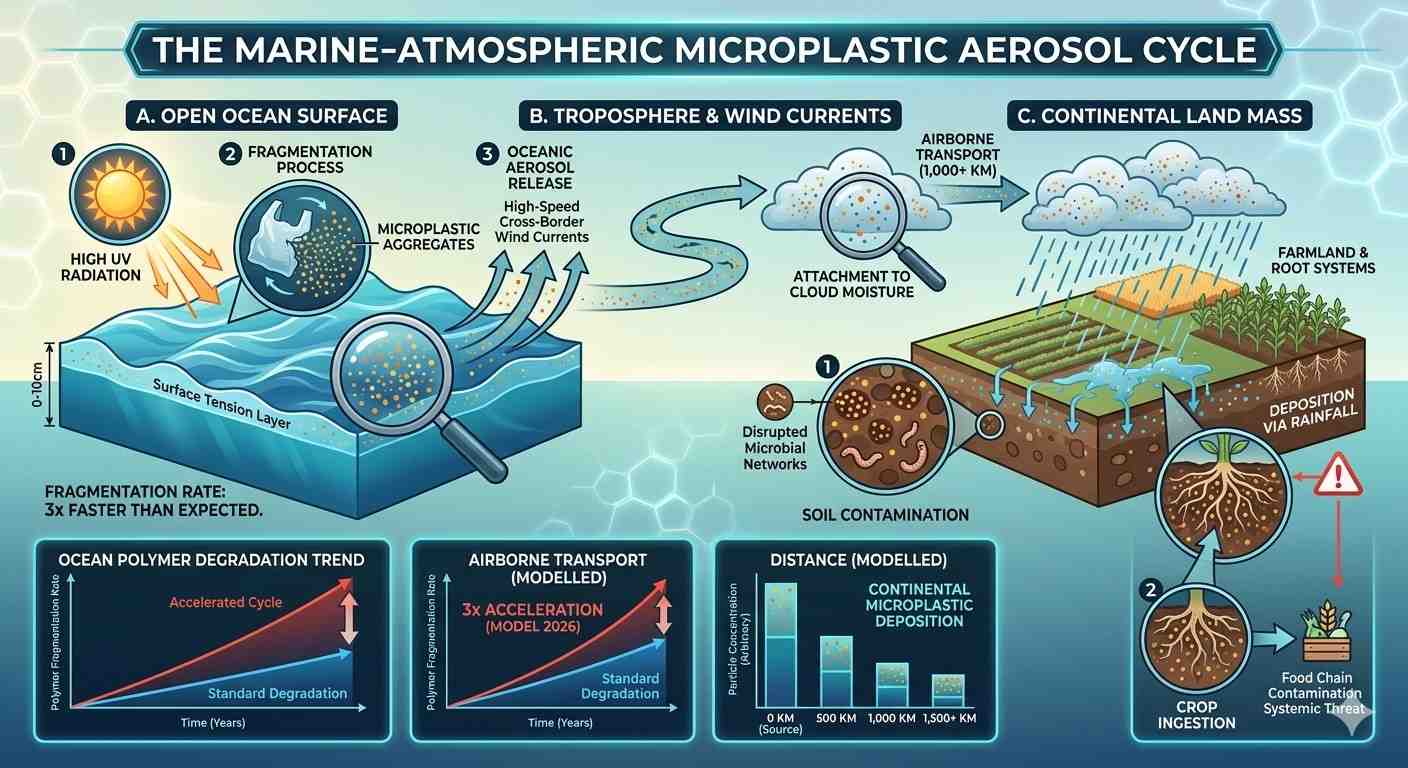
A pioneering global marine study has uncovered a profound and previously unmapped environmental vector, revealing that marine microplastic pollution is no longer confined to oceanic sinks. Atmospheric and marine scientists monitoring open-ocean simulation arrays have determined that plastic polymers floating on the ocean surface are fragmenting into toxic microscopic chemical aerosols at a rate three times faster than previously estimated by standard degradation models.
The accelerated degradation is driven by a volatile combination of high-intensity ultraviolet radiation and shifting ocean surface salinity profiles. The real danger lies in the atmospheric transport mechanism: high-speed wind currents travelling across ocean boundaries are sweeping these ultrafine, toxic particles directly from the ocean’s surface tension layer. Once suspended in the troposphere, these microplastic aerosols are being carried thousands of kilometres inland, where they attach to cloud moisture and deposit directly onto remote continental agricultural soils via standard rainfall events.
Agronomists and soil scientists are warning that this creates an unprecedented cross-contamination feedback loop. The continuous deposition of ocean-derived plastic particles into agricultural fields alters soil porosity, disrupts local microbial networks, and allows toxic chemical additives to leach into the root systems of essential food crops. This transition effectively upgrades microplastics from a marine waste dilemma into a direct, systemic threat to land-based food security and the global agricultural supply chain.
Fact Check & Official Stances
Leading the global marine assessment project, Chief Atmospheric Chemist Dr Eleanor Vance explicitly warned that standard environmental models have completely missed the scale of this airborne cycle.
"Our current instrumentation confirms that the atmospheric transport of microplastics is no longer an isolated anomaly," Dr Eleanor Vance stated on 7 September 2026. "We are observing a massive, continuous transport loop where marine synthetic waste is effectively being weaponised by wind currents and rained back down onto prime agricultural regions. The long-term degradation of agricultural soil health could become irreversible if global plastic production remains unchecked."
Countering the immediate severity of the study's conclusions, global petrochemical industry representative Marcus Vance urged caution regarding premature agricultural restrictions.
"The study relies heavily on high-speed open-ocean simulation models that may not accurately mirror diverse real-world coastal dynamics," Marcus Vance noted during an industry briefing. "Plastics remain foundational to modern food packaging and logistical security; we must focus on improving regional waste collection infrastructures rather than introducing sweeping regulatory bans based on early atmospheric tracking data."


Leave a comment