

TreeTake Network
The global atmosphere serves as the circulatory system of our biosphere—an interconnected web where shifts in macro-climatic patterns directly dictate the biological health of living organisms. The human body does not exist in isolation; it continuously absorbs, reacts to, and mirrors the state of the surrounding environment. As global temperatures rise and ecosystems face severe stress, the boundary between environmental crises and human pathology is entirely dissolving.
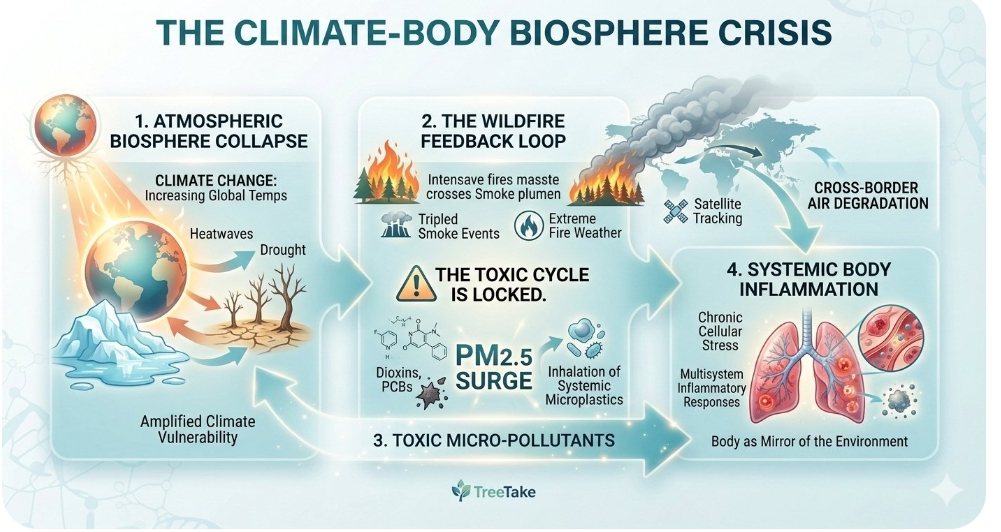
The World Meteorological Organisation (WMO) has identified a dangerous environmental phenomenon: a toxic feedback loop in which extreme heatwaves and intensifying wildfires generate highly toxic, microscopic airborne pollutants. This atmospheric degradation does not just damage distant forests or wilderness; it acts as a direct physical input into human biology. By breathing in climate-driven fine particulate matter, our bodies experience heightened cellular stress and widespread inflammation. Examining this feedback loop reveals that air pollution and climate change are not separate challenges. They are a single, unified threat demonstrating how deeply human health is tied to the stability of our planet's biosphere.
A major scientific brief issued by the WMO on the International Day of Clean Air for Blue Skies warns that escalating wildfires and heatwaves are creating a vicious cycle that threatens international efforts to improve air quality and protect human health. According to the WMO annual Air Quality and Climate Bulletin, extreme fire weather is multiplying globally, locking climate change and atmospheric pollution into a destructive spiral.
Concurrently, a joint report by the United Nations Environment Programme (UNEP) and the Climate and Clean Air Coalition (CCAC) provides an actionable economic counter-strategy. Their research proves that integrated climate and clean air policies offer a massive 15-to-1 return on investment, providing a clear path forward to protect global communities and fragile ecosystems.
The Vicious Cycle: Wildfires and Heatwaves as Pollution Amplifiers
The latest data from the WMO Global Atmosphere Watch network shows that conventional regulatory frameworks are failing to account for climate-driven environmental extremes. While industrial and transport emissions have successfully declined in regions like Europe and North America due to strict regulations, exposure to fire-related pollution has dramatically risen.
The Tripling of Extreme Smoke Events
Global atmospheric monitoring reveals that extreme fire-smoke events have tripled worldwide since the 1990s. This surge in wildfire frequency and intensity is fueled by persistent droughts and rising global baselines. The smoke generated by these massive blazes is not localised; satellite tracking confirms that wildfire emissions regularly cross international borders and entire continents, degrading air quality thousands of miles away from the active flames.
[ Climate Change & Warming Baselines ]
│
▼
[ Droughts & Extreme Fire Weather ]
│
▼
[ Intense Wildfires & Tripled Smoke Events ]
│
▼
[ Surge in Highly Toxic PM2.5 Pollution ]
│
▼
[ Increased Human and Ecosystem Inflammation ]
The Toxic Feedback Loop Mechanics
The relationship between heat and pollution operates as a multi-layered feedback loop:
- Heatwave Catalysts: Rising seasonal temperatures and stagnant air masses create ideal conditions for ground-level ozone formation. Intense sunlight drives chemical reactions between urban emissions, drastically increasing ozone-related health risks.
- Particulate Surges: Severe drought conditions fuel massive fires, leading to extreme concentrations of fine particulate matter (PM2.5) that far exceed historic averages. Recent spikes have been heavily documented across northern Canada, Siberia, western-central Africa, and the Amazon basin.
- The Toxicity Multiplier: WMO Deputy Secretary-General Ko Barrett noted that extreme wildfires carry devastating health consequences due to the high toxicity of fire-derived smoke. Traditional risk models routinely underestimate wildfire-attributable mortality by up to 93% because they fail to account for how deeply these specific climate-driven particles damage the human body.
The Integrated Solution: Trillions Saved Through Unified Action
While the WMO bulletin outlines a growing atmospheric crisis, the UNEP and CCAC spotlight report, titled Hidden Assets: The Economic and Health Case for Climate and Clean Air Action, provides a verified economic framework to resolve it.
The 15-to-1 Economic Return
UNEP economists have demonstrated that every $1 collectively invested in tackling climate change and air pollution together yields approximately $15 in market and non-market economic benefits. This extraordinary return rate occurs because integrated policies simultaneously reduce greenhouse gases and harmful short-lived climate pollutants (SLCPs), preventing dual expenditures on separate climate and healthcare initiatives.
The 25 Proven Measures
The UNEP report introduces a comprehensive package of 25 integrated solutions spanning the six highest-emitting global sectors. By implementing these coordinated strategies, nations can address long-term decarbonization alongside immediate air quality improvement:
- Decarbonisation Pathways: Transitioning rapidly to renewable energy grids, boosting industrial efficiency, upgrading household insulation, and electrifying mass transit systems.
- Near-Term Mitigation: Tightening vehicle emission standards, eliminating open agricultural burning, capturing methane from waste systems, preventing peatland fires, and phasing down hydrofluorocarbons.
By deploying these 25 solutions globally, projections show the world could cut carbon dioxide emissions by roughly half, reduce methane by 60%, and slash PM2.5 precursors by 70% by mid-century. This unified action would prevent an estimated 0.34°C of global warming, safeguarding biodiversity, agricultural soil quality, and millions of human lives.
Conclusion and Future Outlook
The findings from the WMO and UNEP make one reality clear: climate action and air purification are entirely inseparable. Meeting global health guidelines will become progressively harder if nations continue to treat industrial emissions and climate-driven wildfires as isolated problems. Protecting the biosphere requires a shift toward integrated policies where environmental containment, wildfire prevention, and clean energy deployment are funded under a single framework. Embracing the UNEP's 25 integrated measures offers global leadership a pathway to protect human physiology from toxic feedback loops while securing trillions of dollars in shared economic prosperity.
Editor's Note
At TreeTake, our publication is dedicated to exploring the deep structural links between human wellness and the broader biosphere. The WMO and UNEP reports remind us that the air we breathe is a shared biological asset under active threat from climate feedback loops. When tracking public health, we must look at the environmental inputs—such as wildfire smoke and systemic atmospheric pollutants—that alter our biology. We publish these briefs to emphasise that protecting human health requires an ongoing, aggressive commitment to restoring, cleaning, and preserving the natural world around us.



Leave a comment