

TreeTake Network
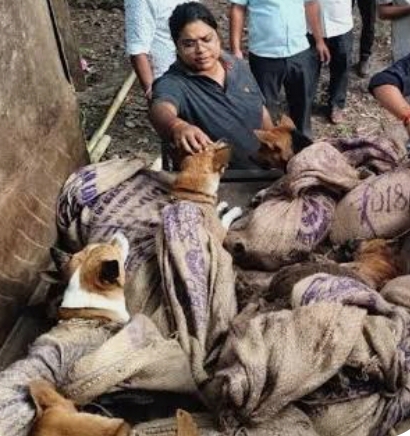
A major operational blow has been dealt to the illegal domestic animal trafficking routes operating through Northeast India following a highly coordinated, late-night tactical intervention on October 28. Operating on precise, actionable field intelligence, the Assam Police joined forces with four prominent national animal protection non-governmental organisations to successfully rescue 26 dogs packed inside a commercial transit truck in the volatile Karbi Anglong district before the animals could be systematically smuggled across state lines.
Joint task force intercepts illicit border trafficking network
The breakthrough occurred when a specialised law enforcement detachment established an emergency check-post along a known transit corridor frequently exploited by illicit syndicates moving livestock and companion animals toward commercial markets in neighbouring states. Upon stopping and inspecting a covered commercial transport vehicle, officers discovered the animals crammed inside coarse jute sacks, with their mouths tightly bound with industrial wires and plastic adhesive tape to prevent them from making noise during transit.
The successful intervention marks the first time that multiple major animal protection organisations—including J-B-F, H-W-A India, the U-C-I Foundation, and A-n-a-a-j-o-r-e-e—have pooled field operations to execute a unified medical and legal rescue alongside state police units. Following their initial extraction, the animals were temporarily stabilised at a local Veterinary Department facility before being transferred across district lines under armed escort to an intensive care and resource centre near Guwahati for advanced trauma management.
Extensive expert projections and official testimonies
The multi-agency nature of this field operation has driven detailed analysis and calls for legal updates from veterinary professionals, policy managers, and law enforcement supervisors who are pushing for structural changes against illegal trade operations.
"Every individual animal salvaged from this commercial infrastructure represents a life spared from profound physical trauma, extreme asphyxiation, and systematic cruelty," stated Keren Nazareth, senior director of companion animals at H-W-A India. "What makes this specific deployment a true turning point for animal welfare in the region is the unprecedented level of institutional collaboration between the state police forces and independent non-governmental networks. We hope this highly publicised action serves as a definitive template for stricter statutory enforcement, tighter border monitoring, and proactive legal interventions across the entire northeastern geographic belt."
Long-term rescue data from the region indicates that while enforcement has expanded, the economic drivers behind the black-market pet trade remain highly aggressive.
"This operation marks our third major field rescue within this calendar year, bringing the cumulative total of animals intercepted along these specific transit lines to 69," confirmed Dr Shashanka Dutta, founder of J-B-F. "While it is incredibly heartening to see the Assam Police actively stepping up to disrupt these syndicates, the sheer level of cruelty we are encountering on the ground is systematically increasing. The legal rescue is only the first phase; the true challenge begins now as our medical teams work around the clock to treat severe lacerations, dehydration, and structural bone injuries to prepare them for local adoption."
Economic transitions and the path toward trade eradication
Welfare strategists and policy experts emphasize that completely eradicating the trade requires shifting focus from border interceptions to rehabilitating the supply side of the market.
"Enforcement must be paired with sustainable socio-economic alternatives to achieve lasting results," explained regional animal policy analyst Ram Das. "Recent field programs in Nagaland have successfully incentivised more than 80 commercial vendors to voluntarily exit the trade in favour of humane local business alternatives. Combining strict legal penalties in transit states like Assam with proactive livelihood transitions in consumer markets is the only viable blueprint to permanently dissolve these illicit trafficking networks."
Editor's Note : The successful rescue in Karbi Anglong highlights the immense power of structured institutional alliances in tackling deep-rooted animal crimes. Moving forward, state governments must formalise these civil-police task forces, establish permanent animal welfare monitoring cells at critical border check posts, and significantly escalate statutory penalties for commercial animal cruelty to ensure the subcontinental transport network is never utilised for illegal exploitation.



Leave a comment