

TreeTake Network
The future of Chennai's critical southern coastal buffer zone hangs in a delicate balance on October 29, as environmental advocates raise urgent alarms over the expanding infrastructure footprint of the Mamallan project. Conservation collectives warn that intensive construction activities along the Kovalam-Nemmeli corridor are actively fracturing vital wetland matrices, systematically dismantling natural flood defence architectures and endangering unique estuarine biodiversity.
Estuarine ecosystems compromised by civil engineering
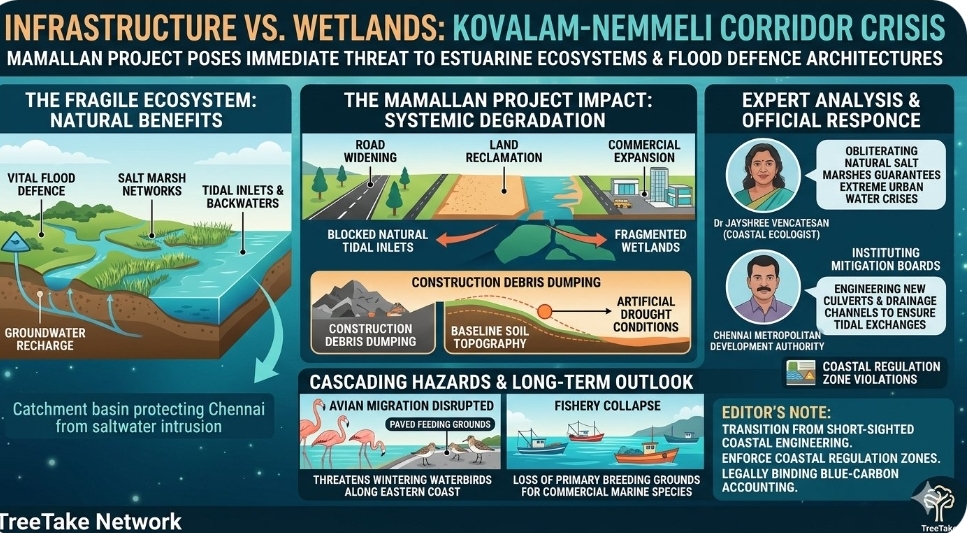
The ongoing infrastructure development involves extensive road widening, land reclamation, and commercial expansion cutting directly through fragile salt marsh networks, backwaters, and tidal flats. Hydrological assessments indicate that these operations have blocked natural tidal inlets and fragmented the contiguous wetland ecosystem. Environmental field groups report that the dumping of construction debris has altered the baseline soil topography, preventing the seasonal flow of brackish water and triggering artificial drought conditions across critical mangrove nurseries.
The Kovalam-Nemmeli wetlands serve as an indispensable natural catchment basin, regulating groundwater recharge profiles and protecting metropolitan Chennai from coastal saltwater intrusion. Local fishing cooperatives have registered sharp drops in seasonal catches, warning that the destruction of these coastal swamps removes the primary breeding grounds for several commercial marine species.
Extensive expert projections and official testimonies
The acceleration of this infrastructure footprint has driven detailed analysis and strong appeals from wetland ecologists, conservation planners, and administrative authorities tracking the coastal changes.
"The systemic fragmentation of the Kovalam-Nemmeli wetland complex represents a profound ecological oversight," stated Dr Jayshree Vencatesan, a prominent coastal wetland ecologist. "These estuarine spaces are not vacant land waiting for commercial modification; they function as highly dynamic hydrological engines. Obliterating these natural salt marshes for hard infrastructure completely strips the coast of its resilience against cyclonic surges and guarantees extreme urban water crises in the future."
Conservation advocates highlight the legal protections governing these coastal zones, demanding an immediate halt to ongoing land reclassifications.
"The current construction activities are occurring in direct violation of statutory coastal regulation zone parameters," argued Jaysingh Nathan, a leading regional environmental attorney. "By reclassifying ecological wetlands as commercial infrastructure corridors, local planning bodies are opening floodgates to unchecked real estate expansion. We are officially petitioning the coastal management authority to declare this entire estuarine system a protected conservation reserve to prevent complete habitat collapse."
In response to the expanding environmental friction, regional development planners defended the strategic utility of the coastal corridor, pointing to new containment frameworks.
"The infrastructure project is a critical component of our regional economic connectivity layout," stated a senior planning engineer from the Chennai Metropolitan Development Authority. "We have instituted specialised environmental mitigation boards to carefully supervise the project's progress. New culvert networks and artificial drainage channels are being engineered along the road corridors to ensure that baseline tidal exchanges continue without compromising structural safety."
Cascading hazards for avian migration and coastal safety
Ornithologists and marine biologists warn that the ecological damage extends far beyond hydrological displacement, directly impacting international avian flyways.
"The Kovalam wetlands are a crucial wintering ground for thousands of migratory waterbirds, including greater flamingos and various sandpiper species," explained Dr S. Subramanya, an avian conservation specialist. "The constant noise, industrial lighting, and physical destruction of mudflats have severely disrupted feeding behaviours. If these feeding grounds are paved over, we will see an immediate collapse in migratory bird populations along the eastern coast."
Editor's Note: The conflict over the Kovalam-Nemmeli wetlands highlights the critical need to transition away from short-sighted coastal engineering models that treat natural buffers as expandable spaces. Moving forward, coastal urban planning must fully integrate nature-based infrastructure strategies, strictly enforce coastal regulation zones, and implement legally binding blue-carbon accounting frameworks to ensure that vital estuarine ecosystems are permanently preserved as defences against climate volatility.



Leave a comment