

TreeTake Network
The European Union has officially launched an international coalition named the "Friends of Credits for Nature and Biodiversity" at the United Nations Biodiversity Conference (COP17) in Yerevan, Armenia. The diplomatic initiative, unveiled on October 28, 2026, seeks to build a highly regulated, high-integrity global market for biodiversity credits to scale up private capital for ecosystem restoration.
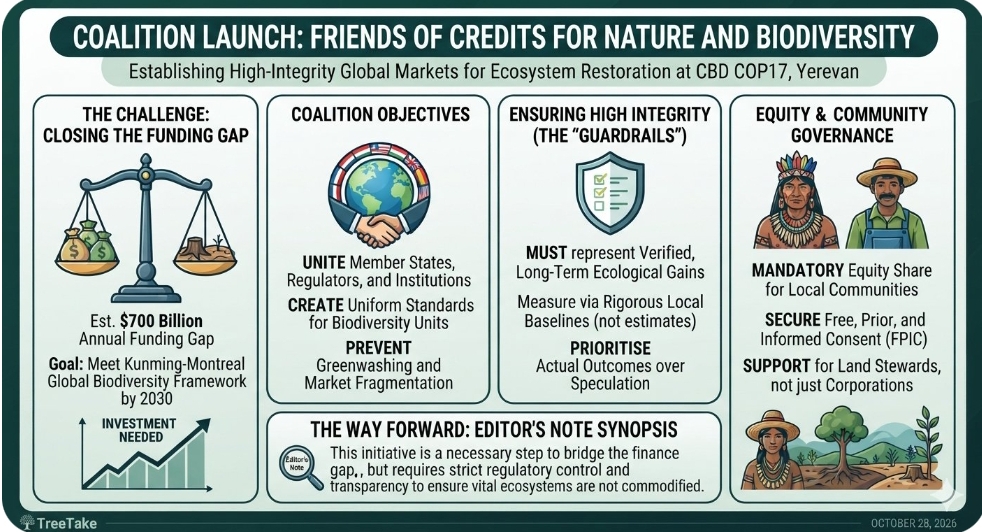
The launch occurs amid intensifying debates at the summit regarding how to plug the estimated 700 billion US dollar annual funding gap required to meet the goals of the Kunming-Montreal Global Biodiversity Framework by 2030. The new coalition unites over twenty member states, financial regulatory bodies, and international environmental institutions to create uniform standards for biodiversity units, preventing greenwashing and market fragmentation.
Establishing Global Integrity and Standards
Historically, the concept of biodiversity credits has faced significant skepticism from civil society groups who fear it could replicate the structural flaws observed in voluntary carbon offsets. The newly formed coalition aims to tackle these anxieties directly by enforcing strict, metrics-based guardrails that prioritise actual ecological outcomes over speculative trading.
Under the framework presented in Yerevan, credits must represent verified, long-term ecological gains measured through rigorous local baselines rather than generalised global estimates. Furthermore, the coalition has established a mandatory governance pillar ensuring that local communities receive an equitable share of the financial returns generated by these credit mechanisms.
Statements from Leadership and Economic Analysts
"We are introducing a structural framework designed to turn nature restoration into a measurable, verifiable asset class," stated Wopke Hoekstra, the European Commissioner for Climate Action, during the official launch event. "Voluntary and uncoordinated frameworks have failed to generate the massive scale of investment that our biosphere critically demands. Through the Friends of Credits for Nature and Biodiversity, the European Union is collaborating with global partners to establish clear rules, robust monitoring, and absolute transparency. This will ensure that every single unit of capital deployed translates directly into revitalised habitats and protected ecosystems."
Anoop Sukumaran, a senior environmental economist specialising in green finance, noted that institutional investors have historically stayed away from biodiversity projects due to the lack of standardised financial instruments.
"The primary barrier to private nature finance has always been the complete absence of a universally accepted currency for biodiversity," Sukumaran explained during a panel discussion. "You cannot scale a market when one project measures success by bird populations and another by tree canopy density. By establishing clear, legally recognised standards for biodiversity credits, this initiative provides the regulatory clarity that large-scale institutional funds require to move capital into ecological infrastructure."
Addressing Equity and Community Governance
A core challenge for the new coalition will be ensuring that market mechanisms do not trample upon the land rights of indigenous peoples, who act as caretakers for the majority of the world's remaining biodiversity. The coalition's charter specifies that no biodiversity credit can be issued or traded without securing the free, prior, and informed consent of local landholders.
"Market instruments must serve the stewards of the land, not just corporate sustainability portfolios," emphasised Dr Gladys Kalema-Zikusoka, a renowned conservationist advising the summit's biodiversity finance working group. "The inclusion of mandatory equity shares within the coalition’s foundational principles is a positive step. However, the international community must remain vigilant to ensure these market mechanisms genuinely benefit frontline communities rather than turning into tools for corporate offsetting."
Editor's Note
The formation of the Friends of Credits for Nature and Biodiversity coalition represents a significant step towards the financialisation of global conservation efforts. While utilising private capital is crucial to bridging the massive environmental funding gap, relying on market-based solutions brings undeniable systemic risks. The European Union's focus on high integrity and strict metrics is a necessary attempt to avoid the speculative pitfalls that previously undermined the credibility of voluntary carbon markets. Moving forward, the ultimate success of this initiative will be judged by its implementation. The coalition must prove that it can maintain strict regulatory control and deliver genuine, long-term ecological preservation without transforming vital natural ecosystems into mere speculative commodities.



Leave a comment