

TreeTake Network
Look closely at a modern urban playground, and you will see a marvel of engineering. Poured rubber tiles, pristine gravel, interlocking plastic mats, and spotless steel swings. It is clean, it is predictable, and it is entirely dead. In our collective quest to protect children from skinned knees and dirty laundry, we have built micro-environments that are practically sterile.
But as it turns out, we have been protecting them from the wrong things. By scrubbing nature out of the spaces where our children play, we have starved their developing bodies of the essential environmental microbes they need to thrive. The consequence isn't just a lack of outdoor connection; it is a global explosion of childhood allergies, asthma, and autoimmune disorders.
A landmark series of real-world trials out of Finland has provided a powerful, grounded solution: the best medicine for a child's baseline health isn't a sanitised surface—it is living soil, wild moss, and a generous dose of mud.
Bringing the Wilderness to the Playground
To test the validity of the "biodiversity hypothesis"—the idea that interaction with natural ecosystems protects humans against chronic inflammatory diseases—researchers in Finland decided to actively redesign the daily lives of urban children.
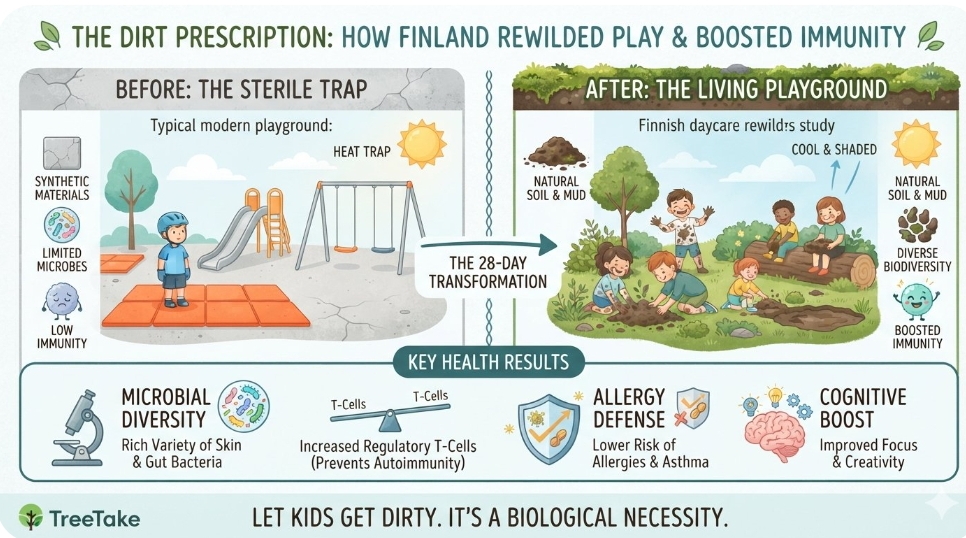
Instead of merely tracking children who already lived in rural settings, scientists from the Natural Resources Institute Finland and the University of Helsinki brought the forest directly to urban daycare centres. They targeted standard, urban daycares equipped with typical concrete, asphalt, and gravel yards. In place of these inorganic surfaces, they laid down a rich tapestry of the Finnish wilderness: living forest floor turf, complete with dwarf shrubs, mosses, peat blocks, wild heather, and native blueberries.
The children, aged three to five, were simply set free to play as they always had. They dug in the rich soil, handled the moss, built make-believe worlds out of mud, and climbed on the peat blocks. They played outside in the elements, rain or shine, embedding themselves in the biological chaos of the earth.
A Microbial Gym That Works in 28 Days
The physiological transformations captured by the researchers were swift and undeniable. By comparing skin and gut samples before and after the landscape overhaul, scientists discovered that just 28 days of regular contact with the rewilded yards fundamentally altered the children's internal biology.
- Enhanced Skin Microscopic Diversity: Within less than a month, children playing in the soil developed a significantly richer variety of bacteria on their skin. Notably, there was a dramatic rise in Gammaproteobacteria, a class of microbes known to strengthen the skin’s natural barrier functions.
- Calibrated Immune Response: Blood analyses revealed a profound shift in the children's immune regulation. The children exposed to the forest soil showed a marked increase in regulatory T-cells (Tregs) and anti-inflammatory proteins. Tregs act as the peacekeepers of the human immune system; they train the body to distinguish between an actual hazardous pathogen and harmless triggers like pollen, dust, or peanuts.
- The "Forest Shift": In four short weeks, the internal microbiomes of these urban children began to shift, mirroring the robust profiles of children who live deep in rural areas and spend their entire lives surrounded by natural forests.
Follow-up assessments across a wider network of daycares showed that these biological benefits, including reduced systemic inflammation indicators, sustained themselves comfortably through the one-year mark as children kept getting their hands dirty.
The Cognitive and Psychological Shift
While the immunological data took the scientific community by storm, educators and behavioural psychologists observed another profound transformation: the children’s minds were changing alongside their microbiomes.
Once the sterile yards were replaced with complex natural textures, playground dynamics shifted dramatically. In concrete spaces, play is often rigid, competitive, and highly repetitive. In contrast, the chaotic structure of a living forest floor sparked an explosion of creative, open-ended play.
Children showed marked improvements in sustained focus, spatial awareness, and motor coordination as they navigated uneven terrain. More importantly, teachers noted a significant drop in playground aggression and anxiety. The sensory input of digging through soil and working with natural materials acted as a powerful emotional stabiliser, proving that green spaces heal a child's nervous system just as effectively as they train their immune system.
Nature as a Core Biological Nutrient
The implications of this research go far beyond playground aesthetics; it reframes our relationship with cleanliness. Researchers involved in the project now refer to natural play areas as a "microbial gym"—a vital training ground where a child's internal defences learn how to function.
Aki Sinkkonen, the environmental ecologist who spearheaded the study, has been clear about how these findings should change our urban design principles. He argues that our increasingly concrete-heavy lifestyles have caused a severe homogenization of human microbes, leaving our immune networks under-challenged and prone to malfunction. His recommendation for schools, city planners, and parents is direct:
“The yard areas of all daycare centres should be transformed into green areas, because this will improve the regulation of children’s immune systems in only a month.”
Sinkkonen points out that the solution is incredibly low-risk and remarkably simple to scale. We do not need to abandon our cities or move our families to remote wilderness tracts to fix our children's immunity. We simply need to invite the raw complexity of the natural world back into the immediate environments where our children spend their formative hours.
Nature is Cheaper Than Plastic
Beyond the obvious biological and mental health victories, shifting away from synthetic playground infrastructure addresses a major hidden crisis for schools: municipal budgets.
The initial cost of installing rubber safety tiles or artificial turf is notoriously steep, but the real financial drain comes from long-term maintenance. Synthetic surfaces function like heavy industry machinery; they dry out, crack under UV exposure, hold intense solar heat, and trap stagnant water, requiring specialised chemical washes, structural patching, and total replacement every few years to meet safety guidelines.
Natural landscapes, by contrast, utilise materials that naturally regenerate. Forest floor turf, native wood chips, sandpits, and soil networks manage stormwater on their own, eliminate the need for costly drainage systems, and cost a fraction of the price to maintain. By replacing heavy plastic infrastructure with self-healing ecosystems, schools can slash their facilities budgets while building spaces that actively improve child longevity.
How to Bring the Finnish Method to Urban Homes
You do not need access to an expansive forest to replicate these health benefits for your family. Even in small urban apartments, concrete backyards, or balconies, parents can intentionally cultivate a high-microbe environment using a method called “micro-rewilding.”
- The Balcony Biodiversity Box: Fill a large wooden planter or container with unsterilized, organic topsoil, native mosses, and hardy forest plants rather than sterile potting soil. Let your child dig in this specific box with their bare hands, make mud pies, and root through the dirt daily.
- Selecting Safe Target Plants: When designing a small urban rewilding box, focus on sturdy, non-toxic species that invite sensory play. Dwarf shrubs, wild heather, and child-safe herbs like chamomile, creeping thyme, and mint are excellent choices because they survive rough handling, provide diverse root structures for healthy soil bacteria, and release calming aromatics when bruised during play.
- Bring the Undergrowth Indoors: Collect small rotting logs, smooth river stones, wild pinecones, and moss patches during weekend trips to natural parks. Place them in a dedicated sensory bin at home for routine tactile play.
- Ditch the Antibacterial Obsession: Allow children to eat fresh vegetables straight from an organic garden with just a quick water rinse. Avoid using harsh antibacterial soaps immediately after outdoor play unless they have encountered actual chemical contaminants.
The Takeaway
Finland’s ongoing playground shifts illustrate that our modern obsession with pristine sterility has come at a massive physical cost. While plastic grass and rubber mats look clean and require minimal weeding, they turn our children's play areas into biological deserts.
Allowing a child to get completely caked in mud, to track dirt into the hallway, and to dig bare-handed through the moss is not a failure of proper parenting or hygiene. It is a fundamental requirement for their physical resilience. If we want the next generation to grow up protected against the rising tide of chronic illness, we must have the courage to pull up the plastic, step back, and let the dirt do its essential, life-giving work.



Leave a comment