

TreeTake Network
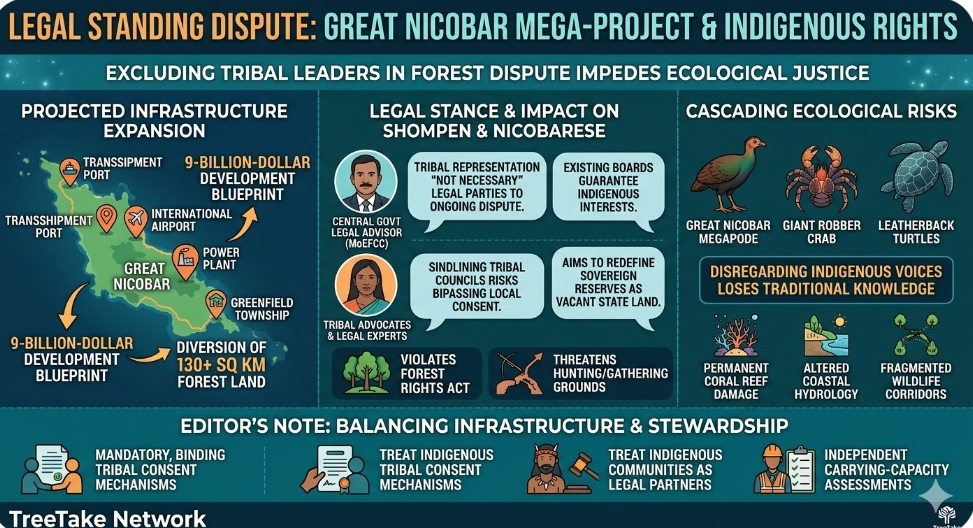
The legal battle surrounding the nine-billion-dollar Great Nicobar mega-project took a significant turn on October 29, as the Central Government explicitly stated before the National Green Tribunal that local tribal leaders are not "necessary" legal parties to the ongoing forest rights dispute. The statement has intensified deep structural tensions between state-driven infrastructure goals and ancestral indigenous land protections on the ecologically sensitive island.
Infrastructure expansion vs tribal sovereignty
The legal dispute centres on the sweeping environmental and forest clearances granted for the holistic development project, which includes a transhipment port, an international airport, a power plant, and a greenfield township. Environmental groups and tribal advocates argue that the project will lead to the destruction of vast swathes of pristine rainforest and systematically displace the vulnerable Shompen and Nicobarese communities from their traditional hunting and gathering grounds.
The administration’s push to sideline tribal leaders from direct judicial representation has provoked massive outcry from human rights watchdogs and legal experts, who assert that indigenous communities hold primary stakes in any ecological reorganisation of the territory. The project requires the diversion of over 130 square kilometres of forest land, which critics argue directly violates the Scheduled Tribes and Other Traditional Forest Dwellers (Recognition of Forest Rights) Act.
Extensive expert projections and official testimonies
The government's hardline judicial stance has driven urgent analysis and sharp rebukes from social scientists, environmental lawyers, and indigenous rights advocates tracking the tribunal proceedings.
"Excluding indigenous representatives from formal legal status within a major forest rights dispute sets a highly dangerous environmental precedent," stated Dr Amrita Johri, a senior anthropologist specialising in island ecosystems. "The Shompen and Nicobarese peoples have sustainably managed the dense habitats of Great Nicobar for millennia. To claim their leaders are not necessary parties when their ancestral forests are being completely cleared for industrial concrete infrastructure is an institutional denial of ecological justice."
Legal experts represent the move as a strategic attempt to fast-track corporate development by bypassing mandatory local consent structures.
"The state’s legal position directly undermines the foundational spirit of our forest protection laws," argued Ritwick Dutta, a prominent environmental attorney managing conservation disputes. "By isolating tribal councils from active legal standing, the administration is attempting to redefine sovereign tribal reserves as vacant state land, clearing a smooth path for industrial development without facing rigorous local vetoes or statutory human rights audits."
In response to the mounting international and local criticisms, government legal representatives defended the administrative framework before the tribunal, arguing that tribal welfare remains safe under existing bureaucratic boards.
"The development plans have been systematically designed to minimise direct community contact while maximising national economic security," stated a senior legal advisor representing the Ministry of Environment, Forest and Climate Change. "Sufficient administrative oversight is already built into our separate project implementation boards to thoroughly guarantee that local indigenous interests are protected without slowing down the judicial timeline with additional non-state parties."
Cascading ecological risks for unique island biodiversity
Beyond human displacement, conservation biologists warn that the sheer scale of the project will inflict permanent damage on one of the world's most unique insular ecosystems.
"Great Nicobar is a vital global biodiversity hotspot home to species found nowhere else on earth, including the megapode and the giant robber crab," explained Dr Kartik Shanker, an island conservation biologist. "The massive footprint of a transhipment port will permanently alter coastal hydrology, destroy fragile coral reef networks, and split critical terrestrial wildlife corridors. Disregarding indigenous voices also means losing the invaluable traditional knowledge required to protect these landscapes from irreversible ecological collapse."
Editor's Note: The systematic exclusion of indigenous leadership from formal environmental tribunals highlights a growing imbalance between national infrastructure ambitions and local ecological stewardship. Moving forward, large-scale developmental blueprints must prioritise mandatory, binding tribal consent mechanisms, treat indigenous communities as primary legal partners, and implement rigorous, independent carrying-capacity assessments to ensure that strategic economic growth does not entirely extinguish irreplaceable island cultures and pristine natural habitats.



Leave a comment