

TreeTake Network
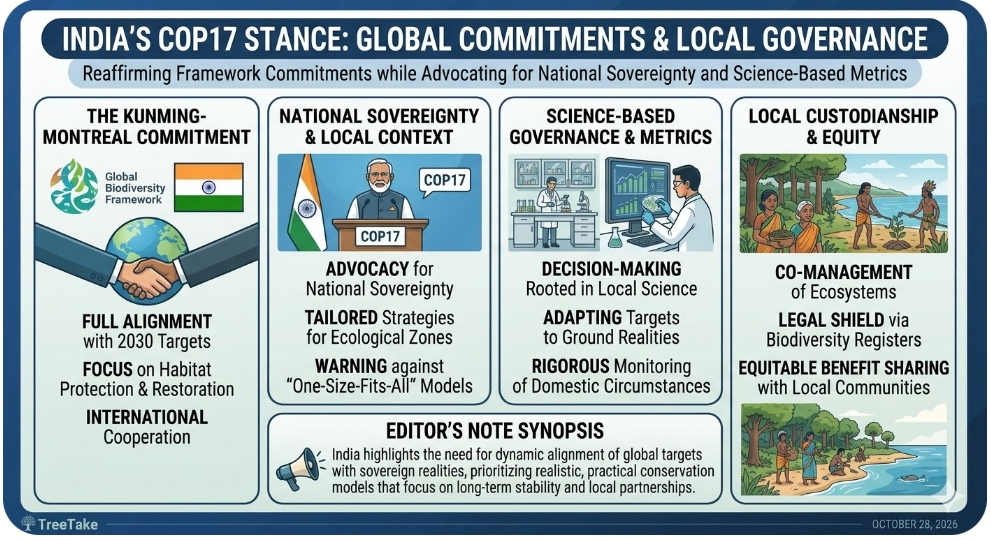
India has firmly reasserted its commitment to the Kunming-Montreal Global Biodiversity Framework while strongly advocating for national sovereignty and science-based governance tailored to local environmental realities at the United Nations Biodiversity Conference (COP17) in Yerevan, Armenia. Delivering a key address on October 28, 2026, India's Union Minister for Environment, Forest and Climate Change, Bhupender Yadav, outlined the nation's targeted ecological strategies while warning against one-size-fits-all global enforcement models that ignore regional socio-economic challenges.
The ministerial address occurs as nations at the summit face intense pressure to accelerate their National Biodiversity Strategies and Action Plans (NBSAPs). India, holding a massive portion of the world's mega-biodiversity across distinct ecological zones, has consistently argued that international conservation metrics must remain flexible enough to accommodate the developmental needs and livelihood dependencies of developing populations.
Emphasising Local Custodianship and Practical Metrics
A primary focus of India's presentation centered on the institutionalised role of local communities in managing ecological preserves. Rather than imposing strictly exclusionary conservation zones, the Indian framework highlights a collaborative model where indigenous populations and rural communities actively co-manage sensitive forest and wetland ecosystems.
The strategy documents presented in Yerevan demonstrate how local biodiversity management committees have successfully mapped thousands of traditional ecological registers. This bottom-up documentation process serves as a legal shield against bio-piracy while ensuring that the commercial benefits derived from biological resources are shared equitably with local custodians.
Statements from Executive Leadership and Conservation Officials
"Global targets must align dynamically with the ground realities of individual sovereign nations," stated Union Minister Bhupender Yadav during his plenary address to the working group. "India has consistently demonstrated that substantial ecological restoration is entirely achievable without compromising domestic food security or rural livelihoods. Our conservation policies are deeply rooted in science, but they are also deeply compassionate toward the communities that act as the primary stewards of our forests. We urge COP17 to establish monitoring frameworks that respect these distinct socio-economic landscapes rather than enforcing rigid, external mandates."
Reflecting on the technical aspects of the address, Dr Pradip Kumar, a senior biodiversity policy analyst tracking the negotiations, highlighted the geopolitical balance India is seeking to maintain.
"The core of the Indian intervention is a reminder that ecological targets cannot be divorced from human realities," Dr Kumar observed following the session. "By emphasizing science-based governance that adapts to domestic circumstances, India is pushing back against arbitrary international metrics that could penalise developing nations for prioritizing local poverty alleviation alongside habitat protection. It is a strategic call for realistic, practical conservation models that focus on long-term stability rather than immediate diplomatic headlines."
Scaling Up Financial and Technical Assistance
The address also renewed calls for developed nations to fulfill their financial obligations under international treaties, reminding the assembly that successful global conservation relies heavily on substantial technical and financial transfers. Indian delegates stressed that without predictable, public-funded international support, scaling up complex ecological corridors across borders will remain difficult for many nations in the Global South.
"We cannot talk about aggressive global biodiversity goals without securing the financial foundations to support them," added Jitendra Kumar, an advisor to the Indian environmental delegation. "India is doing its part by mobilizing massive domestic resources for projects like the International Big Cat Alliance and extensive wetland restoration. However, true international cooperation requires the developed world to match our domestic ambition with reliable, scalable financial transfers."
Editor's Note
India's stance at COP17 underscores a critical and ongoing tension within international environmental diplomacy: the friction between universal global mandates and sovereign local governance. By advocating for science-based targets that account for unique domestic circumstances, the Indian delegation is highlighting a pragmatic truth that global policy-makers routinely overlook. Conservation initiatives simply cannot succeed in the long term if they treat local populations as external threats rather than essential partners. As the summit progresses, the challenge for the international community will be to create a flexible framework that holds nations accountable to their broad global commitments while granting them the legislative space needed to implement those policies effectively on the ground.



Leave a comment