

TreeTake Network
The escalation of territorial friction between residential student populations and community animal packs within large educational estates has exposed a critical regulatory vacuum in institutional safety frameworks. The growing conflict, highlighted by recent structural disputes across major technical institutes including the Indian Institute of Technology Hyderabad, has forced a national re-evaluation of how bounded campus ecosystems handle public safety. Local authorities and university boards are struggling to balance the strict containment of free-ranging animals with national animal welfare guidelines, turning academic campuses into administrative battlegrounds.
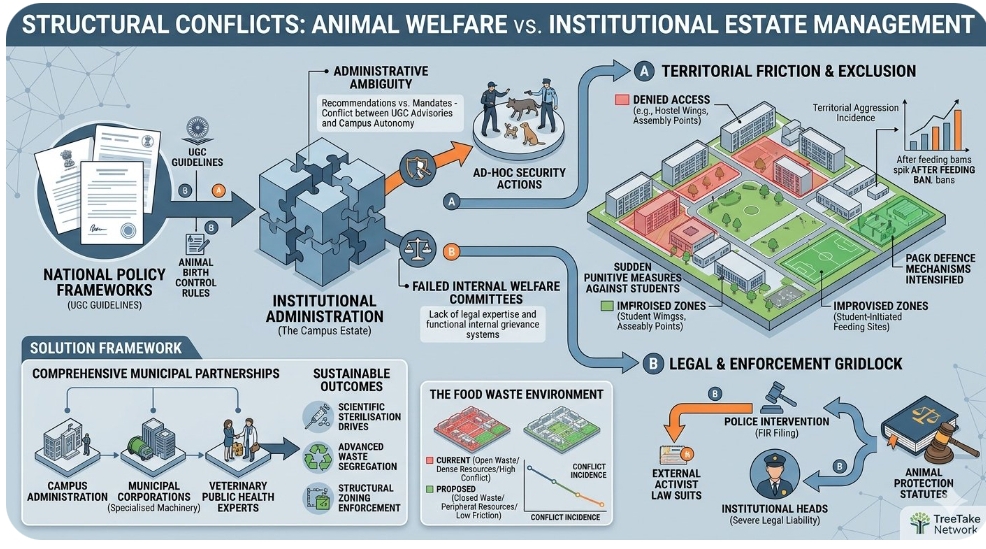
Regulatory ambiguity in higher education campus guidelines
The primary institutional crisis stems from the conflicting interpretation of national welfare frameworks within semi-autonomous academic estates. Gopinath Muvvala, Chairman of the Hostel Coordinating Unit at the Indian Institute of Technology Hyderabad, noted, "The current national guidelines provided by the University Grants Commission serve primarily as administrative recommendations rather than legally mandated directives. While student groups seek the immediate establishment of a formal campus animal welfare committee, our primary institutional duty requires balancing compassionate community care with the practical management of an active population of approximately 200 free-roaming canines." This administrative gap ensures that daily management decisions are often reactionary, shifting erratically between aggressive eviction drives and complete institutional passivity.
Territorial dynamics and designated feeding zone failures
Urban animal behaviourists point out that the architectural layout of modern residential campuses inadvertently exacerbates territorial aggression among community animal packs. An active campus researcher, tracking student disciplinary files, observed, "Enforcing sudden punitive measures against students, such as the notices issued by the Hostel Coordinating Unit to residential scholars for distributing food resources near the hostels, directly fractures established canine territories. When food distribution is abruptly restricted, pack defence mechanisms sharply increase, leading to severe territorial friction near the primary student assembly wings." Experts maintain that spatial zoning must precede any physical exclusion measures to prevent localised behavioural escalation.
Legal accountability loops and administrative enforcement resistance
The enforcement of campus safety measures frequently collides with national animal protection statutes, creating severe legal liabilities for institutional heads. Commenting on the legal gridlock following the filing of a formal First Information Report at the Sangareddy Rural Police Station, Adulapuram Goutham, Cruelty Prevention Manager at the Stray Animal Foundation of India, stated, "University compounds are bound by the Prevention of Cruelty to Animals Act. Attempting to manage wildlife or street animals through unmonitored security actions, as seen during the critical altercations inside the campus block premises, violates structural protocols and exposes an absolute failure in institutional transparency." These legal complications have left many institutions unable to execute consistent safety protocols, as actions are frequently halted by external police interventions and activist lawsuits.
Comprehensive municipal partnerships as the sustainable alternative
Veterinary public health experts argue that educational institutes must stop trying to resolve animal management crises independently. Highlighting the necessary structural pivot, PETA India's Director of Veterinary Affairs, Dr Manilal Valliyate, argued, "An academic campus cannot act as an isolated island; its animal population is directly linked to the surrounding municipal ecosystem. The only sustainable resolution is for university administrations to form formal, legally binding partnerships with local municipal corporations to execute continuous, scientifically monitored sterilisation and vaccination drives inside campus perimeters." Without integrated institutional pacts, campus authorities will continue to face cycle after cycle of territorial friction and administrative deadlock.
Editor's Note
The escalating conflicts within residential academic estates demonstrate that mechanical exclusion and arbitrary administrative bans are completely ineffective tools for managing complex campus ecosystems. Securing student housing requires a transition away from ad hoc security measures towards structured, legally compliant animal welfare boards within university governance. The sustainable way forward demands that higher education institutions integrate campus town planning with advanced solid waste segregation to eliminate open food resources, while executing institutional municipal partnerships to achieve long-term public safety and regulatory compliance.



Leave a comment