

TreeTake Network
The immense atmospheric engine of Cyclone Arnab has thoroughly restructured the subcontinental weather footprint, generating severe environmental and logistical crises stretching from its primary coastal impact zones to the landlocked plains of northern India on October 29. Operating as a unified meteorological crisis, the system's core has physically hammered the eastern seaboard while its vast outer moisture plumes have marched thousands of kilometres inland, breaking historical post-monsoon climate baselines across multiple states.
Coastal devastation and critical infrastructure failure
The storm system completed its high-velocity landfall process along the Andhra Pradesh and Yanam coasts, unleashing extreme gales and a massive storm surge before tracking slowly inland. In the immediate impact zones of coastal Andhra Pradesh and Odisha, torrential downpours operating over a twenty-four-hour window have severely damaged primary transportation corridors. According to official telemetry from regional monitoring stations, Ganjam district in Odisha recorded an unprecedented 54.6 centimetres of rainfall, causing the primary Bahuda river network to swell far past safe operational thresholds.
The ensuing deluge submerged major railway tracks and structural bridges, forcing the East Coast Railway to execute emergency cancellations for nine primary train services—including the premier Bhubaneswar-Visakhapatnam Vande Bharat Express and the Visakha Express—while systematically diverting 14 other long-distance trains on the critical Howrah-Chennai coastal line. Simultaneously, the heavy winds, which clocked sustained speeds between 125 and 135 kilometres per hour during the landfall phase, have flattened thousands of hectares of premium paddy, banana, and coconut plantations across the Guntur and Srikakulam districts, leaving local farming communities facing acute economic hardship.
Northern plains and Uttar Pradesh face unseasonal deluge
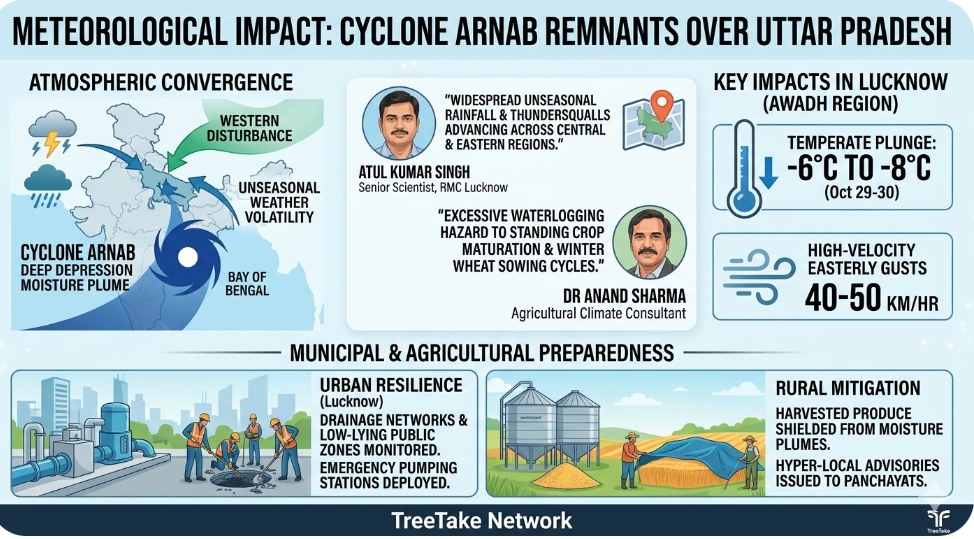
As the core of the system weakened into a deep depression over the central landmass, its massive internal moisture pump continued to funnel vast convective bands directly into northern India. This tropical moisture collided aggressively with an active western disturbance travelling over the higher latitudes of northwestern India, amplifying weather volatility across the state of Uttar Pradesh. In Lucknow and the broader Awadh geographic belt, the typical dry, post-monsoon October skies were abruptly replaced by dense, low-altitude cloud walls, volatile lightning, and high-velocity easterly gusts.
Regional weather centres logged a sharp, vertical drop in baseline daytime temperatures, with microclimates experiencing a prolonged 6 to 8 degrees Celsius dip. The India Meteorological Department issued a multi-district orange emergency alert across eastern and central Uttar Pradesh, putting municipal rescue divisions, state emergency response teams, and urban drainage networks on absolute standby to manage flash flooding and widespread waterlogging risks.
Extensive expert projections and official testimonies
The exceptional dual-zone nature of this late-season atmospheric anomaly has driven urgent field operations and comprehensive analysis from national disaster monitors, meteorological scientists, and agricultural specialists.
"Widespread unseasonal rainfall, heavily accompanied by intense thundersqualls, lightning, and strong gusty winds operating at speeds between 40 to 50 kilometres per hour, is actively advancing across the eastern and central regions of the state through October 29 and 30," stated Atul Kumar Singh, a senior scientist at the Regional Meteorological Centre in Lucknow. "Due to the sheer volume of moisture driven by Arnab from the Bay of Bengal, we are observing a rare weather pattern that shifts our traditional late October agricultural baseline."
National rescue operations have focused heavily on restoring basic human security and clearing critical transport routes blocked by the initial coastal impacts.
"Our response teams are actively engaged in clearing uprooted trees and restoring basic road connectivity in coastal villages like Uppada," confirmed National Disaster Response Force Inspector General Narendra Singh Bundela. "The system has transitioned from a very severe cyclonic storm to a depression, but the sheer volume of water displacement requires persistent local monitoring."
In landlocked urban centres, administrative bodies have been forced to quickly shift priorities from routine post-monsoon maintenance to active flood mitigation.
"In light of the sudden storm alerts, our field command centres have been entirely restructured to systematically manage urban drainage choke points and low-lying public zones," confirmed Lucknow Municipal Commissioner Inderjit Singh. "Emergency pumping infrastructure has been fully modernised and deployed to key sectors across the city capital to handle any sudden variations in water logging."
Transportation officials have mirrored these safety protocols, prioritizing safety over schedule timelines until structural evaluations are complete.
"Train services will be fully restored only after the water levels recede below the danger mark and our structural engineers declare the bridge sections entirely safe for train operations," stated a senior official from the East Coast Railway command center.
Severe agro-ecological disruptions threaten winter cycles
The timing of the cyclonic downpours has amplified profound ecological anxieties within agricultural scientific institutions, as the subcontinental rural economy is currently transitioning into highly sensitive winter crop cycles.
"This sudden, unseasonal deluge presents an immediate hazard to our regional farming framework," explained Dr Anand Sharma, a prominent north Indian agricultural climate consultant. "Thousands of rural communities are right in the middle of preparing land tracts for the critical winter wheat sowing cycle. Excessive waterlogging at this exact juncture will inevitably delay field preparation, submerge ready-to-harvest paddy fields, and ruin mature crops currently stored in open, unshaded rural markets."
State disaster relief authorities across both coastal zones and northern plains have directed block-level extension officers to maintain hourly communication with village panchayats, urging cultivators to shield harvested produce from long-term exposure to the lingering moisture plumes.
Editor's Note : The capacity of a single Bay of Bengal cyclonic system to simultaneously paralyze coastal infrastructure and thoroughly destabilise the atmospheric architecture of landlocked northern states underscores a structural escalation in climate volatility. Moving forward, national agricultural and infrastructure policy must be modernized by expanding localized weatherproof storage silos, engineering elevated drainage catchments for rural plains, climate-proofing coastal transit corridors through elevated bridge designs, and shifting to highly adaptive, hyper-local agro-meteorological forecasting systems to insulate the subcontinental economy from multiplying climate emergencies.



Leave a comment