

TreeTake Network
An ecosystem's integrity is intrinsically tied to the ethical and physical health of its cohabiting species. In urban biospheres globally, community and street animals function as sentient biological components, acting as buffers in public health and environmental ecosystems. However, the expansion of industrial zones and rapid urbanisation have forced street animals into highly vulnerable micro-environments.
When the institutions tasked with managing these populations collapse into systemic negligence, the results are devastating. The crisis surrounding India’s Animal Birth Control (ABC) programmes highlights a profound ecological failure: when municipal systems cut corners, cut off resources, and ignore post-operative protocols, surgical centers effectively become processing lines for secondary infections and high-mortality trauma. Examining institutional animal cruelty is not merely a localised issue; it exposes a systemic failure where unchecked negligence compromises public trust, breaks statutory laws, and damages the foundational health of our urban environments.
The tragic death of a healthy community dog at a major regional shelter has exposed severe systemic failures within municipal animal management programmes. Despite explicit statutory frameworks mandated by the central government, investigative reports, judicial tracking, and independent audits reveal widespread institutional negligence in the post-operative care of street animals across India.
Driven by low-bid private contracts, insufficient medical funding, and a complete lack of required legal oversight, multiple animal shelters have transformed vital health procedures into vectors for severe trauma, untreated secondary infections, and avoidable deaths.
The Catalyst: The Chandigarh SPCA Tragedy
On September 2, 2026, a healthy female community dog died during a botched sterilisation procedure at the Society for the Prevention of Cruelty to Animals (SPCA) facility in Sector 38 West, Chandigarh. The incident has triggered public outrage and a formal police inquiry into veterinary negligence.
Timeline of Procedural Failure
- The Clinical Delay: A community caregiver presented the healthy street dog to the Municipal Corporation for routine sterilisation. Upon examination, veterinarians noted the dog was actively in heat. Because operating during an active estrus cycle carries an exceptionally high risk of severe internal haemorrhaging and shock, the surgery was explicitly postponed, and a firm date was set for September 9.
- The Unauthorised Operation: Despite the clear medical postponement, alternative surgical staff bypassed the chart notes the following day, proceeding with the operation while the dog was still in heat.
- Fatal Consequences: The caregiver received an emergency call informing them that the dog had died from shock while being moved to the post-operative room.
Welfare advocates on-site condemned the incident as a "diagnostically blindfolded surgery." The tragedy highlights a broader structural problem: Chandigarh’s ABC activities resumed despite recent formal legal representations indicating the city was operating without the mandatory Project Recognition Certificate (PRC) required under federal rules.
A Pattern of Custodial Negligence: The Broader Institutional Crisis
The Chandigarh tragedy is not an isolated event; it represents a documented history of institutional failures inside municipal shelters nationwide.
The Seizure Crisis (March 2026)
Just months prior at the exact same Sector 38 West SPCA facility, animal welfare advocates filed formal emergency complaints with the UT Chief Secretary. Eyewitness accounts documented a street dog suffering from severe, repeated neurological seizures inside a kennel for over six continuous hours. Despite a supervisor and a staff veterinarian being present on the premises, zero medical intervention or emergency care was administered, resulting in a agonizing, preventable death that advocates officially labeled a "custodial failure."
The Raipur Kalan Confinement Incident (Feb 2026)
A severe crisis unfolded when a pregnant community dog was unlawfully confined at the Raipur Kalan ABC shelter for nearly 60 days—a direct violation of the statutory 3-to-5-day post-operative retention limit. The extreme psychological and physiological distress of prolonged confinement led to a horrific outcome where the animal consumed her own litter, triggering massive public protests and forcing the High Court to intervene.
Nationwide Data: The Rohtak and Nagpur Audits
- Rohtak Civic Probe (July 2026): The municipal corporation ordered a sweeping emergency probe after 29 community dog carcasses were found dumped along a roadside. Post-mortem examinations confirmed the animals had recently undergone sterilisation by a private contractor, with deaths directly attributed to zero post-operative tracking, secondary infections, and internal bleeding.
- Nagpur Facility Audits: Independent veterinary audits revealed a catastrophic failure rate at a major municipal centre. Out of 300 dogs operated on in a single month, a staggering 250 operations completely failed. Investigation showed an absolute absence of post-operative care, causing surgical stitches to burst open after the dogs were returned to cold kennels without monitoring.
The Legal Framework vs. Real-World Failure
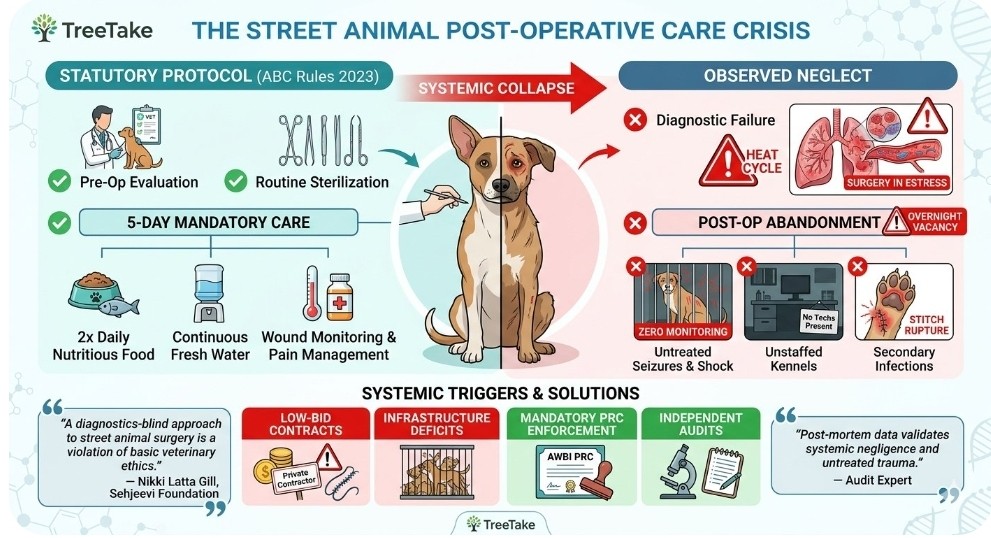
In 2023, the Government of India introduced the updated Animal Birth Control (ABC) Rules under the Prevention of Cruelty to Animals Act, 1960. These rules establish strict, scientifically backed standard operating procedures (SOPs) designed to ensure zero-mortality pipelines.
[ Statutory 5-Day ABC Protocol ] │ ├──► Day 1: Humane Capture & Registration ├──► Day 2: Pre-Op Vet Evaluation & Surgery ├──► Day 3 & 4: Mandatory Post-Operative Care │ (Nutritious food twice daily, continuous water, │ wound monitoring, and pain management) └──► Day 5: Release to Exact Original Location (If fully healed)
The Gap in Post-Operative Realities
While Rule 11(9) explicitly mandates a strict post-operative recovery window with clean, spacious kennels, twice-daily nutritious feeding, and continuous access to potable water, the reality on the ground is starkly different. Right now, shelters face severe structural failures:
- Contractor Exploitation: Municipalities frequently award ABC contracts to the lowest-bidding private agencies. To maximise profit margins on fixed per-dog government payouts, these operators minimise spending on high-quality surgical sutures, essential post-operative antibiotics, and pain medications.
- Staff Deficits: Multi-kennel facilities are regularly left entirely unstaffed overnight or during weekends. If a post-operative animal experiences internal bleeding, stitch rupture, or shock, there are no veterinary technicians present to provide life-saving care.
- Infrastructure Deficits: Right now, the Supreme Court has pulled up states for failing to build adequate sterilisation infrastructure. Many existing facilities operate far beyond capacity, leading to overcrowded, unsanitary kennels where recovering animals are exposed to parvo, distemper, and territorial violence.
Expert Perspectives and Solutions
Veterinary experts and legal advocates emphasise that resolving this crisis requires moving away from cheap, volume-driven contracts toward strict quality metrics.
"A diagnostics-blind approach to street animal surgery is a clear violation of basic veterinary ethics. The absence of structured post-operative monitoring turns a routine population-control measure into a death sentence."
— Nikki Latta Gill, Executive Director of the Sehjeevi Foundation
To stop these recurring tragedies, experts demand three immediate, systemic changes:
- Mandatory PRC Enforcement: No local municipality should be allowed to fund or operate an ABC drive unless the executing agency holds a valid Project Recognition Certificate verified by the Animal Welfare Board of India.
- Independent Organ and Post-Mortem Audits: Standardising independent oversight committees to inspect surgical organs and mandating independent post-mortems for any shelter deaths to eliminate fraudulent billing and hidden mortality rates.
- Mandatory 24/7 Veterinary Staffing: Legally requiring that any facility holding post-operative, recovering animals must maintain round-the-clock medical staff on-site to handle post-surgical complications.
Editor's Note
At TreeTake, our editorial focus explores the deep links between public wellness, environmental ethics, and the treatment of cohabiting species within our biosphere. The widespread operational failures within India’s municipal animal birth control centres are a stark reminder of what happens when institutional empathy and legal accountability collapse. Street animals are part of our shared urban ecology. When we allow underfunded, blindfolded surgeries and negligent post-operative care to occur inside public shelters, we compromise the ethical standards of our society. Resolving the stray animal crisis does not require cruel, unauthorised culling or cutting corners on medical safety; it demands strict adherence to federal laws, proper financial oversight, and compassionate, scientific care.



Leave a comment