

Thinking Point
TreeTake Network
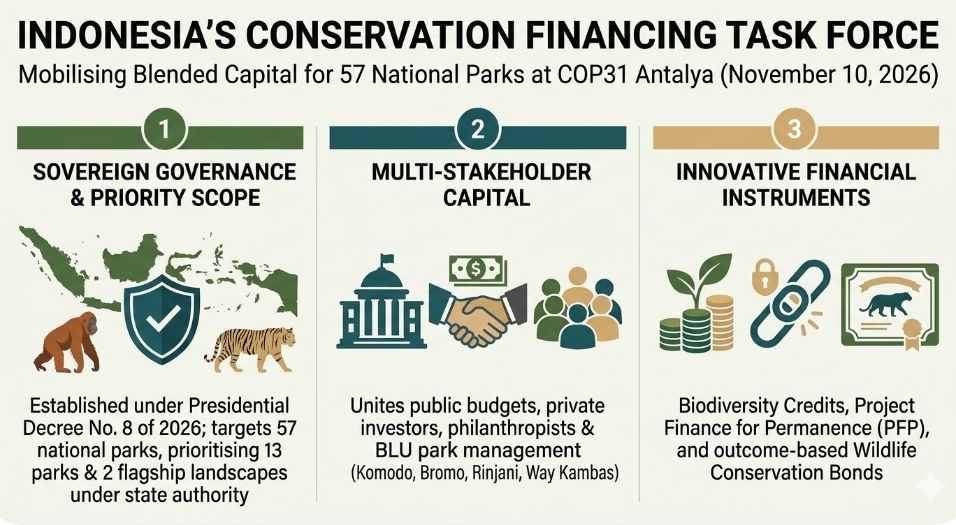
Indonesia has officially introduced its National Task Force on Innovative National Park Financing during proceedings at the 31st Conference of the Parties (COP31) to the United Nations Framework Convention on Climate Change (UNFCCC) in Antalya, Türkiye, on November 10, 2026, establishing an institutional mechanism to unlock long-term private, philanthropic, and blended capital for the country's protected ecosystems.
Established under Presidential Decree Number 8 of 2026 signed by Indonesian President Prabowo Subianto, the cross-sectoral task force is designed to address persistent conservation funding gaps across Indonesia's 57 national parks. In its initial operational phase, the framework prioritises 13 national parks and two flagship conservation landscapes that safeguard globally threatened megafauna, including Sumatran and Bornean orangutans, Sumatran tigers, Javan and Sumatran rhinoceroses, Asian elephants, and Komodo dragons.
Multi-Stakeholder Capital and Sovereign Oversight
Leading the Indonesian delegation and chairing the task force, Special Envoy of the President of the Republic of Indonesia for Climate and Energy Hashim S Djojohadikusumo emphasised that safeguarding Indonesia's terrestrial and marine biodiversity requires moving beyond fragmented annual state budgets toward durable financial architecture. "We must proceed beyond short-term projects, transitioning into a sustainable financing system that connects the government, business players, philanthropists, and the international community," Hashim S Djojohadikusumo stated during the COP31 launch event.
He further stressed that financial innovation must deliver tangible ecological and social outcomes on the ground. "The success of this financing will not be measured merely by how much funding is collected, but by healthy ecosystems, protected wildlife, and empowered surrounding communities," Hashim S Djojohadikusumo added.
Addressing concerns over governance and national sovereignty in conservation finance, Indonesian Deputy Forestry Minister Rohmat Marzuki clarified that public authority over protected areas remains absolute. "Indonesia's national parks remain under state authority, with conservation as their primary objective," Rohmat Marzuki affirmed, adding that "all strategic decisions, management models, and financial allocations will remain under government supervision." To improve site-level financial agility, the Ministry of Forestry is also expanding the Public Service Agency (BLU) management model across four priority parks, namely Komodo, Bromo Tengger Semeru, Mount Rinjani, and Way Kambas national parks.
Blended Instruments and Strategic Outlook
Alongside the task force launch, Indonesia introduced the Indonesia Conservation Financing White Paper, which outlines a suite of market-aligned and results-based financial instruments tailored for tropical biodiversity protection. These mechanisms include:
- Biodiversity Credits: High-integrity credit systems linked to verified habitat restoration and species recovery metrics.
- Project Finance for Permanence (PFP): Long-term, single-closing financial structures designed to secure multi-decade operational funding for large conservation landscapes.
- Wildlife Conservation Bonds: Outcome-based debt instruments modelled on international rhino conservation bonds, tying investor returns to measurable population stability and anti-poaching performance.
Welcoming the policy roadmap at the Antalya session, World Wide Fund for Nature (WWF) Indonesia Chief Executive Officer Aditya Bayunanda noted that institutionalising blended finance marks a decisive turning point for protected area management. "By establishing a clear governance framework that unites state oversight with innovative capital instruments, Indonesia is creating a credible pathway to turn biodiversity protection from an underfunded budget line into a durable long-term investment," Aditya Bayunanda observed.
Editor's Note
Indonesia's Conservation Financing Task Force offers a compelling structural blueprint for megadiverse developing nations seeking to close the global biodiversity funding gap without surrendering sovereign control over public lands. As blended instruments such as wildlife bonds and biodiversity credits move from white papers into field deployment across priority national parks, long-term credibility will depend on rigorous ecological verification, transparent governance, and ensuring that indigenous peoples and forest-fringe communities receive direct, equitable economic benefits as primary stewards of these landscapes.



Leave a comment