

TreeTake Network
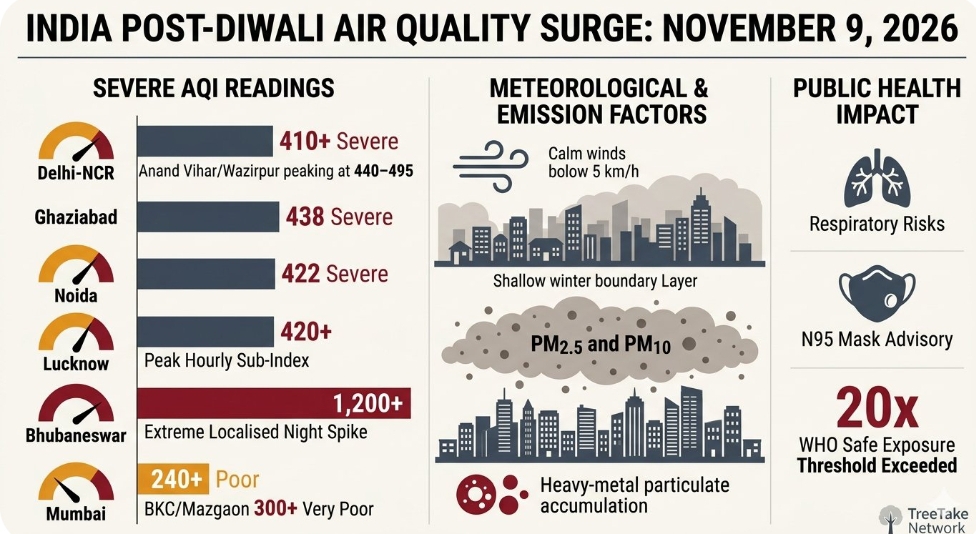
Thick toxic smog engulfed major urban centres across northern, eastern, western, and central India on the morning of November 9, 2026, following widespread overnight firecracker bursting during Diwali celebrations on November 8, 2026. Data compiled from the Central Pollution Control Board (CPCB) and state pollution monitoring networks confirmed that the Air Quality Index (AQI) breached the severe threshold above 400 in Delhi, Ghaziabad, Noida, and Lucknow, while extreme localised spikes exceeded 1,200 in Bhubaneswar and deteriorated sharply across Mumbai, Indore, Ujjain, Chennai, and Bathinda.
Delhi-NCR Breaches Severe Threshold Amid Stagnant Winds
In the national capital, the 24-hour rolling average AQI surged past 410 by early morning on November 9, 2026, placing the city firmly in the severe category under the national air quality classification. Out of 39 active continuous ambient air quality monitoring stations across Delhi, more than 30 recorded severe readings, with heavily congested hubs including Anand Vihar, Jahangirpuri, Bawana, Wazirpur, Mundka, and Vivek Vihar registering indices between 440 and 495.
Satellite cities in the National Capital Region mirrored the sharp decline. Ghaziabad recorded an overall AQI of 438, while Noida and Greater Noida registered readings of 422 and 408, respectively, driven by a combination of post-festive particulate accumulation, vehicular exhaust, and plummeting night-time temperatures.
Meteorological officials noted that calm surface winds below five kilometres per hour and a shallow planetary boundary layer trapped fine particulate matter (PM2.5 and PM10) close to ground level, preventing dispersion across the Indo-Gangetic Plain.
Lucknow, Bhubaneswar, and Metro Cities Record Sharp Spikes
Across Uttar Pradesh, the state capital Lucknow woke up to dense grey haze on November 9, 2026, as citywide air quality deteriorated into the severe and very poor brackets. Monitoring stations at Lalbagh, Talkatora, and Gomti Nagar recorded sharp post-midnight surges in PM2.5 concentrations, with peak hourly sub-indices crossing 420 following late-night pyrotechnic displays.
In eastern India, Odisha's capital Bhubaneswar experienced acute, short-term particulate spikes during Diwali night on November 8, 2026, and into the early hours of November 9, 2026. Monitoring instruments in commercial and residential neighbourhoods recorded instantaneous PM2.5 and PM10 surges pushing localised index readings past 1,200—more than 20 times the World Health Organisation's safe 24-hour exposure limit—before light morning breezes gradually moderated daytime averages.
Coastal and central cities also registered marked post-festive deterioration. In Maharashtra, Mumbai recorded an overall AQI exceeding 240 in the poor category on November 9, 2026, with monitoring stations at Bandra Kurla Complex, Mazgaon, Colaba, and Chembur crossing 300 into the very poor zone. Similar air quality declines were documented in Chennai, Indore, Ujjain, and Punjab's Bathinda, where post-festive smoke combined with regional agricultural residue burning.
Pulmonologists and Air Quality Experts Warn of Acute Health Risks
Respiratory specialists and atmospheric scientists stressed that the abrupt overnight spike in toxic metals and fine particulates poses immediate dangers to children, elderly residents, and patients with chronic cardiopulmonary conditions.
Dr Randeep Guleria, former Director of the All India Institute of Medical Sciences (AIIMS) in New Delhi and Chairman of the Institute of Internal Medicine and Respiratory and Sleep Medicine at Medanta, emphasised the severe clinical impact of post-Diwali smog. "Every year after Diwali, we see a sharp surge in patients arriving at emergency departments with acute asthma exacerbations, chronic obstructive pulmonary disease flare-ups, and severe breathlessness," Dr Guleria stated. "Fine particulate matter laden with heavy metals from firecrackers penetrates deep into the lungs and enters the bloodstream, triggering systemic inflammation."
Anumita Roychowdhury, Executive Director of Research and Advocacy at the Centre for Science and Environment (CSE), highlighted the structural vulnerability of Indian cities during the early winter transition. "The festive emissions act as an acute chemical shock on top of an already elevated baseline of vehicular, industrial, and construction pollution," Roychowdhury noted. "When winter inversion sets in and wind speeds drop, even a single night of widespread firecracker bursting overwhelms the local airshed and pushes millions of residents into hazardous exposure levels."
Dr Arvind Kumar, Founder Trustee of the Lung Care Foundation and Chairman of the Institute of Chest Surgery at Medanta, warned against treating the annual post-Diwali spike as a temporary inconvenience. "Breathing air with an AQI above 400 is equivalent to smoking dozens of cigarettes a day," Dr Kumar explained. "The damage is cumulative, particularly for young children whose lungs are still developing."
Public Health Advisories and Enforcement Response
Following the spike on November 9, 2026, state pollution control boards and municipal authorities activated intensified mechanised road sweeping, anti-smog gun deployment at pollution hotspots, and water sprinkling across major arterial corridors in Delhi, Lucknow, and Mumbai. Health advisories urged citizens to avoid outdoor morning walks, wear certified N95 masks when stepping outside, and strictly refrain from open waste burning.
Editor's Note
:The recurring post-Diwali air quality emergency across Indian cities demonstrates that reactive emergency measures cannot offset sudden festive emission surges once winter meteorological conditions set in. Long-term protection of public health requires strict year-round enforcement against illegal firecracker manufacturing and sales, paired with sustained structural reductions in vehicular, industrial, and agricultural emissions across regional airsheds.



Leave a comment