

TreeTake Network
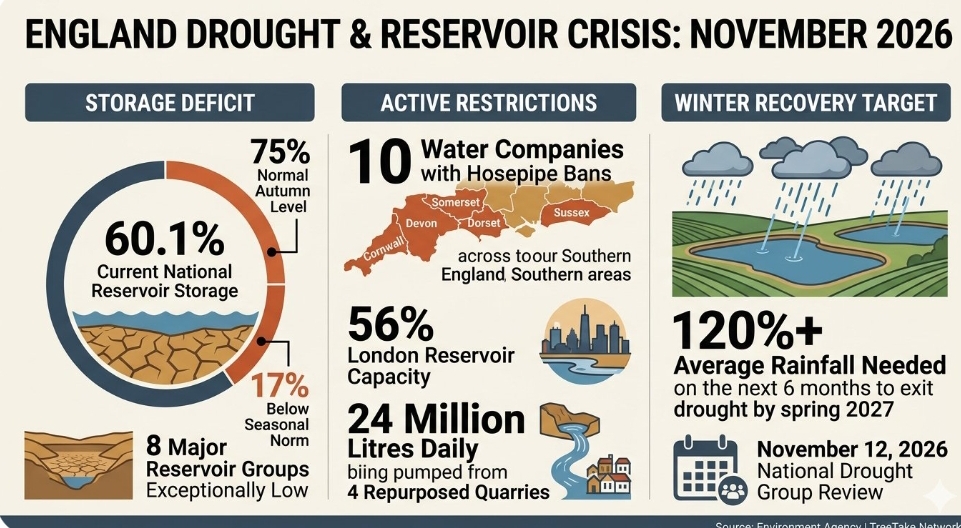
Water resources across England remain under severe strain on November 9, 2026, despite above-average rainfall recorded during October, according to the latest hydrological assessment from the Environment Agency. Total national reservoir storage stands at 60.1 per cent of overall capacity—marking a modest weekly increase from 57.9 per cent, yet remaining 17 per cent below the long-term seasonal average—with eight major reservoirs or reservoir groups still classified as exceptionally low and drought-related environmental incidents exceeding the annual totals documented in both 2022 and 2025.
Severe Drought Persists Across Southern and South-Western Counties
Following the United Kingdom's hottest summer on record and the driest April-to-September period in over a century, severe drought status remains firmly in place across parts of Devon, Cornwall, Dorset, Somerset, East Sussex, and West Sussex. While two regions in north-west England have transitioned into formal recovery, 82 per cent of the country remains under drought conditions, with rainfall during the opening days of November averaging just two millimetres nationally.
Critically depleted water bodies include Ardingly Reservoir in West Sussex, Wimbleball Reservoir in Somerset, Colliford and Stithians reservoirs in Cornwall, Clatworthy Reservoir, and multiple storage groups across Devon and the Midlands. Parched surface soils across southern catchments continue to absorb or deflect short bursts of autumn rain, preventing significant percolation into depleted underground aquifers and keeping river flows well below normal baselines.
Water Companies Maintain Hosepipe Bans and Deploy Emergency Supplies
Temporary use bans—commonly known as hosepipe restrictions—remain active across 10 water utilities, including Southern Water, South West Water, Thames Water, and Wessex Water, alongside active drought permits and drought orders designed to safeguard public water supplies.
In the south-west, South West Water confirmed on November 9, 2026, that four repurposed former quarry sites integrated into its regional supply network—including the Hawks Tor facility acquired after the 2022 drought—are providing up to 24 million litres of additional drinking water daily to relieve pressure on critically low reservoirs in Devon and Cornwall. Meanwhile, Thames Water reported that total London reservoir storage stood at 56 per cent as parts of London and the Thames Valley passed 100 consecutive days of official drought, prompting the utility to expand its leak-detection workforce by 18 per cent compared with the previous year.
Environment Agency and Water Leaders Warn Winter Rain Is Vital
Environment Agency Chief Executive Philip Duffy emphasised that isolated autumn downpours cannot undo months of extreme heat and rainfall deficits, urging continued public water conservation ahead of the National Drought Group's scheduled review on November 12, 2026.
"The recent rain is welcome, but the drought is not over," Duffy stated. "A few wet days cannot reverse months of hot, dry weather. Our rivers, reservoirs, and groundwater need sustained rainfall to recover, and the effects on nature can last much longer."
Highlighting the operational urgency facing regional suppliers, Duffy added, "Record-breaking summer heat and severe drought have put our water resources under immense pressure. Recovery depends on both rainfall and how much water we use. We cannot change the weather, but water companies can act now, and we expect them to follow their drought plans to secure public water supplies."
Water UK Chief Executive David Henderson echoed the call for sustained vigilance across households and businesses as forecasters anticipate settled, dry high-pressure conditions over the coming week. "While October rainfall offered welcome relief in parts of the north, reservoirs across southern England remain far below normal autumn refill curves," Henderson noted. "Every litre saved today protects river ecosystems and strengthens supply resilience ahead of spring 2027."
At Least 120 Per Cent Average Rainfall Needed by Spring
According to Environment Agency hydrological modelling, England requires at least 120 per cent of its long-term average rainfall over the next six months to exit drought conditions across all regions by spring 2027. Any shortfall during the critical winter recharge window risks carrying severe water restrictions and ecological stress directly into next summer.
Editor's Note
England's prolonged drought highlights the growing vulnerability of national water infrastructure to consecutive seasons of extreme heat and erratic rainfall. While emergency quarry abstractions, leak-repair drives, and temporary use bans are helping stabilise immediate public supplies, long-term water security depends on accelerating new reservoir construction, modernising ageing distribution networks, and restoring wetland catchments capable of retaining winter rainfall.



Leave a comment