

TreeTake Network
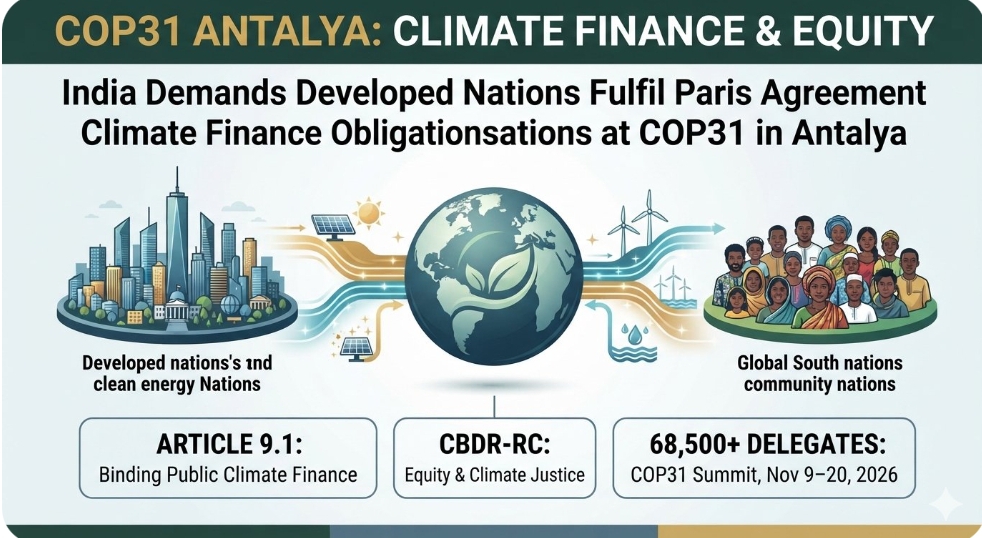
India has called upon developed nations to fulfil their binding climate finance commitments under Article 9.1 of the Paris Agreement during its formal opening intervention at the 31st Conference of the Parties (COP31) to the United Nations Framework Convention on Climate Change (UNFCCC) in Antalya, Türkiye, on November 10, 2026.
Delivering the national statement on behalf of the Government of India, Ministry of Environment, Forest and Climate Change (MoEFCC) Secretary Narendra Bhooshan emphasised that the success of global climate action depends on fair financial delivery, technological transfer, and strict adherence to equity principles. Aligning India's negotiating position with the Group of 77 (G77) and China, the Like-Minded Developing Countries (LMDC), and the BASIC bloc comprising Brazil, South Africa, India, and China, New Delhi underscored that developing economies cannot shoulder disproportionate mitigation burdens without predictable, grant-based public finance from industrialised nations.
Upholding Equity and Article 9.1 Commitments
Addressing negotiators at the EXPO Antalya venue on the second day of the 12-day summit, which runs from November 9 to November 20, 2026, Narendra Bhooshan reiterated that the Paris Agreement must be implemented in full accordance with the principle of Common But Differentiated Responsibilities and Respective Capabilities (CBDR-RC) and national circumstances.
Speaking on the necessity of accessible financial flows for the Global South, Secretary Narendra Bhooshan stated, "Developing countries are demonstrating ambitious climate leadership despite developmental imperatives, yet the scale and quality of climate finance remain far below what is required under Article 9.1 of the Paris Agreement." He further noted, "Predictable, accessible, and new and additional public finance from developed nations is indispensable so that adaptation and mitigation efforts in developing countries do not aggravate sovereign debt burdens."
India also highlighted that climate policy responses must remain free from unilateral trade-restrictive measures that penalise developing economies while shifting the economic cost of decarbonisation onto vulnerable populations.
Building on Pre-Summit Calls for a Dedicated Finance Work Programme
India's intervention in Antalya reinforces the groundwork laid ahead of the summit by Union Minister for Environment, Forest and Climate Change Bhupender Yadav, who has consistently advocated for operationalising a dedicated Climate Finance Work Programme to track the delivery of funds promised under the New Collective Quantified Goal (NCQG).
Ahead of the COP31 proceedings, Union Minister Bhupender Yadav had emphasised that global climate governance faces a critical credibility test if financial pledges fail to materialise on the ground. "Climate justice is not an abstract ideal but a foundational pillar of multilateral cooperation, requiring developed nations to honour their historical responsibilities through concrete financial and technological support," Bhupender Yadav remarked while outlining India's negotiating priorities.
Global Context and Summit Priorities in Antalya
The 2026 UN Climate Change Conference has convened more than 68500 registered delegates, government representatives, scientists, and civil society observers in Antalya, with Türkiye serving as COP31 President and Australia presiding over formal intergovernmental negotiations.
Opening the conference on November 9, 2026, UNFCCC Executive Secretary Simon Stiell urged nations to move beyond procedural delays and focus on tangible implementation across finance, adaptation, and clean energy transitions. "The Paris Agreement is delivering real progress in bending the emissions curve, but the pace is not yet fast enough, and COP31 must bridge the gap between ambition and the financial means required to achieve it," Simon Stiell said during the opening plenary.
COP31 President and Turkish Minister of Environment, Urbanisation and Climate Change Murat Kurum echoed the call for practical solidarity between developed and developing nations. "Antalya must be remembered as the summit where climate promises were translated into concrete action, ensuring that no developing nation is left behind due to a lack of financial or technological capacity," Murat Kurum stated.
Independent climate policy analysts observing the Antalya negotiations noted that India's firm stance on Article 9.1 sets a clear benchmark for the upcoming World Leaders' Summit scheduled for November 11 and November 12, 2026. Dr Arunabha Ghosh, Chief Executive Officer of the Council on Energy, Environment and Water (CEEW), observed that resolving the trust deficit over public climate finance remains central to unlocking higher ambition. "Without concessional public capital flowing at scale to de-risk investments and fund adaptation in emerging economies, the global transition risks fragmenting along economic lines," Dr Arunabha Ghosh noted in his assessment of the COP31 finance track.
Editor's Note
India's opening intervention at COP31 in Antalya places the spotlight squarely on the structural accountability of developed nations under the Paris Agreement. While global renewable energy deployment has accelerated over the past decade, developing countries continue to face high capital costs and mounting climate-induced losses that cannot be addressed through commercial loans alone. Moving forward, the credibility of the COP31 outcome will hinge on whether negotiators establish transparent mechanisms to verify public finance delivery under Article 9.1, protect developing economies from unilateral green trade barriers, and ensure that climate finance reaches vulnerable communities without deepening fiscal distress.



Leave a comment