

TreeTake Network
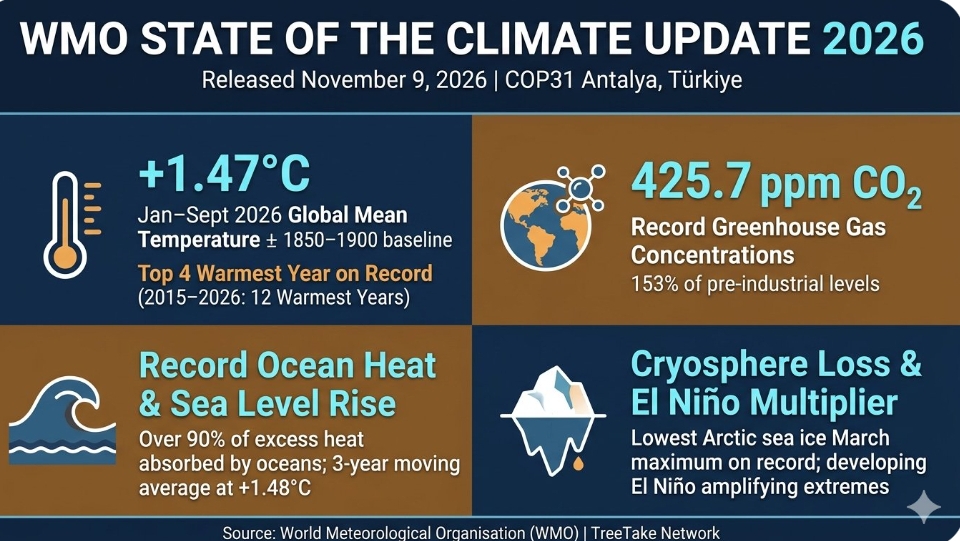
The World Meteorological Organisation (WMO) released its flagship State of the Climate Update 2026 on November 9, 2026, coinciding with the opening day of the 31st United Nations Climate Change Conference (COP31) in Antalya, Türkiye. The assessment confirms that 2026 is on track to rank among the four warmest years in the 177-year observational record—and will likely finish as the second warmest—as a developing El Niño compounds relentless human-induced greenhouse gas accumulation.
Global Surface Temperatures Approach Critical Thresholds
According to the consolidated international dataset analysed by the WMO, the global mean near-surface temperature for the January to September 2026 period stood at 1.47 degrees Celsius (with an uncertainty margin of plus or minus 0.13 degrees Celsius) above the 1850 to 1900 pre-industrial average. The first nine months of 2026 were the warmest on record outside the exceptional El Niño-driven heat spikes of 2023 and 2024, placing the calendar year firmly behind 2024—the hottest year ever measured at 1.55 degrees Celsius above pre-industrial levels—and closely trailing 2023.
The report confirms that the past 12 years, spanning 2015 through 2026, constitute the 12 warmest years ever documented. Furthermore, the three-year moving average temperature from 2024 to 2026 sits at 1.48 degrees Celsius above pre-industrial baselines, demonstrating that the planet is hovering directly at the 1.5 degrees Celsius guardrail established under the 2015 Paris Agreement.
Record Greenhouse Gases, Ocean Heat, and Cryosphere Loss
Atmospheric concentrations of the three primary long-lived greenhouse gases—carbon dioxide, methane, and nitrous oxide—reached new record highs in 2025 and continued rising throughout 2026. Global average carbon dioxide levels reached 425.7 parts per million in 2025, representing 153 per cent of pre-industrial concentrations and marking the third-largest annual increase since modern atmospheric monitoring began.
More than 90 per cent of the excess heat trapped by these emissions is absorbed by the world's oceans. Upper-ocean heat content (measured down to 2,000 metres) reached an all-time high in 2025 and has remained at record levels throughout 2026, accelerating thermal expansion and marine heatwaves. Global mean sea level rose to a new satellite-era peak in 2025, continuing a long-term rate of rise that has more than doubled since satellite altimetry records commenced in 1993.
In the cryosphere, Arctic sea ice extent fell to its lowest annual maximum on record in March 2026 before shrinking to its second-lowest summer minimum in September 2026. Meanwhile, mountain glaciers experienced their fourth consecutive year of severe mass loss, contributing directly to sea-level rise and threatening downstream freshwater supplies for hundreds of millions of people.
Scientists Warn El Niño Will Push Temperatures Higher
Presenting the findings in Antalya on November 9, 2026, WMO Secretary-General Celeste Saulo emphasised that natural climate cycles are colliding with an unprecedented baseline of trapped heat.
"Decades of rising greenhouse gas emissions have accumulated so much heat in the Earth system that we have pushed global temperatures and extreme weather off the charts," Saulo stated. "Now, a developing El Niño event is acting as a risk multiplier, threatening to drive temperatures to new heights and intensify extreme weather across the globe."
Addressing delegates at the COP31 opening plenary, United Nations Secretary-General António Guterres underscored the policy urgency of the WMO findings. "The science is unmistakable, and the warnings could not be louder," Guterres declared. "Every fraction of a degree matters, and every year of delay locks in deeper devastation for communities on the front lines."
Professor Richard Betts, Head of Climate Impacts Research at the United Kingdom's Met Office Hadley Centre, noted that the trajectory of 2026 illustrates the rapid pace of underlying human warming. "Even without a fully matured El Niño throughout the first half of the year, global temperatures have remained persistently close to 1.5 degrees Celsius," Betts explained. "As El Niño conditions strengthen into late 2026 and 2027, there is a high likelihood we will see global temperature records challenged once again."
Devastating Extreme Weather Across Continents
The WMO update catalogues severe meteorological and hydrological disasters recorded across every inhabited continent during 2026, including prolonged heatwaves across Southern Europe, North Africa, and South Asia, catastrophic monsoon flooding in the Indian subcontinent, destructive wildfires in the Mediterranean and North America, and severe drought conditions affecting agricultural basins in Southern Africa and parts of Western Europe.
Editor's Note
: The World Meteorological Organisation's 2026 climate assessment strips away any remaining diplomatic ambiguity at COP31 in Antalya. With the three-year global temperature average already at 1.48 degrees Celsius above pre-industrial levels and a strengthening El Niño poised to amplify heat extremes into 2027, the margin for incremental policy adjustments has vanished. Negotiators must treat this scientific baseline as an immediate operational mandate to enforce rapid fossil fuel reductions, scale up early warning systems, and fully capitalise on adaptation finance for vulnerable nations.



Leave a comment