

TreeTake Network
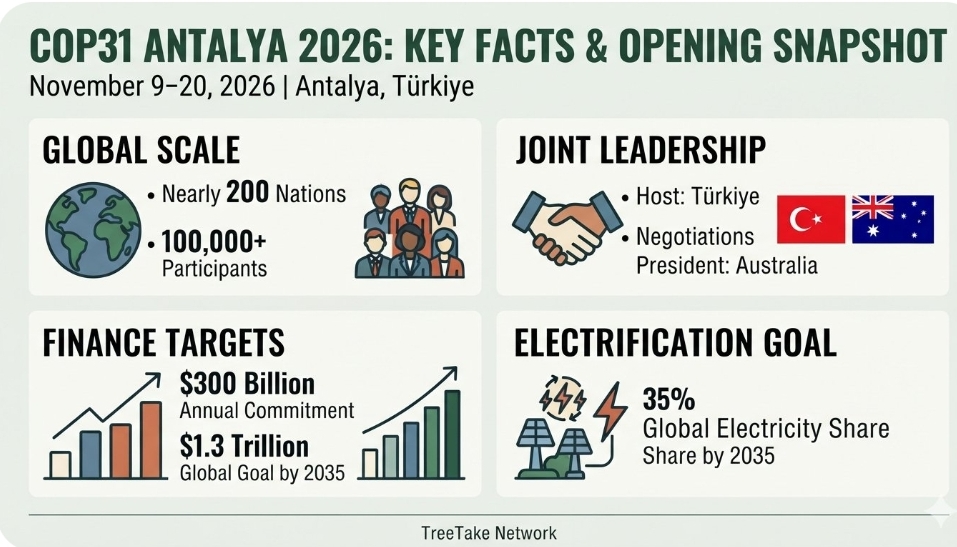
The 31st United Nations Climate Change Conference (COP31) officially commenced on November 9, 2026, in the Mediterranean coastal city of Antalya, Türkiye, bringing together delegates from nearly 200 nations for a 12-day summit running until November 20, 2026. More than 100,000 participants—including world leaders, negotiators, scientists, business executives, and civil society observers—are gathering at the Antalya Expo Centre under a unique dual-leadership model in which Türkiye hosts the summit and Australia presides over formal negotiations.
Opening Delays Over Climate Finance
Proceedings on November 9, 2026, opened with an unexplained one-hour delay after negotiators from developed and developing countries remained locked in late talks over whether to include contentious climate finance items on the official conference agenda. Developing nations, led by African states, are pressing for formal discussions on tripling adaptation finance to help vulnerable regions fund sea walls and drought-resistant agriculture, alongside operationalising a dedicated finance dialogue agreed upon at COP30 in Belém, Brazil, in 2025.
Addressing the tense start, Jasper Inventor, head of Greenpeace's COP31 delegation, noted, "This has already been a difficult start for COP31." He added that wealthy nations were "taking a hard line" against incorporating the COP30 finance platform into the formal negotiating track.
UN Leadership Demands Rapid Implementation
UN Climate Change Executive Secretary Simon Stiell and UN Secretary-General António Guterres urged delegates to accelerate global climate action, warning that extreme weather events, energy shocks, and a worsening El Niño are outpacing current policies. Guterres stressed that the world has entered "a new age of climate extremes" requiring faster emissions cuts and vital support for vulnerable nations.
Co-presidents Turkish Environment Minister Murat Kurum and Australian Climate Change and Energy Minister Chris Bowen emphasised practical solutions over rhetoric. Kurum outlined Türkiye's plan to boost electricity's share in the economy to 35 per cent by 2035, while Bowen affirmed that the Paris Agreement remains functional despite geopolitical challenges and human impacts such as European heat deaths and a glacial collapse in Nepal.
Independent experts, including former US science adviser John Holdren, warned that rising fossil fuel advocacy threatens global progress, as negotiators prepare for upcoming debates on artificial intelligence infrastructure emissions ahead of the World Leaders Summit.
Editor's Note
COP31 in Antalya exposes the widening gulf between accelerating climate devastation and persistent financial inertia. While the Turkish-Australian co-presidency has anchored its agenda around practical electrification and household energy resilience, procedural deadlocks over adaptation funding and the lack of strict low-carbon mandates risk diluting substantive progress. To establish genuine credibility during the opening week, wealthy economies must resolve the trust deficit surrounding the 300 billion-dollar annual climate finance commitment and ensure that electrification targets accelerate a decisive shift away from fossil fuels.



Leave a comment