

TreeTake Network
A marine conservation initiative has proposed a 100 million US dollar biodiversity bond to finance large-scale whale protection across the Pacific Ocean, linking institutional capital directly to a pioneering nature finance instrument termed kinship credits, according to market and conservation dispatches published on November 10, 2026.
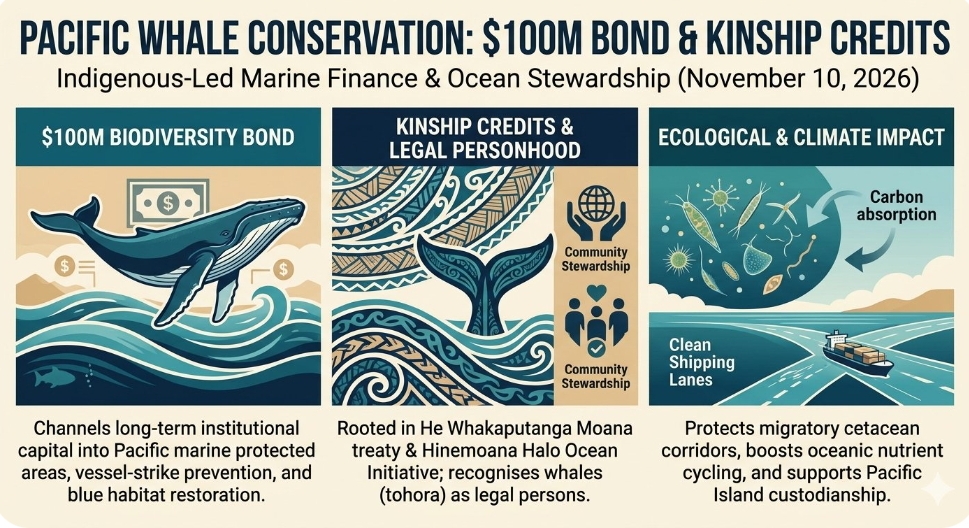
The proposal builds upon the Indigenous-led ocean stewardship architecture established across Polynesia following the signing of the He Whakaputanga Moana treaty—the declaration for the ocean that recognised whales, or tohora, as legal persons with inherent rights—and the accompanying Hinemoana Halo Ocean Initiative. By pairing fixed-income bond financing with kinship-based biodiversity credits, the mechanism seeks to channel long-term capital toward safeguarding migratory cetacean corridors, reducing vessel strikes, and restoring marine ecosystems across Pacific Island jurisdictions.
Bridging Indigenous Kinship Governance and Marine Finance
Unlike conventional carbon or biodiversity offsets that treat ecosystems solely as tradeable commodities, kinship credits are rooted in Pacific Indigenous relational governance, recognising whales as ancestral relatives and vital ecological engineers. Under the proposed 100 million US dollar bond structure, proceeds are earmarked for marine spatial planning, acoustic vessel-tracking networks, entanglement prevention, and community-managed marine protected areas across Pacific waters.
Outlining the foundational vision behind the 100 million US dollar Pacific whale financing architecture and Indigenous-led marine protection, Hinemoana Halo Ocean Initiative leader Mere Takoko emphasised how legal personhood and dedicated capital work together to anchor sustainable ocean stewardship. "We see this opportunity as a way to anchor the blue economy in the Pacific," Mere Takoko stated, adding, "And we are establishing a 100 million dollar fund to assist Pacific governments to put enabling legislation in place. And there will be a whole other raft of benefits through the protection of the whale, which includes the restoration of our blue habitats."
Similarly, underscoring the principle that Pacific nature finance must centre Indigenous custodianship rather than external charity, Moananui Sanctuary Trust Chair Rahui Papa remarked, "This is a demand for a just and equitable system — one that recognises Indigenous peoples as the original and enduring custodians of biodiversity and climate solutions."
Ecological Imperative Across Pacific Blue Corridors
Marine biologists and ocean economists note that safeguarding great whales delivers measurable planetary benefits beyond species recovery. Whales play a critical role in oceanic nutrient cycling—stimulating phytoplankton growth that absorbs atmospheric carbon dioxide—while also sequestering substantial carbon in their bodies over multi-decade lifespans. Yet across the Pacific, migratory whale populations face mounting threats from commercial shipping collisions, underwater noise pollution, ghost fishing gear entanglement, and warming ocean temperatures.
Highlighting the human and cultural stakes driving Pacific ocean conservation commitments, Bezos Earth Fund Vice Chair Lauren Sánchez Bezos observed during regional Pacific marine funding initiatives, "Out there, the ocean isn't just a beautiful view. It's the road, the pantry, the backyard. They've been protecting it for generations because their lives depend on it."
Editor's Note
The proposal for a 100 million US dollar Pacific whale conservation bond linked to kinship credits marks an innovative evolution in nature finance, demonstrating how capital markets can be aligned with Indigenous legal frameworks rather than imposed over them. Moving forward, the credibility and scalability of kinship credits will depend on establishing transparent ecological verification standards, binding shipping-lane speed regulations across Pacific Exclusive Economic Zones, and legally guaranteed governance roles for Pacific Island nations and Indigenous custodians so that financial returns translate into thriving whale populations and resilient marine ecosystems.



Leave a comment