

TreeTake Network
Severe traffic congestion, road closures, and overcrowded shuttle services stranded thousands of delegates and disrupted early morning proceedings at the 31st Conference of the Parties (COP31) to the United Nations Framework Convention on Climate Change (UNFCCC) in Antalya, Türkiye, on November 10, 2026.
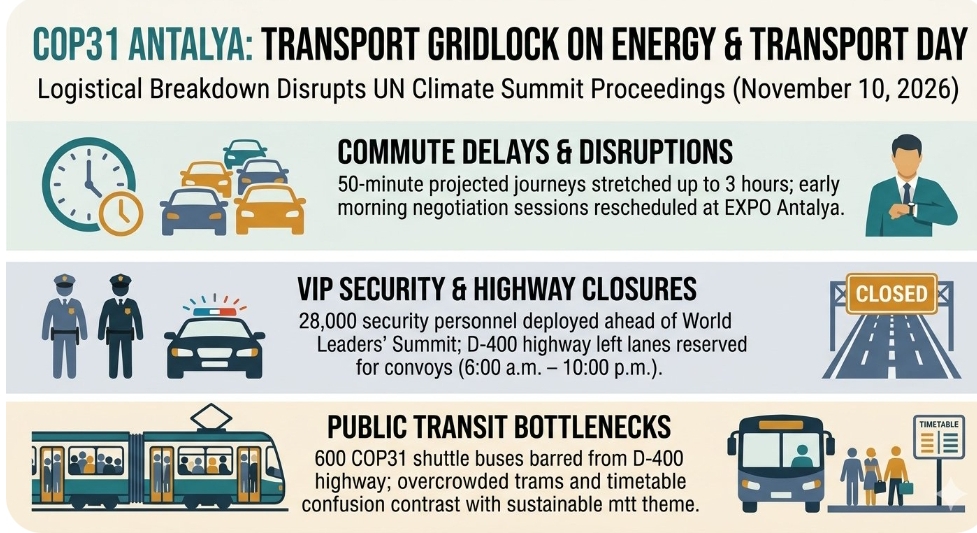
The logistical breakdown unfolded on the second day of the 12-day global climate summit—ironically designated on the official thematic calendar as Energy and Transport Day—forcing session coordinators to delay and reschedule morning meetings at the EXPO Antalya venue. Commutes that had been projected to take roughly 50 minutes stretched up to three hours for government negotiators, accredited observers, and international journalists, leaving many participants waiting in chilly morning conditions at designated stops across the coastal resort city.
VIP Security Restrictions and D-400 Highway Bottlenecks
The transit bottleneck coincided with sweeping security and traffic control measures enforced by Turkish authorities ahead of the World Leaders' Summit scheduled for November 11 and November 12, 2026. To guarantee uninterrupted passage for incoming heads of state and high-level official motorcades, Antalya security agencies imposed strict lane reservations and route diversions between November 10 and November 12, 2026.
Outlining the provincial traffic management operation, Antalya Deputy Provincial Police Chief responsible for traffic, Sedat Akyurek, confirmed that approximately 28000 security personnel, supported by helicopters, unmanned aerial vehicles, and ground camera networks, were deployed across the city. Under the special arrangements along the vital D-400 highway linking Antalya and Alanya, left lanes were cordoned off exclusively for official convoys while heavy vehicles, intercity buses, trucks exceeding 3500 kilogrammes, and minibuses were prohibited from operating between 6:00 a.m. and 10:00 p.m.
Sedat Akyurek also noted that although roughly 600 COP31-branded shuttle buses were allocated to provide free transit across the province, those buses were barred from using the D-400 highway on November 10, November 11, and November 12, 2026, compounding delays along secondary roads. Authorities further announced that Liderler Road would face a complete closure between 7:30 a.m. and noon on November 11, 2026 to accommodate arriving world leaders.
Delegate Frustration and Official Organiser Response
Inside and outside the venue, participants voiced sharp frustration over overloaded trams, confusing timetable alerts, and the stark contrast between the summit's sustainable mobility theme and the gridlock outside the gates. Facing mounting complaints, the COP31 Transport Team issued an urgent email advisory to accredited participants seeking to clarify timetable confusion, stating, "Please disregard the earlier system message about the bus schedule."
The logistical strain underscored the immense scale of the Antalya gathering, which has drawn tens of thousands of registered delegates, venue staff, and observers amid heightened geopolitical and energy security tensions. Setting the substantive agenda for Energy and Transport Day, COP31 President and Turkish Minister of Environment, Urbanisation and Climate Change Murat Kurum emphasised the urgency of accelerating clean power systems to insulate nations from fossil fuel volatility. "Electrification is the answer. It protects communities from volatile global markets and cuts emissions," Murat Kurum stated, adding that COP31's core objective is "to usher in the age of electricity."
Meanwhile, UNFCCC Executive Secretary Simon Stiell reminded negotiators that operational and diplomatic hurdles must not distract from delivering concrete climate outcomes during the two-week conference. Assessing the pace of global action as delegates convened in Antalya, Simon Stiell warned that current progress remains "nowhere near far enough or fair enough," urging governments to translate pledges into rapid implementation.
Editor's Note
The transit paralysis on Energy and Transport Day at COP31 serves as a telling reminder that the credibility of international climate diplomacy begins with practical, low-carbon urban planning and inclusive logistics. When VIP security cordons immobilise public shuttles for tens of thousands of negotiators, observers, and civil society representatives, both operational efficiency and equitable participation suffer. Moving forward, future COP presidencies and host cities must integrate dedicated high-capacity public transit corridors that remain accessible to all accredited participants throughout high-level summits, ensuring that host-city mobility models reflect the very decarbonisation principles debated inside the plenary halls.



Leave a comment