

TreeTake Network
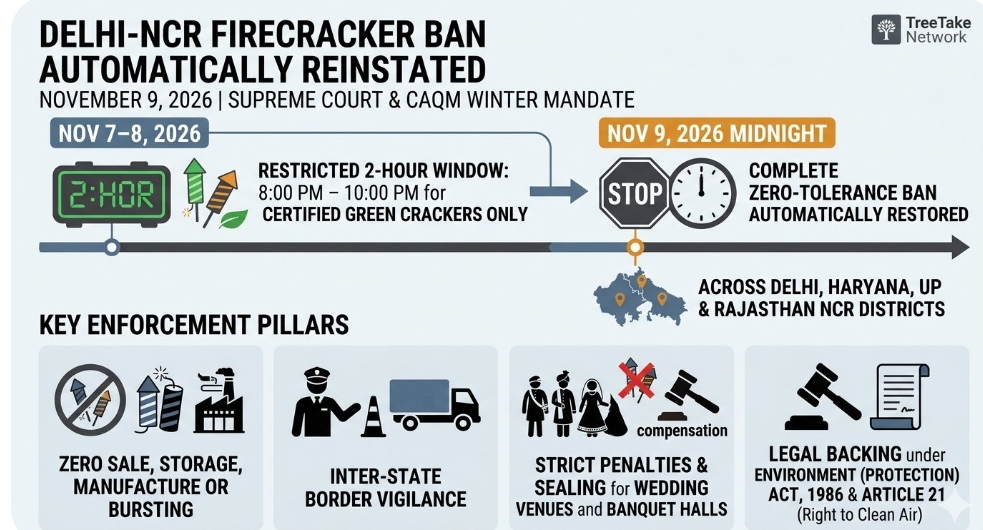
The comprehensive ban on the manufacture, storage, sale, and bursting of all firecrackers automatically returned to full force across Delhi and the National Capital Region (NCR) on November 9, 2026, following the conclusion of the tightly restricted two-day green cracker window permitted for Diwali on November 7 and November 8, 2026. Enforced under standing directives of the Supreme Court of India and the Commission for Air Quality Management (CAQM), the reinstated prohibition applies across Delhi as well as the adjoining NCR districts of Haryana, Uttar Pradesh, and Rajasthan throughout the winter season.
Supreme Court Framework and Post-Diwali Enforcement
Under the calibrated regulatory framework established by the Supreme Court of India to balance festive traditions with urgent public health protection, authorities had permitted the conditional use of certified, reduced-emission green firecrackers only between 8:00 pm and 10:00 pm on November 7 and November 8, 2026. At midnight, the two-day window expired, and a complete, zero-tolerance prohibition resumed automatically across the entire region on November 9, 2026.
Delhi Police, district magistrates, and state pollution control boards across Gurugram, Faridabad, Noida, Greater Noida, and Ghaziabad activated joint enforcement squads on November 9, 2026, to inspect wholesale markets, seize unauthorised stock, and prosecute violators under the Environment (Protection) Act, 1986, and relevant provisions of the Bharatiya Nyaya Sanhita.
Enforcement data compiled from police and municipal control rooms indicated widespread violations of the designated two-hour evening window on Diwali night, with conventional barium-based firecrackers burst well past midnight across residential colonies in Delhi, Noida, and Ghaziabad, directly triggering the severe morning smog recorded on November 9, 2026.
Legal and Environmental Experts Call for Supply-Chain Accountability
Legal analysts and clean-air researchers emphasised that while automatic reinstatement of the ban provides clear statutory authority, enforcement failures at inter-state borders and manufacturing hubs continue to undermine compliance during peak festive days.
Sunita Narain, Director General of the Centre for Science and Environment (CSE), stressed that post-festive prohibitions must be backed by strict upstream supply-chain regulation. "A ban that is enforced only on the night of Diwali at the neighbourhood level will always struggle if illegal firecrackers are allowed to enter the National Capital Region weeks in advance," Narain stated. "Effective compliance requires sealing inter-state transit routes, auditing certified green cracker QR codes at the factory gate, and holding licensed distributors strictly accountable."
Supreme Court advocate and environmental lawyer Ritwick Dutta highlighted the constitutional mandate underpinning the reinstated restriction. "The Supreme Court has repeatedly affirmed that the right to life under Article 21 encompasses the right to breathe clean, unpolluted air," Dutta noted. "Once the limited festive relaxation expires on November 9, any continued sale, storage, or bursting of firecrackers constitutes a direct breach of judicial orders and warrants immediate penal action."
Dr Mukesh Sharma, Professor in the Department of Civil Engineering at the Indian Institute of Technology (IIT) Kanpur and a leading air-quality modelling specialist, pointed out that preventing post-Diwali celebratory bursting during the upcoming wedding season is vital to containing winter pollution. "In northern India, November marks the onset of severe meteorological trapping," Dr Sharma explained. "Eliminating further pyrotechnic emissions after Diwali prevents additional spikes in toxic metals such as barium, strontium, and copper, which linger in the lower atmosphere for days."
Zero-Tolerance Directives for Upcoming Wedding Season
With the wedding season commencing across northern India in mid-November 2026, the Delhi Pollution Control Committee (DPCC) and neighbouring NCR municipal bodies issued fresh circulars on November 9, 2026, warning banquet halls, farmhouses, hotels, and event organisers that any bursting of firecrackers during marriage processions will result in immediate sealing of premises and heavy environmental compensation penalties.
Editor's Note
The automatic reinstatement of the Delhi-NCR firecracker ban on November 9, 2026, closes the narrow festive window just as regional air quality has already breached severe thresholds. To prevent recurring winter health emergencies during the upcoming wedding season, authorities must shift from reactive street-level seizures to sustained inter-state border vigilance and strict accountability for banquet venues and wholesale suppliers.



Leave a comment