

TreeTake Network
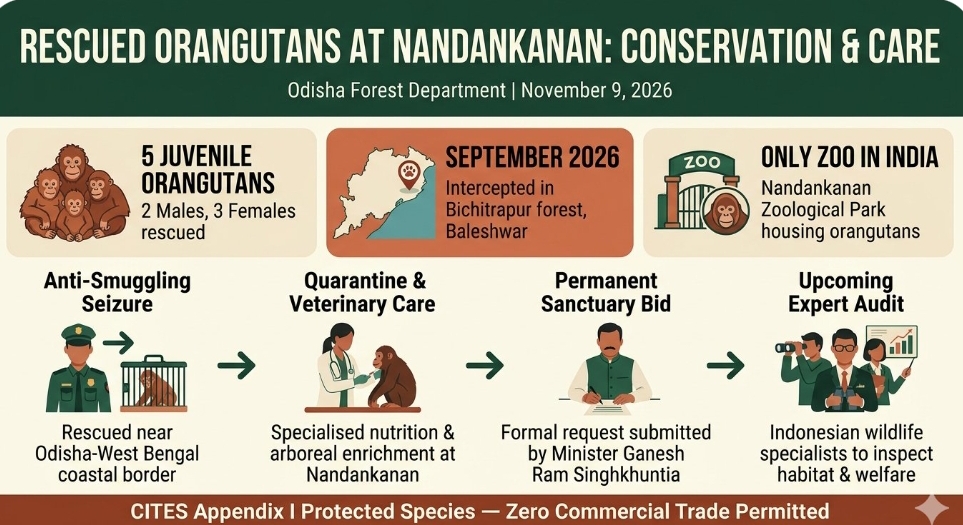
The Odisha Forest, Environment and Climate Change Department has formally requested permanent residency at Nandankanan Zoological Park on the outskirts of Bhubaneswar for five juvenile orangutans rescued from illegal wildlife traffickers earlier this year. Confirming the development ahead of November 9, 2026, Odisha Forest and Environment Minister Ganesh Ram Singhkhuntia announced that a delegation of wildlife specialists and veterinarians from Indonesia is scheduled to visit the zoo shortly to inspect the apes' enclosure facilities, health parameters, and long-term care protocols.
Rescue Operation and Intensive Rehabilitation at Nandankanan
The five endangered primates—comprising two males and three females—were intercepted by vigilant forest patrol teams in the Bichitrapur mangrove forest area of Baleshwar district in September 2026 during an anti-smuggling operation near the Odisha–West Bengal coastal border. Following their seizure, the dehydrated and stressed juveniles were transferred under strict veterinary escort to Nandankanan Zoological Park, where they were placed in an isolated quarantine and rehabilitation ward.
Over the past several weeks, dedicated keepers and wildlife veterinarians at Nandankanan have administered specialised nutrition, behavioural enrichment, and round-the-clock medical monitoring to stabilise the apes. Currently, Nandankanan is the only zoological institution in India housing orangutans, making its experienced veterinary team uniquely equipped to manage the species' complex physiological and psychological needs.
Minister Confirms Formal Proposal and Indonesian Assessment
Addressing media queries regarding the long-term custody of the confiscated primates, Odisha Forest and Environment Minister Ganesh Ram Singhkhuntia confirmed that the state government has submitted an official proposal to central wildlife authorities to retain the five orangutans permanently at Nandankanan.
"The five rescued orangutans are recovering well under the dedicated care of our veterinary team at Nandankanan," Minister Singhkhuntia stated. "We have formally requested permission to keep them permanently at Nandankanan Zoological Park, and a team of Indonesian experts will visit the facility soon to evaluate their living conditions, diet, and habitat enrichment."
Nandankanan Zoological Park Deputy Director Sanath Kumar Narayanan highlighted the intensive preparations undertaken by the zoo's animal care staff since the rescue. "Because orangutans are highly intelligent, arboreal great apes, they require specialised vertical climbing structures, cognitive stimulation, and strict biosecurity," Narayanan explained. "Our keepers have replicated natural canopy conditions and tailored their nutritional regimen to ensure steady physical and behavioural recovery."
Conservationists Highlight Transnational Wildlife Trafficking Risks
Wildlife conservation biologists and anti-trafficking specialists noted that the interception in Baleshwar underscores the vulnerability of eastern India's coastal corridors to international exotic pet smuggling syndicates operating across Southeast Asia.
Dr Bivash Pandav, senior wildlife biologist and former Director of the Bombay Natural History Society (BNHS), emphasised the importance of accredited rescue centres in combating illegal trade. "When critically endangered great apes like orangutans are confiscated from illegal transit routes, immediate access to specialised veterinary care and naturalistic enclosures is vital for their survival," Dr Pandav noted. "Collaborative assessments with range-country specialists from Indonesia ensure that global welfare standards are upheld while sending a strong deterrent signal against transnational wildlife crime."
Under the Convention on International Trade in Endangered Species of Wild Fauna and Flora (CITES), orangutans are listed under Appendix I, prohibiting all commercial international trade and requiring strict intergovernmental coordination regarding repatriation or permanent sanctuary placement of confiscated individuals.
Editor's Note
Odisha's initiative to secure permanent sanctuary for the five rescued orangutans at Nandankanan Zoological Park demonstrates how rapid field enforcement must be paired with world-class ex-situ veterinary care. Hosting Indonesian specialists to audit habitat standards sets a benchmark for international conservation cooperation, while reinforcing the urgent need for heightened coastal surveillance against exotic wildlife smuggling along the Bay of Bengal.



Leave a comment