

TreeTake Network
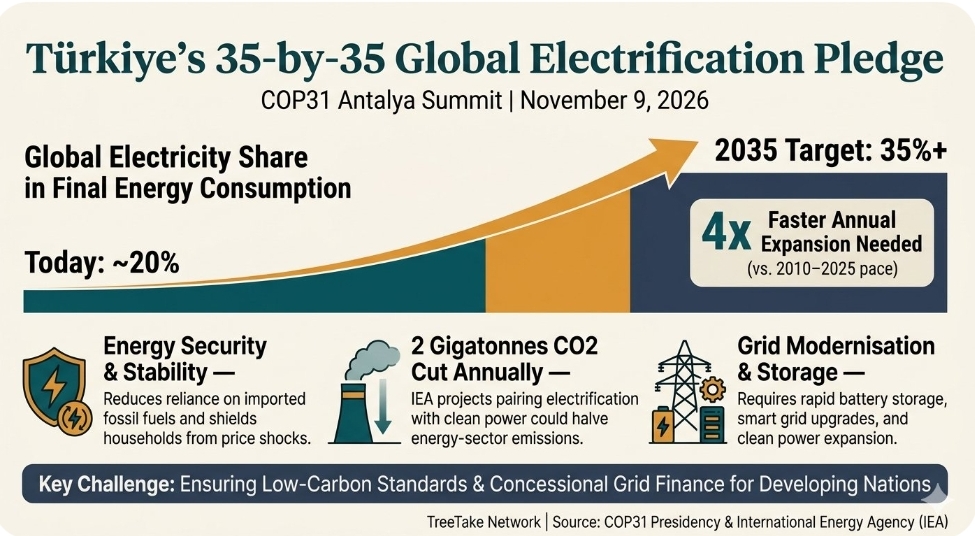
Türkiye placed global electrification at the centre of the 31st United Nations Climate Change Conference (COP31) agenda as the 12-day summit opened on November 9, 2026, in Antalya. Spearheaded by COP31 President and Turkish Environment Minister Murat Kurum alongside Australian Climate Change and Energy Minister Chris Bowen, the non-binding 35-by-35 Global Electrification Pledge aims to raise electricity's share in global final energy consumption from roughly 20 per cent today to at least 35 per cent by 2035.
Energy Security and the Age of Electricity
Supported by a special technical assessment from the International Energy Agency (IEA), the initiative requires expanding global electrification at nearly four times the annual pace recorded since 2010, backed by rapid grid modernisation, battery storage, and clean power expansion. High-level ministerial discussions on November 10, 2026, and a dedicated Leaders' Summit on Electrification on November 11, 2026, are scheduled to establish the political and financial architecture for the target.
Minister Murat Kurum highlighted that ongoing energy market disruptions demonstrate the necessity of domestic control over energy resources, noting that imported energy leaves communities vulnerable. "The era of electricity is not just an environmental choice; it is an imperative for energy security, economic stability, and meeting rising digital and artificial intelligence demands," Kurum stated, framing the initiative as a shield against global fossil fuel price volatility.
Co-Presidency and International Energy Agency Endorsement
Australian Minister Chris Bowen emphasised that electrification serves as a vital complement to existing pledges on energy efficiency and renewable power expansion. "We cannot hold global warming to 1.5 degrees Celsius without rapid, economy-wide electrification," Bowen declared.
IEA Executive Director Dr Fatih Birol added that achieving the target alongside clean power generation could halve energy-sector emissions and eliminate two gigatonnes of greenhouse gases annually. "Electrification is the single biggest lever to cut fossil fuel dependence across transport, heating, and industry," Birol noted, though he cautioned that major oil-exporting nations may resist shifts that curb transport-related oil demand.
Debate Over Low-Carbon Mandates and Finance
The voluntary nature of the pledge has drawn criticism from climate advocates and South Pacific island states, who warn that failing to mandate exclusively renewable or low-carbon electricity sources risks locking in coal or gas-powered grids. Furthermore, energy analysts point out that developing nations require dedicated concessional finance and technology transfers to overcome grid infrastructure deficits and high borrowing costs.
Editor's Note
Türkiye's 35-by-35 electrification pledge offers a practical mechanism to accelerate decarbonisation and shield energy-importing nations from fossil fuel shocks. However, to prevent unintended coal or gas expansion, the COP31 presidency must pair this target with strict clean-power generation standards and dedicated grid financing for the Global South.



Leave a comment