

TreeTake Network
Human health took centre stage on the opening day of the 31st United Nations Climate Change Conference (COP31) on November 9, 2026, in Antalya, Türkiye, as the World Health Organisation (WHO) launched a dedicated Health Day alongside a major philanthropic funding announcement. Coinciding with the summit's opening thematic focus on food, agriculture, and health, the Climate and Health Funders Coalition revealed it has awarded more than 225 million dollars during its inaugural year to protect vulnerable communities from climate-driven health emergencies.
Dedicated Health Day Opens Two-Week Climate Programme
Organised jointly by the COP31 Presidency and the WHO, Health Day on November 9, 2026, established Dynamic and Resilient Health Systems as Priority Theme 8 of the presidency's Action Agenda. The opening-day programme featured four high-level panel discussions and a ministerial roundtable examining climate-sensitive health technologies, digital health systems, humanitarian aid, and climate-health financing.
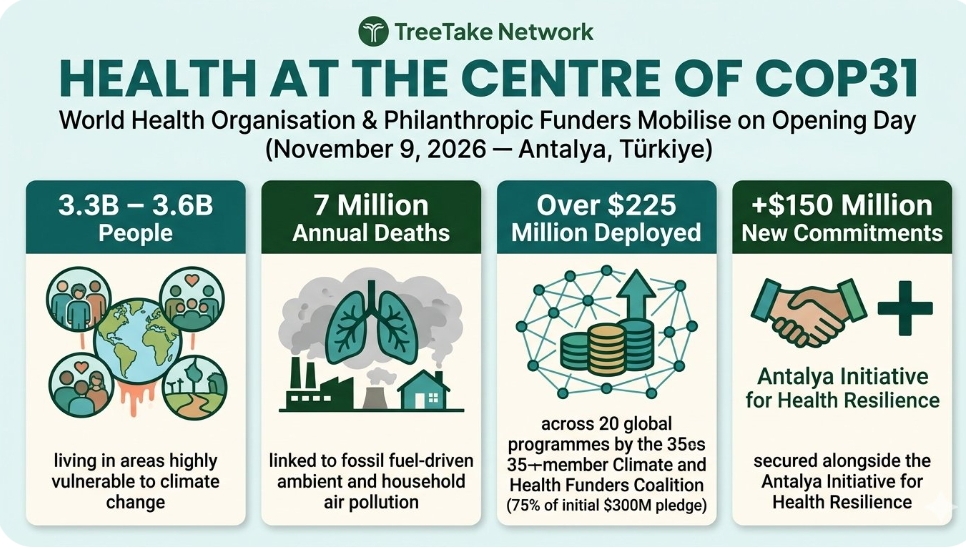
According to WHO technical briefings released for the summit, between 3.3 billion and 3.6 billion people currently live in environments highly vulnerable to climate change, with over 90 per cent of deaths from climate-related disasters over the past two decades occurring in developing countries. Furthermore, ambient and household air pollution—largely driven by fossil fuel combustion—claims approximately 7 million lives annually worldwide.
WHO leaders emphasised that Antalya must mark a decisive transition from policy pledges to practical execution of the Belém Health Action Plan adopted at COP30 in 2025, backed by the Alliance for Transformative Action on Climate and Health (ATACH) and the newly launched Antalya Initiative for Health Resilience.
Dr Diarmid Campbell-Lendrum, Head of Climate Change and Health at the WHO, stated that the medical sector can no longer treat global warming as a distant threat. "The climate crisis is a health crisis unfolding in hospitals, clinics, and communities right now," Campbell-Lendrum warned. "We must move beyond promises to tangible action that protects the most vulnerable populations."
WHO Director-General Dr Tedros Adhanom Ghebreyesus reinforced this message, warning delegates that fossil fuel dependence directly harms human wellbeing. "Every fraction of a degree of warming increases disease outbreaks, heat-related mortality, and cardiopulmonary conditions," Dr Tedros declared. "Protecting human health requires rapid clean energy transitions and resilient healthcare infrastructure."
Philanthropic Coalition Deploys Over 225 Million Dollars
The Climate and Health Funders Coalition announced it has disbursed over 225 million dollars across 20 global programmes during its first year, representing 75 per cent of the initial 300 million dollars pledged by its 35-member alliance—including the Rockefeller Foundation, Wellcome Trust, Gates Foundation, Bloomberg Philanthropies, IKEA Foundation, and Children's Investment Fund Foundation—following its launch at COP30. These grants finance initiatives tackling extreme heat, air pollution, vector-borne diseases, and early warning data networks such as the WISER Africa Programme, alongside an additional 150 million dollars secured in new donor commitments.
Editor's Note
Placing human health at the forefront of COP31 shifts the focus of climate diplomacy toward immediate survival. While the Climate and Health Funders Coalition's funding provides crucial backing for frontline healthcare resilience, philanthropic grants alone cannot substitute for binding government policies and rapid fossil fuel phaseouts.



Leave a comment