

TreeTake Network
The New Delhi-based public interest research and advocacy organisation Centre for Science and Environment (CSE) released a comprehensive new assessment titled Powering Progress, Protecting People on November 10, 2026, examining how rapid large-scale renewable energy deployment across India is triggering social, agrarian, and ecological conflicts.
Drawing upon field investigations and case studies spanning Rajasthan, Gujarat, Andhra Pradesh, Madhya Pradesh, Assam, and several other states, the report evaluates the on-ground impacts of utility-scale solar and wind projects on local communities and fragile landscapes. Outlining the central premise of the assessment, the official CSE publication states, "India’s renewable energy transition is advancing rapidly, but its success depends on how projects affect the people and landscapes around them."
The Illusion of Wastelands and Loss of Rural Commons
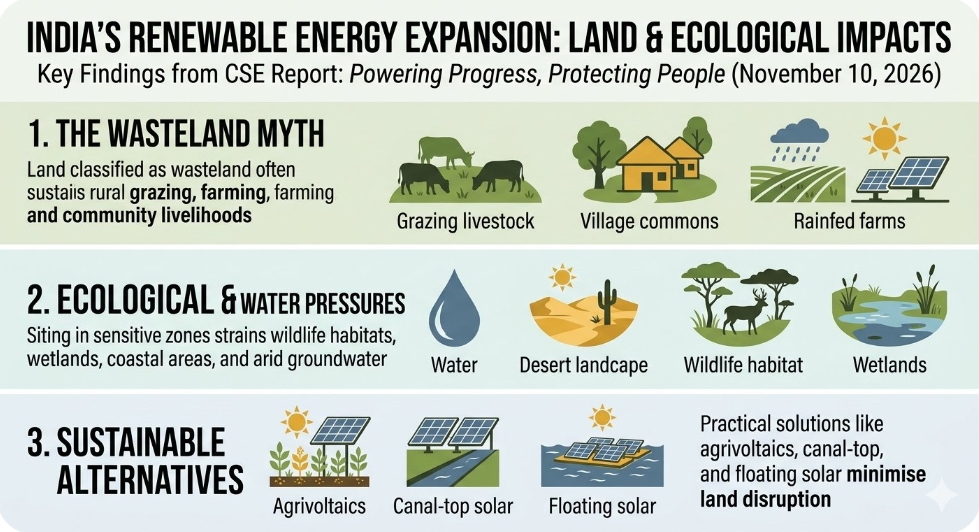
A central finding of Powering Progress, Protecting People is that tracts officially designated in revenue records as wastelands or vacant government land are rarely devoid of human or ecological value. Across semi-arid and rural regions in states such as Rajasthan and Gujarat, these lands serve as vital grazing grounds for pastoralists, support rainfed agriculture, sustain local hydrological networks, and hold deep cultural significance as village commons.
Highlighting how land classification practices fuel rural friction, the CSE assessment notes, "Large solar and wind projects frequently rely on land classified as 'wasteland' or vacant government land—areas that often support grazing, rainfed farming, local water systems, and community livelihoods." When large tracts are fenced off without meaningful community consultation, local agrarian and pastoralist livelihoods face immediate disruption, while compensation mechanisms and long-term operational employment remain unevenly distributed.
Commenting on the institutional intersection between community land rights and green energy planning, CSE Programme Manager for Renewable Energy Binit Das stated, "India's renewable energy transition must go hand in hand with protecting community rights and livelihoods."
Ecological Pressures on Wildlife Habitats, Wetlands, and Water Systems
Beyond agrarian and social friction, the report catalogues mounting environmental pressures resulting from the siting of large renewable installations in ecologically sensitive zones. According to the official CSE release, "Projects located in ecologically sensitive zones have placed pressure on wildlife habitats, wetlands, and coastal areas, while solar installations have increased local water demand in arid regions."
In semi-arid landscapes, utility-scale solar arrays require substantial quantities of water for regular panel cleaning, placing additional strain on already depleted groundwater aquifers. Furthermore, associated transmission lines and access roads in wildlife corridors can fragment open natural ecosystems and pose collision risks for avian species.
CSE Director General Sunita Narain has consistently emphasised that environmental governance in India must treat natural ecosystems as the foundational resource base for rural survival rather than empty spaces awaiting industrial conversion. "For millions of people in India, the environment is not a luxury or an aesthetic issue; it is a resource base on which their daily livelihood and survival depend," Sunita Narain observed in her commentary on sustainable development and commons management.
Practical Pathways and Five Policy Priorities
To reconcile India's clean energy ambitions with ecological stewardship and social equity, Powering Progress, Protecting People identifies practical engineering and governance alternatives drawn from project experiences across the country. As noted in the CSE summary, "The study highlights practical alternatives—such as agrivoltaics, canal-top solar, and floating solar—that demonstrate how renewable energy can be developed with minimal land and ecological disruption."
The report concludes with five core policy priorities aimed at strengthening environmental and social accountability across central and state energy agencies, ensuring that renewable energy expansion delivers climate mitigation without disenfranchising rural communities or degrading biodiversity.
Editor's Note
India's rapid clean energy expansion represents a cornerstone of global decarbonisation, yet the findings of CSE's November 10, 2026 report demonstrate that green infrastructure cannot be treated as inherently benign by default. Reclassifying vibrant pastoral commons, grasslands, and wetlands as wastelands repeats the extractive land-use mistakes of conventional industrial development. Moving forward, central and state policymakers must mandate rigorous environmental and social impact assessments for large renewable parks, incentivise distributed rooftop and agrivoltaic models over land-intensive mega-projects, and place village institutions at the centre of land-use decisions so that climate progress reinforces both ecological resilience and rural livelihoods.



Leave a comment