

TreeTake Network
The Government of Odisha has stated that neither Indonesia nor any other country has furnished concrete documentary evidence establishing ownership of the five infant orangutans rescued from a coastal forest in Balasore district two months ago, expressing the state's wish to retain the critically endangered great apes at Nandankanan Zoological Park in Bhubaneswar.
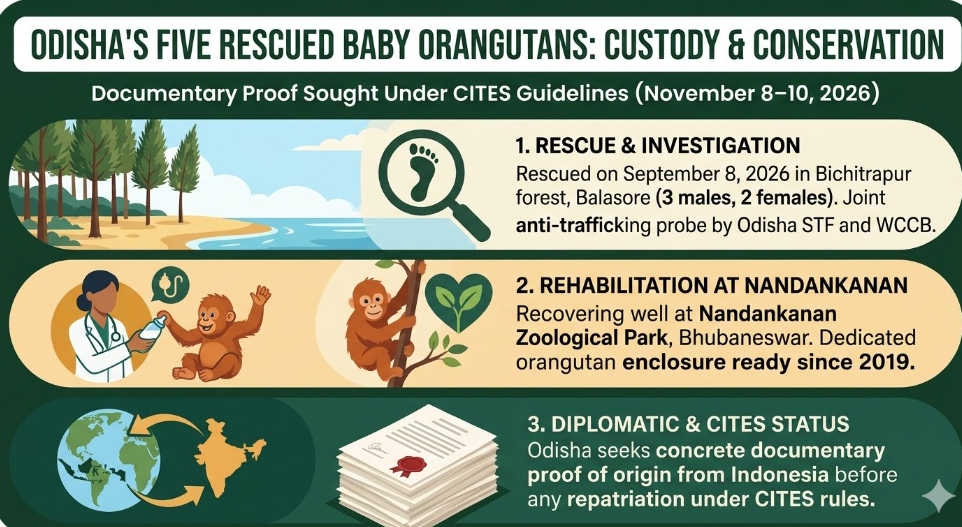
Addressing reporters in Bhubaneswar on November 8, 2026, with diplomatic and conservation follow-ups continuing through November 10, 2026, Odisha Forest, Environment and Climate Change Minister Ganesh Ram Singh Khuntia clarified that any international repatriation claim under global wildlife trade regulations must be backed by verifiable proof of origin. The three male and two female infant orangutans—species native solely to the rainforests of Borneo and Sumatra in Indonesia and Malaysia—were discovered abandoned in a casuarina forest at Bichitrapur under Bhograi block in Balasore district, roughly eight kilometres from Digha in West Bengal, on September 8, 2026.
Documentary Evidence Required Under International Trade Norms
Following their rescue by Balasore Wildlife Division patrolling teams, Indonesia's forestry authorities contacted Indian officials to initiate preliminary discussions regarding a potential return, with early assessments suggesting the infants may have originated from Sumatra. However, Minister Ganesh Ram Singh Khuntia underscored that formal documentary proof remains absent.
Speaking to media personnel in Bhubaneswar, Minister Ganesh Ram Singh Khuntia stated, "Neither Indonesia nor any other country has submitted concrete documentary proof establishing ownership of the rescued baby orangutans so far, and we are treating the matter through proper diplomatic and legal channels." He added, "All details regarding the rescued primates have been communicated to the Union Ministry of Environment, Forest and Climate Change, and we are awaiting the scheduled inspection by an expert delegation."
Steady Recovery and Rehabilitation at Nandankanan Zoological Park
Transferred to a temperature-controlled quarantine facility at Nandankanan Zoological Park following their September 2026 rescue, the five infant orangutans have steadily gained weight and acclimatised after initial treatment for severe anaemia and stress. Park Director Pradeep Mirase confirmed their steady clinical progression under round-the-clock veterinary care, noting, "All five infant orangutans have responded remarkably well to specialised nutrition and intensive veterinary monitoring, showing healthy weight gain and active social behaviour."
Minister Ganesh Ram Singh Khuntia further emphasised Odisha's commitment to housing the apes permanently if repatriation is not established under the Convention on International Trade in Endangered Species of Wild Fauna and Flora (CITES) guidelines. "Odisha possesses a highly suitable climate and world-class zoological infrastructure at Nandankanan, and we wish for these five orangutans to remain here under dedicated care," the Minister remarked, noting that Nandankanan previously housed an orangutan named Binny until her passing in 2019 and maintains a specialised enclosure ready for the species.
Ongoing Anti-Trafficking Probe Across Coastal Borders
The unexpected discovery of non-native great apes along the Bay of Bengal coast triggered a multi-agency investigation by the Odisha Crime Branch Special Task Force (STF) and the Wildlife Crime Control Bureau (WCCB) to dismantle transnational exotic wildlife smuggling syndicates. Investigators have been analysing surveillance footage along the Bichitrapur and Digha coastal corridor to trace how the animals were transported and abandoned.
Commenting on the enforcement dimension of the rescue, Wildlife Trust of India (WTI) Chief Executive Officer Vivek Menon highlighted the growing challenge of illegal exotic pet networks across South and Southeast Asia. "The interception of live great apes along coastal transit routes underscores the urgent need for coordinated cross-border intelligence sharing and strict enforcement under amended wildlife protection laws to deter international traffickers," Vivek Menon noted in his assessment of exotic primate trafficking trends.
Editor's Note
The rescue and rehabilitation of the five infant orangutans in Odisha highlights both the vigilance of frontline forest personnel and the escalating threat posed by transnational exotic wildlife trafficking along South and Southeast Asian coastal corridors. Moving forward, any final decision on custody must strictly adhere to CITES protocols, DNA provenance testing, and the long-term welfare of the developing primates, while maritime police, customs agencies, and wildlife crime units intensify joint border surveillance to dismantle smuggling networks before endangered species are uprooted from their native habitats.



Leave a comment