

TreeTake Network
The West Bengal Forest Department initiated specialised veterinary diagnostics for a three-year-old radio-collared Royal Bengal Tigress following her successful capture in the Kokrajhar district of Assam. The extensive wildlife management operation, coordinated alongside the National Tiger Conservation Authority, marks the stable containment of the apex predator after she wandered out of her designated territory. The incident highlights the complex behavioural dynamics of translocated large carnivores navigating highly fragmented regional wildlife corridors.
Translocation Logistics and Interstate Dispersal
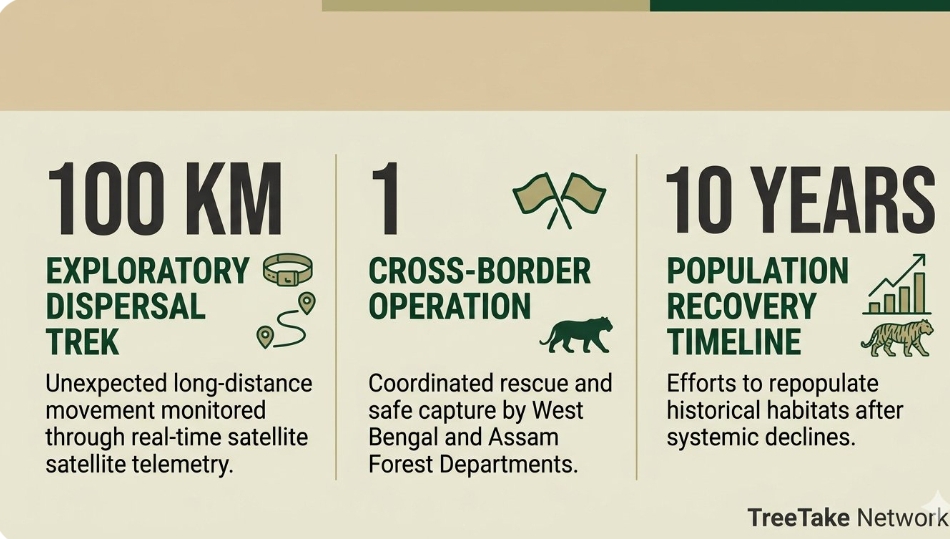
The young tigress, designated as BT1 and popularly known as Dooars Rani, was originally translocated from Bihar's Valmiki Tiger Reserve and released into the core zone of West Bengal's Buxa Tiger Reserve. The high-profile interstate conservation initiative was designed to repopulate historical habitats where tiger populations had experienced severe systemic declines over the past 10 years. However, real-time satellite telemetry logs indicated that upon her release, the predator commenced an unexpected exploratory dispersal trek, travelling over 100 kilometres through thick jungle patches.
Field tracking teams monitored her movements as she crossed the Sankosh River before entering the complex forest network of Raimona National Park in the Bodoland Territorial Region of Assam. The tracking parameters altered sharply when the tigress deviated toward communal agricultural lands near human settlements in Gelaguri. Recognising the high probability of an immediate conflict scenario, wildlife authorities mobilised a joint tactical team consisting of forest rangers from both West Bengal and Assam to initiate a safe chemical immobilisation protocol.
Administrative Interventions and Wildlife Management Perspectives
West Bengal Chief Wildlife Warden Pradeep Vyas confirmed that the field teams utilised trained monitoring elephants and heavy ground machinery to establish a secure perimeter before successfully sedating the tigress with zero physical injuries. The animal was transported under continuous veterinary observation to the Rajabhatkhawa rehabilitation facility, where she remains in stable health inside a large, heavily monitored wilderness enclosure.
Assam Principal Chief Conservator of Forests Sandeep Bhooshan stated that this successful cross-border operation demonstrates the immense value of real-time intelligence sharing between adjacent state forest departments, proving that automated satellite alerts can prevent tragic conflict encounters before large predators wander too close to rural populations.
National Tiger Conservation Authority specialists added that the animal's extensive migration validates the historical connectivity of the Buxa-Raimona landscape, though future releases must incorporate longer pre-release acclimatisation phases to minimise extreme post-release wandering behaviours. The complete movement maps, veterinary health sheets, and tranquilisation summaries can be analysed within the official printed records of the state forest ministry.
Editor's Note
The long-distance movement of the translocated tigress underscores the absolute necessity of maintaining unfragmented, functional forest corridors between adjacent states. Moving forward, environmental ministries must institutionalise a unified, interstate satellite monitoring network and expand community-level awareness programmes along known dispersal pathways to ensure that large carnivore reintroduction frameworks achieve long-term evolutionary success.



Leave a comment