

TreeTake Network
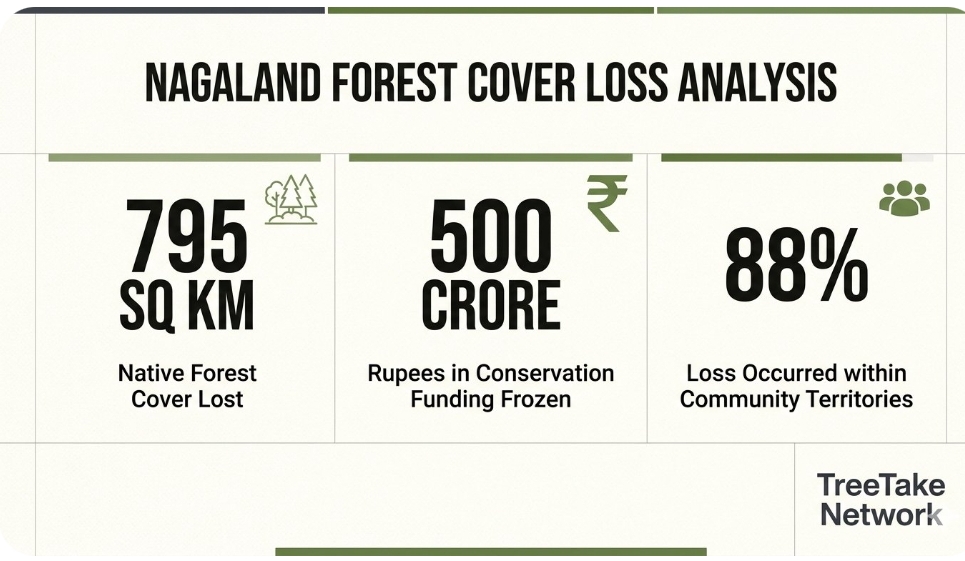
A comprehensive land-use audit released by the State Department of Environment, Forests and Climate Change revealed that Nagaland has experienced an alarming reduction in its ecological footprint. The specialised satellite telemetry data demonstrate that the state has lost 795 square kilometres of native forest cover over a compressed ten-year timeline. Due to severe structural delays in implementing national regulatory frameworks and community-led conservation guidelines, the state has systematically forfeited approximately 500 crore rupees in vital funding allocations from the central ministry.
Constitutional Protections and Private Exploitation Challenges
The sharp decline in dense forest canopy underscores a unique governance deadlock within the Northeast Indian state. Under Article 371A of the Constitution of India, indigenous community bodies maintain absolute ownership over local land and forest resources, severely limiting the statutory enforcement powers of the state forest department. Ground investigations revealed that roughly 88 per cent of the recorded canopy loss occurred within these privately managed community territories, driven by unspaced infrastructure expansions, limestone mining, and extensive clearing for commercial timber and monoculture rubber plantations.
To counter the accelerating ecological degradation, conservation specialists have deployed the Forest Management and Biodiversity Conservation project, which currently targets 41,000 hectares of land spanning 64 designated villages. The field initiative seeks to transition local communities away from traditional slash-and-burn farming toward modern agro-forestry and community-managed carbon credit programmes. However, the historic non-utilisation and subsequent forfeiture of the 500 crore rupee central allocation has severely crippled local forest department operations, leaving hundreds of rural monitoring positions and automated nursery infrastructures without essential financial support.
Policy Deadlocks and Conservation Reassessments
Nagaland Principal Chief Conservator of Forests Dharmendra Prakash emphasised that the loss of 795 square kilometres of ancient forest cover within a single decade represents a catastrophic blow to the region's climate resilience, and the state must urgently re-evaluate how traditional land ownership laws are harmonised with national frameworks to allow statutory conservation bodies to legally intervene against commercial logging operations.
Indigenous Land Rights Council Representative Toshi Wati argued that penalising the state framework by withholding 500 crore rupees in vital conservation funds only isolates local communities further, forcing rural families to accelerate timber clearing to generate basic income rather than participating in state-sponsored biodiversity preservation schemes.
Union Environment Ministry specialists added that the re-allocation of future funds remains strictly conditional upon the state government formulating a legally binding, community-backed regulatory framework to protect the remaining primary forest canopies. The full canopy loss maps, district-wise degradation tables, and project funding ledgers can be thoroughly evaluated within the official gazette of the national forest service.
Editor's Note
The severe loss of green cover in Nagaland exposes the critical vulnerability of biodiversity hotspots when conservation governance is structurally decoupled from indigenous community incentives. Moving forward, environmental planners must abandon punitive funding halts and instead design direct, institutionalised financial rewards for community-led forest retention, ensuring that traditional autonomy functions as a shield for nature rather than an avenue for unregulated industrial clearing.



Leave a comment