

TreeTake Network
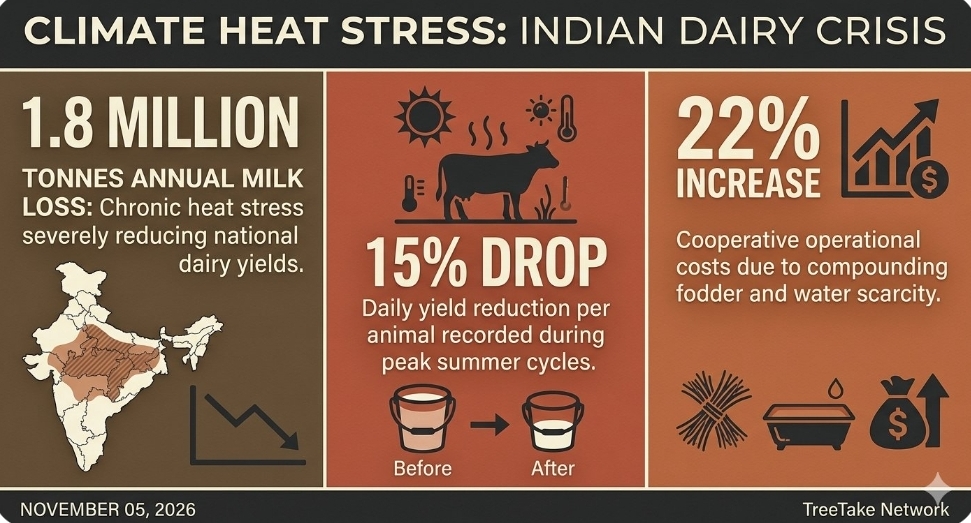
A landmark national synthesis report published by the prominent environmental research organisation Climate Trends revealed that severe climate-induced heat stress is actively destabilising India's agricultural security. The extensive data models indicate that rising ambient temperatures and prolonged heatwaves are cutting directly into the country's primary food supply. Most notably, the agricultural sector has registered an unprecedented annual loss of 1.8 million tonnes in milk production as dairy livestock succumb to metabolic stress.
Thermal Thresholds and Bovine Vulnerability
The research demonstrates that high-yielding crossbred cattle and indigenous buffaloes are experiencing severe physiological distress as the Temperature-Humidity Index continuously breaches critical comfort thresholds. During intense seasonal heat cycles, daytime temperatures consistently remain between three and five degrees Celsius above long-term averages in major dairy-producing corridors across Uttar Pradesh, Punjab, and Haryana. This chronic exposure to extreme thermal environments triggers a sharp reduction in feed intake, impairs metabolic function, and alters reproductive cycles in commercial dairy herds.
Field assessments indicate that daily milk yields drop by up to 15 per cent during thermal anomalies, severely impacting smallholder farmers reliant on single livestock assets. The report underscores that the impact is not restricted to commercial dairies, as millions of smallholders who rely on single livestock assets for daily sustenance have seen their primary income streams severely diminished. Furthermore, the synthesis notes that the compounding effects of fodder shortages and rising water scarcity have escalated operational costs for rural milk cooperatives by 22 per cent.
Institutional Warnings and Adaptation Strategies
Climate Trends Research Lead Dr Palak Balyan emphasised that these agricultural losses represent a systemic challenge requiring massive investment in storage, extension services, and market access, noting that if we look at the climate impacts on agriculture, it is not an individual farmer's problem but a systems problem.
Agro-meteorologists at the Indian Council of Agricultural Research stated that current livestock management frameworks are inadequate to cope with these shifting thermal baselines, necessitating a rapid transition toward climate-resilient animal husbandry, including the selection of heat-tolerant indigenous breeds and the installation of active micro-climate cooling infrastructure within rural dairy shelters.
National Dairy Development Board specialists added that local cooperatives must immediately reorganise their supply chains by implementing automated cold-chain logistics to prevent rapid spoilage during high-temperature transport. The complete policy recommendations and structural data can be reviewed directly in the official institutional white paper.
Editor's Note
The significant decline in domestic milk yields highlights the critical vulnerability of India's unorganised agricultural sector to accelerating global warming. Moving forward, policymakers must synthesise long-term financial support mechanisms to help smallholders modernise livestock infrastructure, ensuring that national food security frameworks can withstand intensifying climate volatility.



Leave a comment