

TreeTake Network
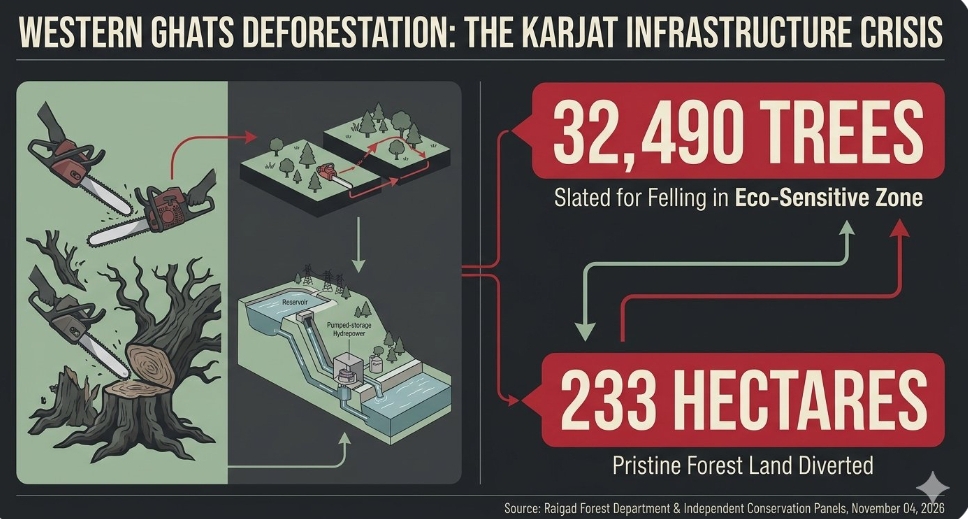
A severe environmental confrontation has erupted across the eco-sensitive slopes of Raigad district on November 04, 2026, as political networks and local tribal communities issue a formal ultimatum to halt a multi-crore infrastructure project. The dynamic mobilisation, spearheaded by the Peasants and Workers Party and local conservation committees, follows revelations that the state forest department approved the diversion of 233 hectares of pristine forest land along the Sahyadri mountain range. The sweeping administrative order permits the felling of 32490 trees to clear a physical corridor for Torrent Power's proposed 13505 crore rupee Saidongar-I Off-Stream Open Loop Pumped Storage Hydroelectric Project. While state energy planners categorise the 3000-megawatt plant as an essential green energy initiative designed to eliminate coal reliance, a volatile public black-flag agitation has forced a temporary suspension of operations after field crews successfully axed the first 1100 trees.
The Erasure of Indigenous Livelihoods and Ecological Resilience
The structural friction over the pumped-storage project extends deep into the socio-ecological fabric of the Western Ghats. Grassroots investigations reveal that more than 150 indigenous Katkari tribal families residing in contiguous forest hamlets like Mohamarwadi have been entirely excluded from official rehabilitation plans. Because these vulnerable communities rely exclusively on gathering dry firewood and seasonal forest produce to earn a marginal daily income of 150 to 200 rupees, the unannounced deployment of heavy machinery has caused acute economic distress. Activists point out that the administrative clearances were secured by claiming the target forest zone was entirely uninhabited, effectively bypassing mandatory local tribal compensation frameworks.
"The state apparatus has treated our ancestral homeland as an empty grid on a corporate blueprint," stated Tukaram Katkari, a local community elder and tribal representative from Mohamarwadi. "For generations, these forests have provided our food, medicine, and shelter, yet the developers arrived with chainsaws without holding a single consultation with our village council. We are being rendered refugees in our own land to power urban industrial grids."
From an ecological perspective, the targeted felling sits within an unfragmented forest zone previously marked for the highest tier of structural protection by expert Western Ghats conservation panels. Local naturalists have documented sudden wildlife mortality at the clearing site, raising intense anxieties that the destruction of canopy continuity will permanently fracture critical mammal migration corridors and disrupt regional microclimate rain cycles. Corporate developers have attempted to neutralise public anger by transferring 253 hectares of compensatory land in the distant Satara district. However, field biologists emphasise that planting young saplings 200 kilometres away cannot replicate the immediate carbon-sink value or complex biodiversity of the mature, decades-old Sal and teak structures currently facing eradication.
"Compensatory afforestation in a completely different ecological zone is a scientific farce," remarked Dr Madhav Gadgil, a veteran ecologist who previously headed the Western Ghats Ecology Expert Panel. "The complex microclimate, orchid populations, and endemic amphibian habitats of Raigad cannot be transported to Satara. By slicing through this contiguous forest canopy, the administration is triggering irreversible topsoil erosion and permanently destroying a biological sanctuary that regulates the water security of the entire Konkan region."
Political Demands and Gridlock Over Regulatory Transparency
The rapid escalation of local blockades has drawn intense national scrutiny, forcing high-ranking opposition figures to visit the active cutting zones to challenge the project's legitimacy.
"This is yet another tragic example of the profound ecological devastation that is being systematically inflicted upon the people of our country," stated Jairam Ramesh, a veteran environmental policy commentator and General Secretary of the Indian National Congress, during a sharp public critique. "We demand that central ministries explain who ultimately reaps the financial gains of these massive infrastructure diversions while marginalised local communities are forced to absorb the entirety of the long-term environmental pain. The clearing operations must be halted immediately until an independent social and ecological audit is presented before Parliament."
This demand for immediate operational transparency is being channelled directly into concrete field resistance by regional political organisers. Outlining the upcoming strategy, Ms Chitralekha Patil, official spokesperson for the Peasants and Workers Party, declared that an absolute ultimatum has been delivered to the state leadership to scrap the energy project entirely.
"We have given the administration a clear and non-negotiable ultimatum to revoke this destructive forest clearance within the next 48 hours," announced Chitralekha Patil during a mass rally at the Karjat cutting site. "If the machinery is re-activated, our volunteer networks will launch a massive, coordinated Chipko-style movement. Thousands of villagers, tribal women, and environmental activists are prepared to physically wrap their arms around the remaining trees to block incoming chainsaws. We will not allow a single additional teak or Sal tree to be sacrificed for corporate profiteering under the guise of clean development."
Technical Context of the Energy Inversions
In response to the mounting public blockades and political friction, project engineers maintain that the multi-billion rupee installation represents a foundational requirement for India's clean energy future. The system functions by utilising two reservoirs at different elevations, pumping water uphill using excess solar or wind energy during off-peak hours and releasing it through heavy generation turbines to feed the grid when peak consumer demand spikes.
"Without large-scale pumped storage infrastructure, stabilising a modern industrial power grid powered by volatile renewable sources remains mathematically impossible," stated Vivek Ramachandran, Chief Project Engineer for Torrent Power's green energy division. "The Saidongar plant is designed to provide 3000 megawatts of instantaneous balancing power, which will offset millions of tonnes of carbon emissions by replacing obsolete coal-fired thermal units. We have strictly adhered to every statutory requirement, and our site sits approximately 16 kilometres outside the formal boundaries of the Bhimashankar Wildlife Sanctuary, meaning no core wildlife reserve protections are being violated."
However, local resistance networks remain entirely unconvinced, maintaining that the peripheral buffer zones are just as critical for regional groundwater recharging and community survival as the core sanctuary lands. Grassroots defenders emphasise that the short-term technological benefits of grid balancing cannot justify the long-term destruction of an ancient, non-reproducible ecological asset.
Editor's Note
The intense environmental gridlock unfolding in Karjat exposes the deep paradox of the modern green transition, where ancient natural ecosystems are sacrificed to build renewable energy infrastructure. Future infrastructure planning must reject the flawed logic that permits local deforestation for global carbon mitigation. Instead, regulatory agencies must implement a binding framework that restricts mega-hydro projects to already degraded industrial landscapes, ensuring that the preservation of indigenous forest rights and regional biodiversity is never treated as a secondary concern.



Leave a comment