

TreeTake Network
Union Environment, Forest and Climate Change Minister Bhupender Yadav outlined India's official negotiating priorities ahead of the United Nations Climate Change Conference in Antalya, Turkey. Briefing the media on the country's strategic blueprint, the minister said India will demand solution-oriented climate action that puts equity and common but differentiated responsibilities at the centre of international climate diplomacy. Most notably, New Delhi will seek a formal decision to commence a structured work programme to align international finance with the practical adaptation needs of developing economies.
The Financial Work Programme and Article Nine Mandates
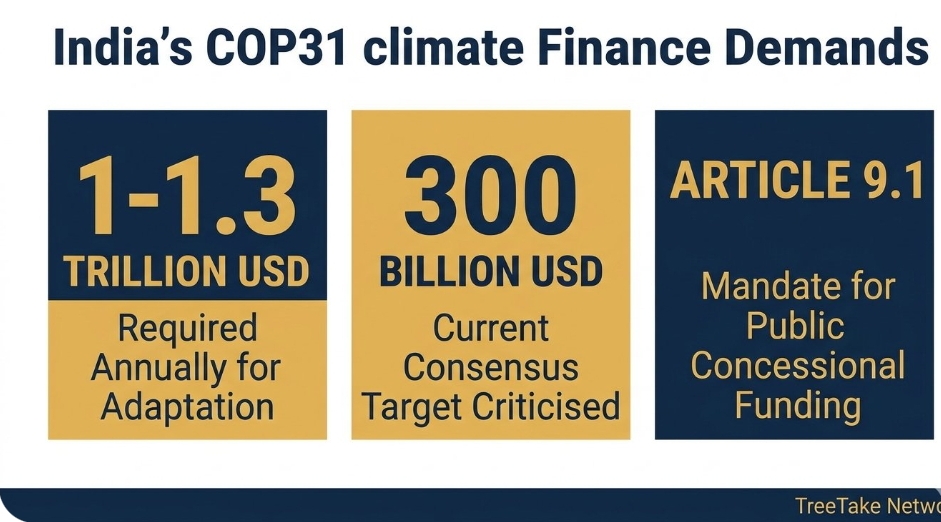
The central pillar of India's negotiating line focuses on moving international climate finance away from ad hoc pledges toward predictable, legally binding distribution mechanisms. Under Article 9.1 of the Paris Agreement, developed nations maintain an explicit obligation to provide substantial financial resources to assist developing economies with both mitigation and adaptation strategies. The minister emphasised that the current consensus target of 300 billion dollars annually by 2035 is grossly inadequate to address shifting thermal baselines, noting that developing countries collectively require between 1 trillion and 1.3 trillion dollars each year to implement long-term structural resilience frameworks.
The state position explicitly outlines that funding supplied by industrialised economies must be predominantly public and concessional in nature to prevent worsening debt distress across the Global South. Recent global data metrics reveal a worrying disparity within the existing international public finance pool, where developed countries have provided approximately 2.30 dollars in complex commercial loans for every 1 dollar issued as an outright grant. India intends to lead a coordinated push alongside the G-77 and China, the Like-Minded Developing Countries grouping, and the BASIC bloc to ensure that future climate accounting frameworks accurately differentiate between genuine public grants and interest-bearing debt instruments.
Sovereignty Concerns and Just Transition Limits
In addition to the financial demands, India's delegation will firmly oppose any attempts to introduce top-down, uniform mitigation targets that ignore localised geographical constraints or threaten domestic poverty-eradication programmes. Commenting on the voluntary presidency action agendas proposed for the summit, the environment ministry clarified that global clean technology initiatives must remain structurally separate from the formal text negotiations to protect national sovereignty. The state will maintain that an immediate, forced phase-out of fossil fuels remains entirely unfeasible, while securing stable energy access for common citizens remains the primary operational goal of the government.
Furthermore, India will champion the continuation of the Just Transition Work Programme through a party-driven, non-punitive mechanism. The minister explained that discussions surrounding the global stocktake and adaptation progress indicators must remain entirely voluntary, ensuring that a developing nation's sparse data tracking infrastructure is never utilised as a restrictive condition to block access to essential international funding pools. The complete administrative text releases, ministerial files, and coordinating group agendas can be analysed within the official gazette records of the national environment ministry.
Editor's Note
India's sharp negotiating stance ahead of the Antalya summit highlights the critical limits of global climate mandates when detached from realistic financing mechanisms. Moving forward, advanced economies must honour their historic obligations under the Paris Agreement by replacing vague loan pledges with direct, non-debt-inducing public grants, ensuring that global climate justice functions as a tangible foundation for infrastructure modernisation rather than an economic penalty on developing growth pathways.



Leave a comment