

Talking Point
TreeTake Network
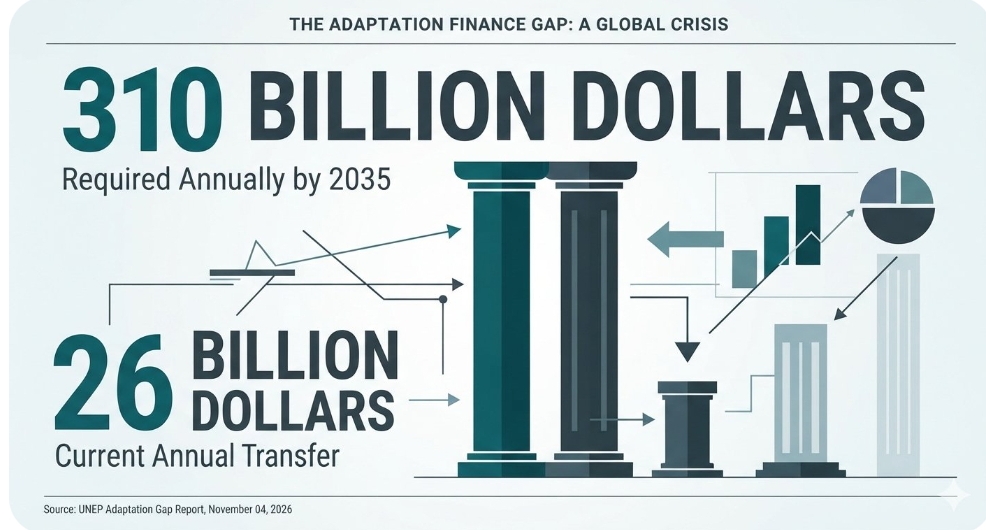
An exhaustive statutory evaluation released on November 04, 2026, by the United Nations Environment Programme reveals a staggering shortfall in the international capital allocated to shield developing states from escalating climatic volatility. The annual report emphasises that vulnerable communities are being left exposed to severe meteorological disruptions due to architectural paralysis within international finance networks. According to modelled projections, the baseline funding required for domestic defensive adjustments in developing territories is set to reach 310 billion dollars annually by 2035. However, current global financial transfers are stalling at approximately 26 billion dollars per annum, exposing a massive deficit that directly threatens millions of lives.
Analytical Breakdown of Public Resource Stratification
The structural rift between documented infrastructure requirements and liquid capital commitments expands significantly when national adaptation strategies are extrapolated. If public planners calculate the financial requests explicitly outlined within individual Nationally Determined Contributions and National Adaptation Plans, the necessary capital injections rise to approximately 365 billion dollars annually by 2035. Present allocations are meeting less than 10 per cent of these expressed demands, forcing lower-income administrative systems to rely heavily on volatile commercial lending markets or high-interest structural debt to organise essential emergency barriers.
This reliance on unfavourable credit instruments introduces a severe secondary crisis, as interest payments steadily erode domestic budgets that would otherwise stabilise public healthcare, localised agriculture, and coastal reinforcement frameworks. Observers note that while 171 sovereign states have formally instituted specific domestic adaptation protocols, actual field implementation remains severely restricted by this foundational capital block.
Institutional Perspectives on Capital Dispersal
The widening fiscal gap has provoked intense debate among global policy coordinators and economic strategists regarding accountability and international resource distribution ahead of future summit cycles. Industrialised economies frequently point out that total public climate financing structures are expanding incrementally, yet administrative delays and local execution bottlenecks inside recipient territories occasionally stall the efficient distribution of these resources.
"A yawning gap in adaptation finance for developing countries is putting lives, livelihoods and entire economies at risk," stated Inger Andersen, Executive Director of the United Nations Environment Programme, during the central briefing. She stressed that stabilising international public finance structures is no longer an act of global charity but an absolute requirement to avoid systemic global economic contagion.
Conversely, economic representatives from vulnerable zones argue that the prevailing framework relies on asymmetrical definitions of assistance. Responding to the structural analysis, Dr Salimul Huq, a senior international adviser on climate justice mechanisms, remarked that forcing vulnerable populations to absorb sovereign debt to protect themselves from systemic damage they did not create represents a profound failure of the international framework. He argued that unless global mechanisms shift rapidly from debt-bearing loans to direct grant allocations, structural stabilisation remains entirely unachievable.
Implementation Bottlenecks and Transformational Realities
Beyond the immediate fiscal friction, the assessment evaluates the physical execution of projects aimed at mitigating rising sea levels, prolonged hydrological droughts, and severe agricultural shortfalls. The institutional data demonstrates that even when nominal funds are successfully allocated, bureaucratic friction within regional agencies often prevents rapid infrastructure stabilisation.
Furthermore, global industrial representatives caution that overemphasising public finance ignores the vast, untapped capacity of private capital pools, which could be mobilised through targeted de-risking mechanisms. Many private institutions maintain that if clear regulatory guarantees and transparency metrics are established by host governments, international private investment could rapidly scale up structural grid adaptation, resilient harbour infrastructure, and advanced agricultural water management systems.
Editor's Note
The systemic financial gridlock highlighted in the report underscores the absolute necessity of transitioning away from incremental funding mechanisms toward structural transformational adaptation. Future strategies must prioritize alternative liquidity pathways, including specialized resilience bonds, formalized debt-for-adaptation swaps, and automated grant distribution systems based on real-time ecological triggers rather than prolonged political negotiations.



Leave a comment