

TreeTake Network
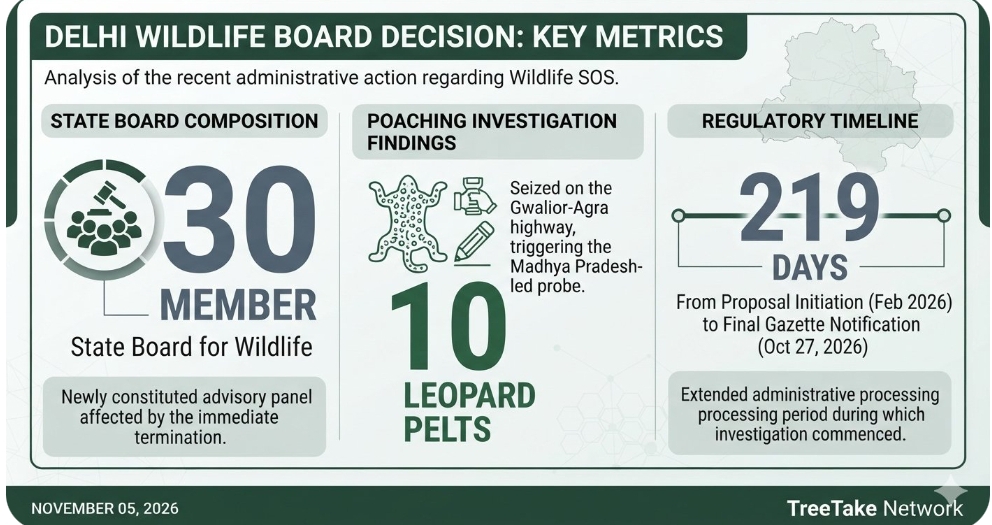
The Delhi government has announced the immediate removal of the prominent non-governmental organisation Wildlife SOS from its newly constituted State Board for Wildlife. The high-level administrative decision, confirmed by Environment and Forest Minister Sardar Manjinder Singh Sirsa, additionally terminates all existing operational associations between the conservation group and the Delhi Forest Department. The rapid intervention follows growing institutional scrutiny surrounding an extensive criminal probe led by the Madhya Pradesh State Tiger Strike Force (STSF) into an organised leopard poaching network operating within the Kuno National Park landscape.
The Reconstitution Timeline and Background Vetting Failure
The Delhi Forest Department had partnered continuously with Wildlife SOS on urban wildlife rescue and rehabilitation operations since 2018. According to internal departmental records, the formal administrative proposal to nominate a representative from the group onto the statutory advisory panel was initially moved in February 2026 and subsequently forwarded to the competent authority for final validation in July 2026. However, the official gazette notification establishing the first-ever 30-member State Board for Wildlife was only issued on October 23, 2026. This immediately sparked intense objections from independent environmental advocates who pointed out a critical failure in background vetting procedures.
The underlying wildlife crime case came to light following a major enforcement raid on July 23, during which law enforcement teams seized 10 leopard skins, animal skeletons, and illegal leg-hold traps on the Gwalior-Agra highway. The discovery led to the direct arrest of 11 suspected smugglers. A subsequent Forest Offence Report, registered on July 30, formalised allegations that the recovered skins were sourced directly from the ecologically sensitive Kuno landscape—a designated cheetah reintroduction zone. The investigation intensified after state investigators alleged that an individual on the NGO's payroll had integrated into the poaching network using a false identity, using an institutional vehicle and specialised trapping gear to facilitate the poaching of the leopards.
Ministerial Directives and Criticisms
Minister Sirsa noted that while the nomination process began earlier in 2026, the government acted immediately upon learning of the August criminal cases in Madhya Pradesh, emphasising zero compromise on wildlife protection. Henceforth, the decision to cut ties with the NGO was made on Nov 2. Activist Ajay Dubey criticised the initial appointment, arguing that involving an organisation linked to Kuno National Park poaching allegations subverts the Wildlife Protection Act, 1972.
Defence and Legal Proceedings
Wildlife SOS strongly denied all trafficking accusations, maintaining that its staff operated as undercover informers who provided the crucial intelligence leading to the seizure of the leopard skins. The CEO, Kartick Satyanarayan, complied with a Supreme Court order by undergoing 27 hours of questioning in Shivpuri. Although interim legal protection was restored by the Supreme Court, the Central Zoo Authority has ordered nationwide inspections of the group's facilities. Full legal records and case files can be reviewed through official state forest registries.
Editor's Note
The rapid dismissal highlights a critical gap in interstate background intelligence. Future statutory board appointments should require mandatory, real-time legal clearance protocols before finalising notifications.



Leave a comment