

TreeTake Network
A consortium of environmental scientists and wildlife authorities has announced the successful reintroduction of the endangered giant burrowing frogs into their native riverine environments across southeastern Australia. The large-scale conservation operation, managed collaboratively by state biodiversity specialists, marks the culmination of an intensive multi-year captive rearing programme designed to rescue the species from localised extinction. The strategic release follows severe habitat disruptions caused by intense, repeating bushfire cycles that had previously decimated the region's fragile upland creek ecosystems.
Population Recovery And Peatland Stabilisation
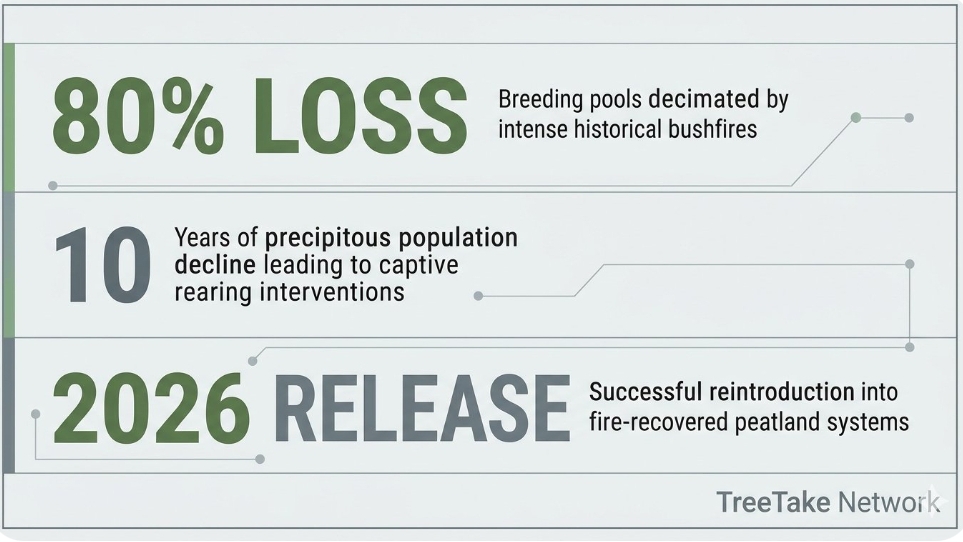
The giant burrowing frog, a highly unique and reclusive amphibian species endemic to the forested sandstone zones of New South Wales and Victoria, has faced precipitous population declines over the past 10 years. Ground surveys confirmed that the intense heat and subsequent siltation from historical bushfires had wiped out over 80 per cent of the specialised breeding pools required for tadpole development. To prevent total demographic collapse, field teams systematically collected surviving egg masses and vulnerable tadpoles from compromised streams to rear them within biosecure laboratory enclosures.
The comprehensive reintroduction project utilised advanced micro-chipping telemetry and automated acoustic tracking devices to monitor the movement patterns of the young frogs as they were systematically released back into protected wilderness zones. Biologists carefully selected release sites within remote, fire-recovered peatlands that feature complex underground burrowing networks and optimal soil moisture profiles. Field logs confirm that the newly released have immediately begun excavating shelter tunnels, demonstrating healthy wild behaviours and establishing secure territories away from active forest boundaries.
Environmental Policy Dynamics and Specialist Valuations
Dr Jennifer Anson, a senior conservation biologist leading the recovery taskforce, emphasised that the successful return of these captive-reared frogs to their natural mountain streams represents a profound victory for regional biodiversity frameworks, proving that intensive, proactive captive interventions can effectively counter the catastrophic habitat degradation caused by climate-driven wildfire emergencies.
Dr Michael Mahony, a renowned amphibian specialist, explained that the giant burrowing frog functions as a vital ecological anchor for upland creek systems, and its successful reintroduction will directly accelerate the natural recovery of sub-surface invertebrate populations while restoring essential nutrient cycling pathways within these delicate sandstone catchments.
Australian Department of Environment specialists added that the project has successfully established a blueprint for future climate-adaptive wildlife management programmes across the continent. The complete field observation logs, water chemistry baselines, and post-release survival statistics can be reviewed within the official printed records of the state ecological management agency.
Editor's Note
The successful reintroduction of the giant burrowing frog provides a critical framework for protecting vulnerable amphibians against accelerating weather extremes. Moving forward, environmental ministries must institutionalise long-term watershed protection frameworks and implement permanent fire-exclusion zones around critical breeding catchments to ensure reintroduced populations can achieve long-term evolutionary stability.



Leave a comment