

TreeTake Network
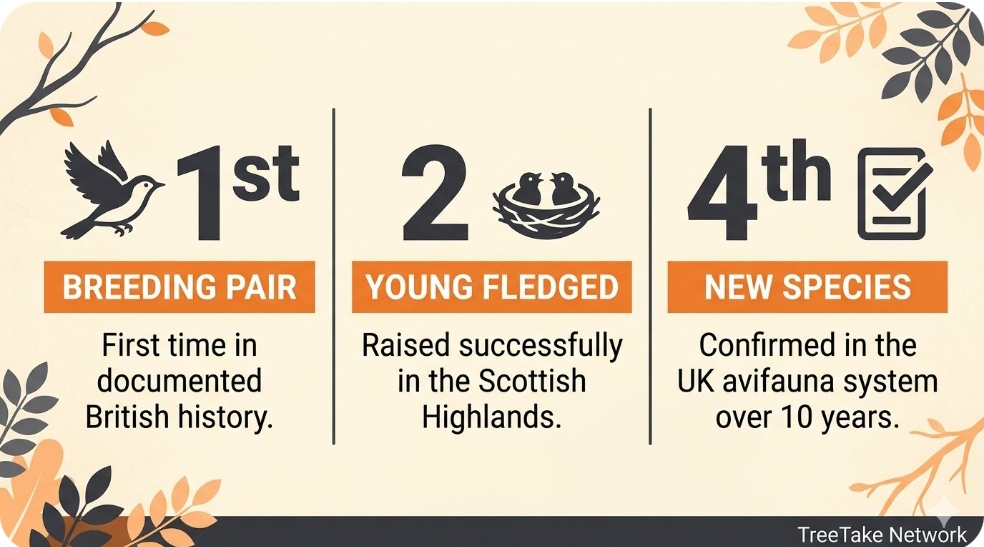
The independent Rare Breeding Birds Panel officially published its comprehensive annual monitoring report, confirming that the Blyth's reed warbler has bred successfully within the United Kingdom for the first time in documented history. The groundbreaking avian survey reveals that a single breeding pair established a secure nesting territory and successfully raised at least two young at a remote conservation site in the Highland region of Scotland. The landmark event marks the fourth entirely new confirmed native breeding bird species added to the British avifauna logging system over the past 10 years.
Westward Expansion And Avian Colonisation
Historically distributed across deep sub-arctic breeding grounds in Scandinavia, Siberia, and western Russia, the slender insectivorous warbler has been steadily expanding its ecological footprint westward through northern Europe over recent decades. Before this conclusive field confirmation, individual singing males had been reported holding temporary spring territories across various British coastal scrublands since 2000. However, field ornithologists had never previously documented a coordinated pair completing an entire reproductive cycle, building an active nest, and fledging chicks on British soil.
The extensive field logging project, completed in collaboration with the British Trust for Ornithology, notes that the arrival of the species aligns with broader shifts in regional climate corridors that are making northern and western maritime zones more hospitable. In addition to the warbler discovery, the panel recorded two territorial male red-breasted flycatchers holding specific woodland territories in north-east Scotland and the Upper Forth region, though neither successfully attracted a breeding mate. Simultaneously, the synthesis report highlighted major population expansions among established wetland specialists, with Eurasian spoonbills, western cattle egrets, and Eurasian bitterns all reaching record-breaking breeding numbers across managed sanctuaries.
Conservation Progress And Policy Insights
Rare Breeding Birds Panel Chairman Dr Mark Eaton highlighted that the first proven breeding record of the Blyth's reed warbler represents an extraordinary milestone for British ornithology, serving as a clear testament to how shifting European climate zones are actively reshaping the distribution patterns of our migratory species.
British Trust for Ornithology National Surveys Coordinator Dawn Balmer stated that while many of our long-established native species face intense ecological challenges, the natural colonisation of these northern warblers shows that our expanding Scottish wilderness networks are providing critical, functional refugia for species displaced from traditional continental breeding grounds.
Joint Nature Conservation Committee specialists added that the detailed monitoring data proves that systematic habitat protection frameworks are essential to allow colonising birds to successfully establish viable populations. The complete dataset, including individual geographical distribution tables and historical county records, can be evaluated within the official printed pages of the institutional journal publication.
Editor's Note
The arrival and successful nesting of the Blyth's reed warbler in northern Scotland provides definitive evidence of the rapid northward and westward shifts occurring within European avian populations. Moving forward, conservation bodies must expand adaptive scrubland management and landscape-scale corridor protections to accommodate these arriving climate refugees while maintaining strict, continuous field-level surveillance networks.



Leave a comment