

TreeTake Network
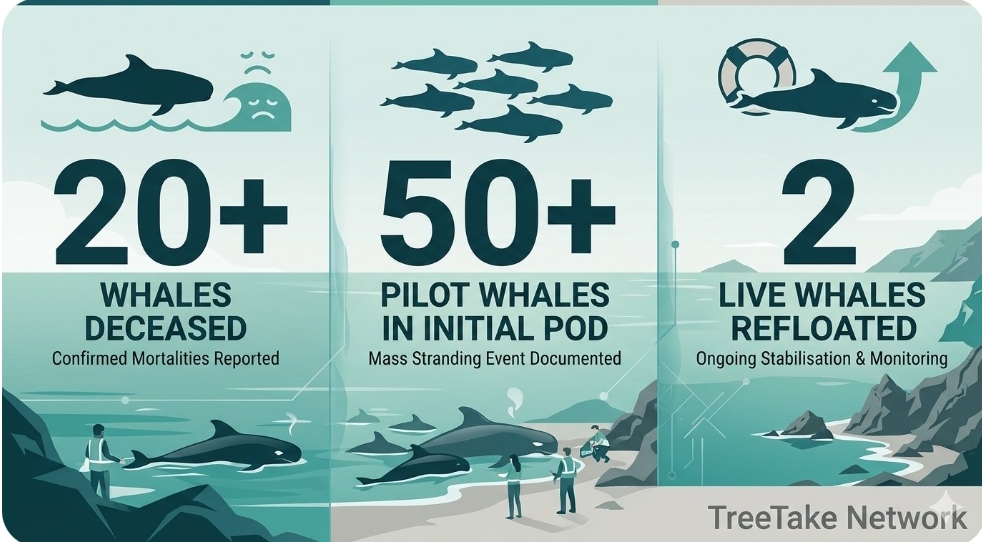
The New Zealand Department of Conservation has announced that an intensive emergency rescue deployment is actively underway along the remote North Island coastline following a massive whale stranding event. Operational field teams and local indigenous community groups have successfully refloated a small number of survivors, but authorities confirmed that at least 20 pilot whales have already perished after washing ashore overnight. The critical wildlife crisis has drawn scores of veterinary specialists and trained volunteers to the intertidal zones near Cape Palliser, the absolute southernmost point of the North Island.
Coastal Infiltration And Refloating Operations
Local residents along the Ngawi coast first discovered the massive cetacean stranding during the pre-dawn hours, notifying emergency marine networks immediately after observing the distressed mammals struggling in the shallow surf. The Department of Conservation quickly established a coordinated command post on the beach, partnering alongside the regional iwi—the local Māori tribe—and Project Jonah, a specialised non-governmental organisation that possesses extensive technical expertise in cetacean rescue protocols. Initial beach reconnaissance logs indicated that up to 50 pilot whales may have been involved in the initial stranding wave.
The highly complex physical operation is currently dictating a race against the elements, as rescue teams utilise specialised sheets, pontoon inflatables, and buckets of seawater to maintain the hydration levels of the surviving whales. Marine biologists noted that the massive weight of the stranded animals causes rapid internal organ failure and muscle degradation when they are left unsupported on open sand for extended durations. Field crews successfully refloated two healthy individuals during the initial high-tide window, while four remaining live whales are being closely stabilised in the shallows as responders wait for the next favourable tidal surge to attempt a secondary deep-water launch.
Marine Biology Insights And Environmental Factors
Project Jonah Executive Director Daren Grover explained that whale strandings are a recurring ecological phenomenon across the deep ocean trenches surrounding New Zealand, but the sudden arrival of such a large pod underscores how volatile coastal currents and potential sub-surface disorientations can quickly drive highly social marine mammals into dangerous geographical traps.
Department of Conservation Spokesperson Amanda Harvey stated that while the immediate priority rests entirely on keeping the surviving cetaceans stabilised and wet, scientific teams will systematically collect biological tissue samples from the deceased individuals to investigate underlying viral pathogens, sonar disruptions, or thermal shifts that might explain the pod's sudden inland trajectory.
Regional environmental specialists added that local maritime traffic has been restricted around the Ngawi peninsula to prevent acoustic interference while the refloated survivors attempt to navigate back out to open sea corridors. The full stranding logs, veterinary assessment charts, and tidal timeline metrics can be reviewed within the official published field reports of the national conservation ministry.
Editor's Note
The tragic mass stranding at Cape Palliser highlights the extreme vulnerability of deep-sea cetaceans to shifting coastal baselines and ocean noise pollution. Moving forward, international marine governance bodies must expand real-time acoustic monitoring arrays along known migratory routes and formalise specialised, rapid-response volunteer networks to enhance the survival rates of stranded marine megafauna during localised crisis events.



Leave a comment