

TreeTake Network
A major regulatory restructuring tabled by the Ministry of Fisheries, Animal Husbandry and Dairying has triggered a sharp division across India's scientific, ethical, and animal welfare infrastructure on November 04, 2026. The publication of the Draft Laboratory Animals Rules, 2026, aims to modernise and streamline the nation's biomedical research ecosystem by changing the historical oversight protocols managed by the Committee for Control and Supervision of Experiments on Animals. Under the newly proposed statutory framework, decentralised Institutional Animal Ethics Committees will receive autonomous powers to fast-track approvals for low- and medium-severity experiments without undergoing mandatory central vetting. While administrative planners maintain that this update removes bureaucratic bottlenecks that cripple domestic pharmaceutical innovation, a united front of veterinary specialists, non-expert public advocates, and animal lovers argues that the decentralisation strips away essential oversight and exposes millions of laboratory animals to severe institutional abuse.
Decentralisation and the Fracture of Ethical Oversight
The core structural friction within the proposed draft centres on the transfer of regulatory authority from an independent central committee to individual institutional panels. In the current framework, any facility utilising animals for scientific research must obtain explicit, centralised authorisation to ensure adherence to strict ethical baselines. The 2026 draft alters this pathway by allowing local committees, which operate inside the very universities and private pharmaceutical firms conducting the trials, to approve their own protocols.
Opposing factions argue that this self-regulatory approach introduces an immediate, insurmountable conflict of interest. Furthermore, animal lovers have expressed intense alarm over a specific provision in the draft that permits the selective acquisition of stray animals and non-purpose-bred wildlife for specific scientific justifications. Activists point out that allowing institutions to capture stray dogs or forest canids for laboratory procedures directly violates decades of domestic legal precedents, including the foundational Wildlife Protection Act of 1972 and the Prevention of Cruelty to Animals Act of 1960.
Institutional Debates and Conflicting Perspectives
The impending closure of the public commentary window on November 05, 2026, has accelerated public mobilisation, with biomedical research corporations and ethical advocacy groups presenting starkly divergent visions for the future of Indian science.
"The proposed rules represent a dangerous retrogressive step that dismantles India's established animal protection framework," stated Alokparna Sengupta, a prominent animal welfare policy specialist leading the opposition campaigns. She emphasised that delegating approval powers to internal institutional boards creates a closed-door environment where profit and academic urgency will consistently override basic humane treatment, effectively rendering the central regulatory body entirely toothless.
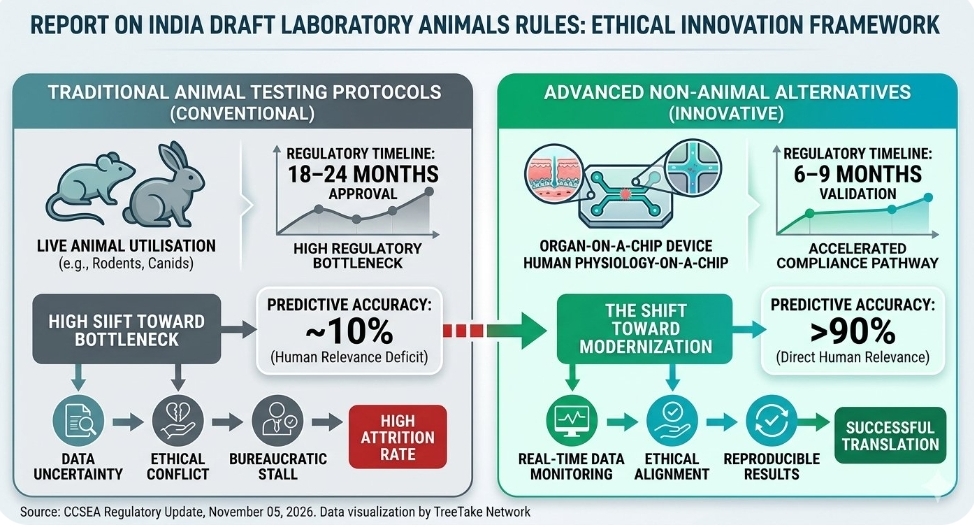
Conversely, representatives from the scientific research and manufacturing sector argue that the existing centralised system forces critical medical trials to stall for up to 24 months, driving vital biotechnology capital out of the country. Defending the legislative update, Dr Anurag Agrawal, a senior biomedical research administrator, remarked that India cannot achieve self-reliance in vaccine development or therapeutic manufacturing. At the same time, bound to a rigid, multi-layered bureaucratic clearing system. He argued that institutional committees are comprised of highly trained veterinary experts who understand local laboratory conditions far better than a remote central board, and that trusting these panels is standard practice across advanced global scientific hubs.
The Non-Expert Perspective and the Demand for Alternatives
The debate has rapidly expanded beyond academic circles to engage non-expert citizens and grassroots community networks. Local animal shelter managers and civic advocates note that vague language around procuring stray animals could inadvertently incentivise illegal trapping networks in urban areas.
"Our community spends years rehabilitating abandoned animals, and the thought of these dogs being legally diverted into laboratory cages because of an administrative loophole is horrifying," stated Gauri Puri, a grassroots shelter coordinator and community animal lover. She argued that public trust in scientific institutions will collapse entirely if stray animals are viewed as cheap raw materials for corporate research laboratories.
This emotional public consensus aligns closely with the technical evaluations of alternative testing advocates. Many progressive bioethicists maintain that instead of spending state capital to modify the logistics of animal containment, India should aggressively invest in human-relevant non-animal testing methodologies. Experts emphasise that cutting-edge technologies like three-dimensional organ-on-a-chip models, computational toxicology frameworks, and human stem-cell matrices provide significantly higher predictive accuracy for human drug reactions than traditional animal trials, which fail to replicate human physiology in over 90 per cent of cases.
Editor's Note
The escalating friction over the Draft Laboratory Animals Rules highlights the urgent need to transition from a regulatory system that merely manages animal suffering to one that actively replaces it. To preserve international scientific credibility while honouring its deep-seated ethical traditions, India must implement a binding statutory timeline that mandates a gradual phase-out of live animal trials alongside specialised financial incentives for laboratories transitioning to advanced, non-animal testing infrastructure.



Leave a comment