

TreeTake Network
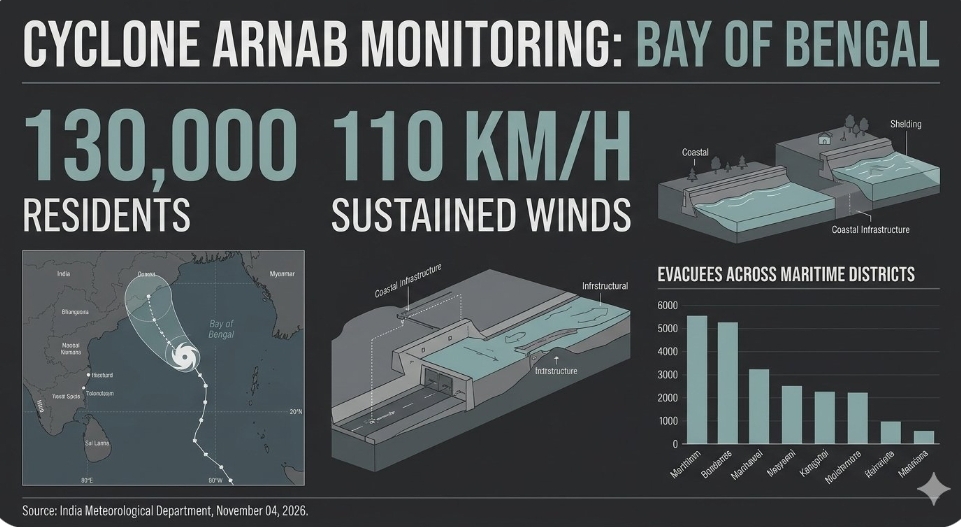
A massive atmospheric system spinning across the Bay of Bengal has intensified into a severe cyclonic storm on November 04, 2026, prompting immediate disaster response deployments across eastern India. The meteorological event, designated Cyclone Arnab, has triggered widespread tidal surges and intense precipitation patterns as it charts an aggressive north-northwesterly trajectory towards the Odisha coast. In response to high-level warning bulletins issued by central monitoring agencies, state planners have initiated a rapid regional evacuation campaign across nine vulnerable maritime districts, including Jagatsinghpur, Kendrapara, Bhadrak, and Balasore. Emergency coordination boards have already transferred more than 130000 coastal residents to reinforced concrete shelters, working continuously to clear low-lying agricultural zones before extreme hurricane-force winds arrive.
Structural Contingencies and Regional Infrastructure Shielding
The rapid acceleration of the cyclone presents a severe test for the coastal resilience networks built across the region over the last three decades. Meteorological models show that Cyclone Arnab is packing sustained surface wind speeds of up to 110 kilometres per hour, with peak gusting velocities breaching 130 kilometres per hour near the eye of the system. This severe kinetic energy is generating destructive storm surges capable of breaching defensive coastal dykes and driving saline water up to three kilometres inland into low-lying delta communities.
To minimise catastrophic damage to public utilities, electricity distribution boards have executed precautionary power shutdowns across vulnerable grids, while telecommunication firms are tracking mobile tower integrity to maintain emergency lines. The state has mobilised 24 active teams from the National Disaster Response Force alongside 35 local units to spearhead structural rescue operations, clear fallen trees, and distribute dry food rations. Simultaneously, marine police squads have implemented a total ban on all commercial fishing operations, forcing hundreds of deep-sea trawlers to seek immediate shelter across regional ports.
Administrative Briefings and Safety Protocols
The closing window for safe evacuation has provoked urgent coordination meetings between regional ministers, relief commissioners, and meteorological agencies to secure community adherence to safety protocols.
"We are tracking this system with absolute precision, and our primary objective is to secure a zero-casualty outcome across all affected zones," stated Dr Mrutyunjay Mohapatra, Director General of the India Meteorological Department, during a live national brief. He emphasised that the outer cloud bands are already causing extreme downpours that could trigger localised flash flooding and severe mudslides, urging citizens residing in mud houses or thatch structures to cooperate immediately with local evacuation officers without any delay.
This call for immediate action is being reinforced on the ground by regional administrative authorities who are managing the massive influx of displaced populations into multi-purpose shelters. Commenting on the operational challenges, Pradeep Kumar Jena, a senior state disaster management adviser, remarked that moving over a lakh of people within 24 hours requires a flawless logistical chain. He explained that emergency personnel are focusing intense efforts on vulnerable groups, ensuring that specialised medical units, infant food supplies, and separate facilities for pregnant women are fully operational across all designated shelters. He warned that if individuals choose to stay behind to guard material property or livestock, local rescue operations will become exceptionally hazardous once the core landfall process begins.
Environmental Degradation and Coastal Vulnerability
Beyond the immediate threat to human settlements, conservation scientists are monitoring the potential ecological fallout of the cyclone on sensitive maritime ecosystems. The projected landfall path cuts directly through the fragile mangrove ecosystems of Bhitarkanika National Park, which serves as a vital natural shield absorbing tidal energy.
Biologists note that while mature mangrove structures are highly adapted to withstand severe weather, the increasing frequency of intense tropical storms prevents young saplings from establishing stable root configurations. Furthermore, the combination of high-velocity winds and severe seawater inundation threatens to destroy extensive nesting sites of the endangered Olive Ridley sea turtles along the Gahirmatha marine sanctuary, emphasising the complex multi-tiered environmental vulnerabilities introduced by escalating global climatic shifts.
Editor's Note
The aggressive intensification of Cyclone Arnab underscores the vital importance of shifting from reactive emergency evacuations to long-term structural climate adaptation along vulnerable maritime borders. Future state planning must invest heavily in expanding biosubstitutes like dense mangrove corridors, constructing elevated community settlements, and establishing automated real-time early warning networks to insulate coastal economies from the intensifying rhythms of tropical cyclonic activity.



Leave a comment