

Talking Point
TreeTake Network
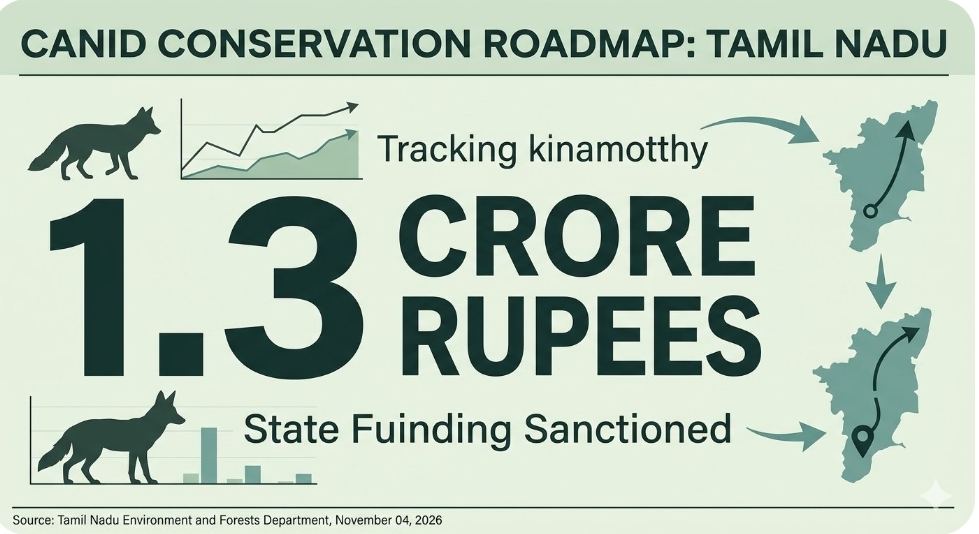
An official biodiversity administrative sanction issued on November 04, 2026, by the Tamil Nadu state government has released 1.3 crore rupees to establish an intensive, long-term conservation roadmap for two increasingly vulnerable canid species. The strategic intervention targets the elusive Bengal fox and the golden jackal, both of which serve as foundational meso-predators and environmental scavengers across the rapidly changing southern landscapes. According to field reports from wildlife monitoring units, the financial resources will fund comprehensive tracking assessments to identify current anthropogenic threats, territory usage, and shifting distribution patterns. Forestry officials emphasise that stabilising these carnivores is a matter of critical ecological urgency, as their dramatic population decline over the last three decades threatens to destabilise local agricultural food webs and rodent control mechanisms.
Analytical Assessment of Scrub Forest Fragmentation
Preliminary surveys orchestrated by the Advanced Institute for Wildlife Conservation in Chennai confirm that these adaptable canids have entirely disappeared from multiple historical ranges due to unchecked rural infrastructure development. Field researchers categorise both the Bengal fox and the golden jackal as edge species, meaning they live on the sensitive ecotones between dense state reserves and human agricultural zones. As aggressive rural expansion clears protective scrublands and native thorn thickets, these carnivores are systematically driven into direct conflict with domestic livestock and human communities.
The historical data highlights a shocking regulatory shift in species status. When the foundational Wildlife Protection Act was originally enacted in 1972, both the Bengal fox and the golden jackal were categorised under the vermin classification, leaving them entirely exposed to uncontrolled culling and trapping. Today, their extreme population contraction has forced central planners to accord them the highest possible legal protection under Schedule I of the amended statutes. Despite this statutory safety net, field personnel note that without organised capital injections to restore physical wildlife corridors across fragmented districts, legal decrees remain functionally ineffective at halting localised extinctions.
Forestry Administrative Coordination and Local Strategic Outreach
Managing carnivores that reside permanently outside formal sanctuary boundaries requires an unprecedented level of inter-departmental cooperation. Because these animals constantly navigate agricultural fields, waste management clusters, and village fringes, the state deployment must bridge standard forestry policing with direct local community participation.
"The conservation of these lesser-known species requires a profound paradigm shift in how we manage non-protected forestry lands," stated a senior administrative official from the Tamil Nadu Environment and Forests Department during the programmatic review. The official stressed that protecting large charismatic mammals like elephants or tigers is insufficient if the foundational grassland scavengers that regulate lower-tier ecosystems are permitted to quietly vanish.
This view is heavily supported by regional conservationists who specialize in human-wildlife friction points across southern India. Commenting on the administrative sanction, Dr S. Bharathidhasan, a veteran ecologist tracking open-canopy ecosystems, remarked that edge species are the ultimate indicators of rural landscape health. He explained that when fox and jackal populations collapse, rodent populations inevitably surge, forcing farmers to utilise hazardous chemical pesticides that further poisons the local trophic layers. He argued that the newly sanctioned capital must be channelled into creating community-managed buffer zones where local farmers actively participate in habitat preservation rather than viewing these small predators as an immediate threat to poultry or livestock.
Regional Operational Deployments and Future Population Tracking
The finalised conservation framework will focus its physical field operations across five distinct administrative districts where remnant breeding pockets have been verified, including Dharmapuri, Tiruvannamalai, Salem, Villupuram, and Madurai. Field teams will utilise advanced digital camera traps, non-invasive genetic scat analysis, and community-led sighting networks to map the precise boundaries of surviving packs.
Simultaneously, the state intends to expand localised educational networks, drawing inspiration from successful specialised volunteer models like the active student ambassador programs running in the southern Tenkasi forest division. By establishing rural youth monitoring blocks, the department aims to drastically minimise retaliatory poisoning, illegal snaring, and vehicular road accidents, which currently stand as the primary drivers of canid mortality along major state transit corridors.
Editor's Note
The targeted financial mobilization by the state administration marks a vital step toward a more holistic, non-mammal-centric wildlife preservation policy. To secure true environmental stabilisation, future state allocation frameworks must move beyond reactive species-specific grants and instead pioneer generalised open-ecosystem infrastructure protections that treat scrub forests, rocky hillocks, and semi-arid grasslands as highly valuable ecological repositories rather than unproductive waste areas.



Leave a comment