

TreeTake Network
An ambitious legislative overhaul tabled in Parliament on November 04, 2026, aims to fundamentally restructure how Southeast Asian administrative systems penalise offshore ecological destruction. The newly introduced Transboundary Haze Pollution Amendment Bill seeks to extend legal accountability beyond immediate landholders to target multinational commercial supply chains, financial institutions, and agricultural trading blocks that profit from unsustainable land-clearing practices. Under the proposed statutory framework, corporations operating within global markets can face severe corporate bans and criminal prosecution if their capital investments are linked to active peatland burning or illegal deforestation. Environmental regulators emphasise that this systemic shift is necessary to break the persistent cycle of seasonal atmospheric pollution that regularly disrupts public health and regional transit networks across the region.
Structural Realities of Agro-Industrial Accountability
The statutory modification addresses a critical historical limitation within the original 2014 legislation, which focused primarily on identifying the specific geographic coordinates of active forest fires. Legal specialists note that proving direct physical culpability for open burning across distant island territories remains exceptionally difficult due to complex corporate subsidiary webs and opaque land tenure maps. By transitioning the evidentiary threshold to track systemic supply chain links and corporate procurement trails, the amendment allows prosecution based on a company's purchase of unsustainably harvested palm oil, pulp, or timber products.
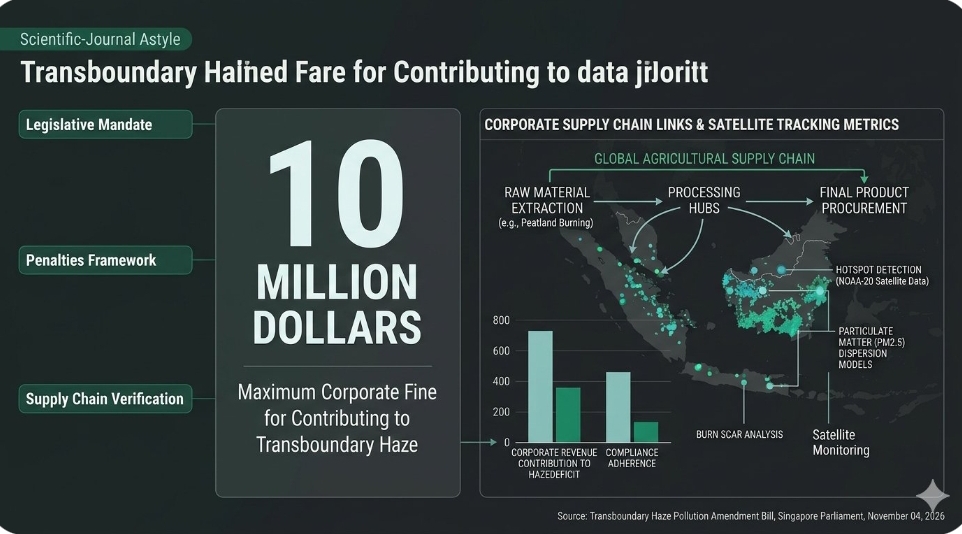
Financial penalties under the revised framework are set to rise exponentially. Corporations found guilty of contributing to transboundary air pollution face maximum fines of up to 10 million dollars, or an amount equivalent to 10 per cent of their global annual revenue, whichever figure is higher. Furthermore, directors and senior executives of non-compliant firms could face mandatory custodial sentences of up to five years, marking an unprecedented escalatory step in statutory environmental enforcement across Asia.
Regional Diplomatic Perspectives and Economic Consensus
The sweeping domestic expansion of extraterritorial jurisdiction has ignited significant debate among trade representatives and regional development economists regarding national sovereignty and market friction. While urban centres strongly support stricter enforcement, agricultural export bodies in neighbouring production zones argue that unilateral supply chain bans could inadvertently penalise vulnerable smallholder farming networks.
"We must shut down the economic incentives that make regional land-burning profitable for global enterprises," stated a senior statutory officer from the Ministry of Sustainability and the Environment during the parliamentary debate. The official emphasised that traditional diplomatic agreements are no longer sufficient to protect public health when massive corporate entities can easily shield themselves behind complex corporate layers.
This perspective is carefully balanced by regional industrial trade strategists who caution against sudden regulatory shocks. Commenting on the legislative draft, Dr K. Raghunathan, an international trade economist specialising in ASEAN agricultural supply chains, remarked that while targeting corporate backers is a progressive step, regulators must establish clear compliance periods. He explained that if the legal definitions are applied too aggressively without robust digital traceability tools, smaller local suppliers who lack advanced auditing frameworks could be completely cut off from formal trade channels, potentially driving the trade into unregulated black markets that completely ignore environmental standards.
Supply Chain Traceability Frameworks and Tech Integration
To ensure the new legal parameters remain enforceable, the state intends to deploy a multi-layered verification network integrating real-time satellite telemetry, blockchain-verified bills of lading, and local forensic pulp sampling. By utilising advanced machine learning algorithms to match sudden atmospheric particulate surges with specific corporate estate concessions, investigators can rapidly build legally defensible prosecution portfolios.
Additionally, financial entities operating within regional banking hubs will be legally mandated to implement rigorous environmental due diligence protocols. Banks will be required to audit their corporate lending portfolios annually, ensuring that no liquid capital or credit facility is actively utilising supply lines linked to burning or uncertified land conversion practices.
Editor's Note
The proposed legislative amendments represent a pioneering attempt to leverage domestic market access as a mechanism for international ecological governance. To ensure permanent regional atmospheric stabilisation, future policy frameworks must move beyond reactive litigation and focus on establishing a unified regional traceability ledger that standardises sustainable supply chain definitions across all neighbouring production landscapes.



Leave a comment