

TreeTake Network
A comprehensive environmental risk assessment compiled by a joint consortium of regional oceanographers and coastal ecology research groups reveals that the Sundarbans mangrove forest has formally reached an existential tipping point. The study documents that the velocity of absolute sea-level rise within the Bay of Bengal corridor has decisively overtaken the natural sediment accumulation rates necessary to sustain the delicate estuarine delta, threatening to collapse the world's largest contiguous mangrove habitat.
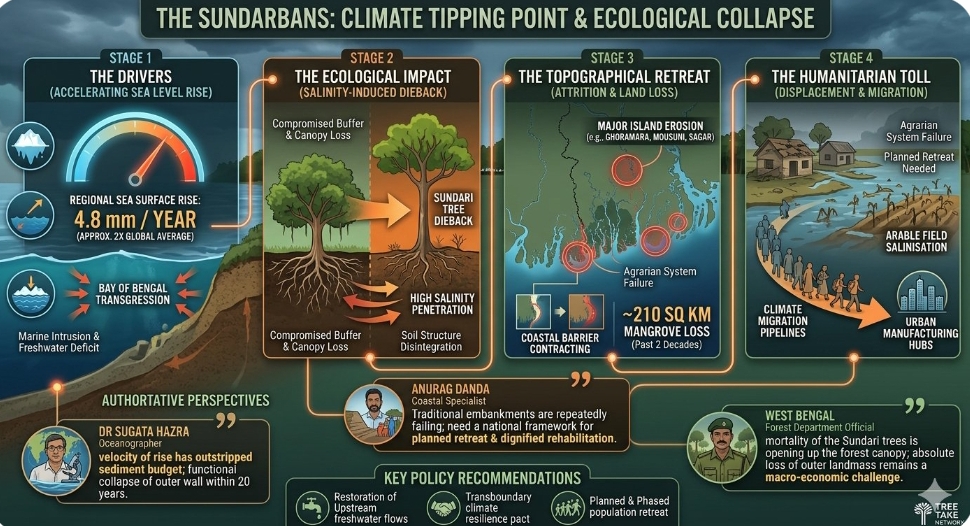
Data gathered from tide gauge networks and satellite altimetry across the deltaic ecosystem indicate that the regional sea surface is rising at a rate of 4.8 millimetres per year—nearly double the global average. This accelerating marine intrusion, coupled with an operational deficit in freshwater discharges from upstream river networks, has drastically heightened soil and water salinity levels across both the Indian and Bangladeshi sectors. The resulting ecological shifts are systematically inducing widespread "dieback" phenomena among the dominant Heritiera fomes (Sundari) tree species, permanently compromising the structural integrity of the deltaic buffer that shields millions of inland residents from catastrophic cyclonic surges.
Topographical Attrition and Agrarian Displacement
The continuous inundation of low-lying island clusters has triggered severe mudflat erosion and critical land loss across outer barrier formations like Ghoramara and Mousuni islands. Local forest divisions report that over 210 square kilometres of mangrove fringe have been lost to the sea over the last two decades, causing the legal boundaries of the Sundarbans Biosphere Reserve to rapidly contract.
This coastal retreat directly impacts the region's human population. The sustained penetration of high-salinity tidal currents into interior agricultural channels has permanently ruined thousands of hectares of arable paddy fields, destroying the baseline economic foundations of the local population. With traditional agrarian and sub-tidal fishing systems rapidly failing, the region is experiencing a massive demographic exodus, forcing tens of thousands of displaced individuals into long-term climate migration pipelines toward urban manufacturing hubs.
Scientific Warnings and Community Perspectives
Regional scientific bodies stress that the modern degradation of the delta stems from a combination of global carbon emissions and localised river diversion infrastructure. Dr Sugata Hazra, a professor at the School of Oceanographic Studies at Jadavpur University, issued an urgent warning regarding the structural survival parameters of the mangrove system:
"The Sundarbans delta is losing its capacity to adapt to the sheer pace of climate-induced marine transgression. Our data confirms that the rate of relative sea-level rise is completely outstripping the delta's sediment budget. Without a coordinated transboundary mechanism to dramatically increase freshwater supply from upstream systems, we will witness the progressive fragmentation and functional collapse of the outer mangrove protective wall within the next two decades."
Concurrently, local conservation organisations operating on the ground highlight the severe socioeconomic vulnerabilities building up within the island communities. Anurag Danda, a senior coastal management specialist and Director of the Sundarbans Landscape Programme, emphasised the limitations of existing adaptation strategies:
"We are witnessing the emergence of India's first large-scale climate refugee crisis in the outer islands of the Sundarbans. Traditional embankments are repeatedly failing because the structural baseline of the soil is disintegrating under continuous saltwater saturation. Pushing for simple afforestation programmes is no longer enough when the underlying topography is physically sinking beneath the high-tide line; we need an immediate national framework for planned retreat and dignified rehabilitation."
The local administrative bodies tasked with implementing daily conservation measures voice deep frustration over the lack of long-term financial allocations. Highlighting the field reality of forest protection divisions, an official from the West Bengal Forest Department confirmed the limits of current operational capacities:
"Our frontline guard outposts are facing extreme logistical challenges as high-tide boundaries creep further into the interior core zones each season. The rapid mortality of the Sundari trees is opening up the forest canopy, which fundamentally alters the microclimate and accelerates soil erosion along the creeks. While we are actively expanding mangrove plantation drives on inner mudflats, the absolute loss of outer barrier landmass remains a challenge that requires macro-economic intervention."
Editor's Note
The structural crisis unfolding across the Sundarbans ecosystem highlights the severe limitations of purely defensive climate adaptation. For decades, environmental planning has relied on building physical earthen embankments and conducting localised plantation drives, treating the delta as a static geographic entity. The accelerating sea-level dynamics prove that the Sundarbans is undergoing a permanent, systemic regime shift. The way forward requires moving past reactionary crisis management toward a legally binding, transboundary climate resilience pact between India and Bangladesh. This strategy must prioritise the restoration of upstream freshwater flows to combat salinity, alongside executing a state-backed framework for planned, phased retreat for the most vulnerable island populations. If the international community fails to finance the stabilisation of this natural barrier, the destruction of the mangrove shield will leave the entire industrial corridor of the upper Bay of Bengal completely exposed to the unchecked fury of the changing climate.



Leave a comment