

TreeTake Network
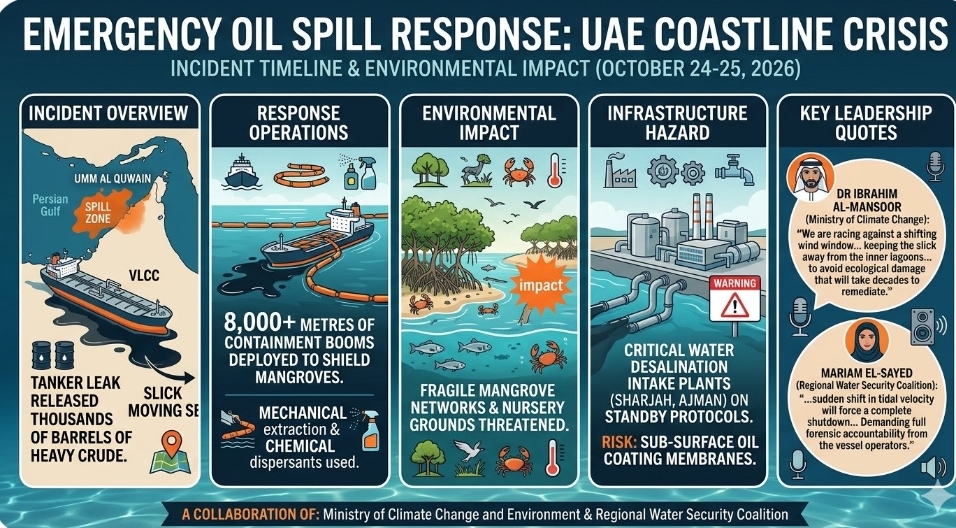
A massive maritime containment operation has been deployed off the coast of Umm Al Quwain following a major oil leak from a Very Large Crude Carrier (VLCC) vessel on October 24, 2026. The incident has triggered an ecological emergency across the northern emirates of the United Arab Emirates (UAE). The spill has released thousands of barrels of heavy crude into the Persian Gulf, threatening fragile mangrove networks and forcing critical municipal water desalination plants into emergency standby protocols.
Critical infrastructure and ecosystems under immediate threat
The slick, which currently spans an estimated 14 kilometres in length, is moving south-east due to strong seasonal surface currents. Federal environmental authorities have mobilised rapid-response skimmer vessels and deployed over 8,000 metres of floating containment booms to shield the highly sensitive biological reserves of the Umm Al Quwain mangroves. These coastal wetlands serve as an indispensable nursery ground for local marine life and act as a primary sanctuary for migratory waterfowl.
The primary infrastructure hazard is centred around the high-capacity water desalination intake facilities located in the neighbouring emirates of Sharjah and Ajman. Because these plants provide the vast majority of municipal drinking water for the region, the arrival of subsurface oil particulates could coat the delicate intake membranes, causing catastrophic mechanical damage and severe supply disruptions.
Response teams clash over industrial accountability
During an emergency operational briefing at the port office on the morning of October 25, 2026, federal engineers and environmental scientists finalised plans to intercept the primary body of the slick before it breaches shallow coastal waters. Technical teams are utilising advanced chemical dispersants alongside mechanical extraction techniques to break up the dense patches of floating crude.
Dr Ibrahim Al-Mansoor, Director of Marine Environmental Protection at the Ministry of Climate Change and Environment, stated at the briefing: "We are racing against a shifting wind window. The oil has already impacted several shallow sandbanks, and our immediate priority is keeping the slick away from the inner lagoons. If the crude breaches the primary mangrove barrier, the toxic residue will settle into the mudflats, causing ecological damage that will take decades to remediate."
Expressing grave concern for the infrastructure network, Mariam El-Sayed, Chief Operations Officer at the Regional Water Security Coalition, remarked: "We have placed the intakes at Ajman on emergency recirculating mode. The physical booms are holding for now, but a sudden shift in tidal velocity will force a complete shutdown of the desalination pipeline. We are demanding full forensic accountability from the vessel operators for this structural failure."
Editor's Note
The UAE oil spill highlights the extreme vulnerability of critical coastal infrastructure and fragile marine habitats to industrial shipping accidents. Regulatory bodies must enforce stricter deep-water maintenance mandates and expand automatic exclusion zones around vital desalination plants to prevent future ecological crises.



Leave a comment