

Arunima SenGupta
The preservation of the bearded vulture depends on a highly coordinated, transnational tree-like network that links global policy with grassroots field operations. At the root level, global policy and science bodies establish survival protocols, track global population datasets, and enforce international chemical bans. Moving down to the regional management level, prominent conservation foundations translate these global guidelines into active, localised intervention plans while directly overseeing funding and regional captive breeding programs. At the structural breeding level, a dedicated network of specialised facilities manages precise genetic pairings to maintain vital biological diversity across continents. Finally, at the local execution level, grassroots field teams work directly on the ground to deploy young birds into the wild, manage isolated feeding zones, run anti-poaching squads, and insulate dangerous high-altitude power grids.
The Marvel of the Rock-Eaters
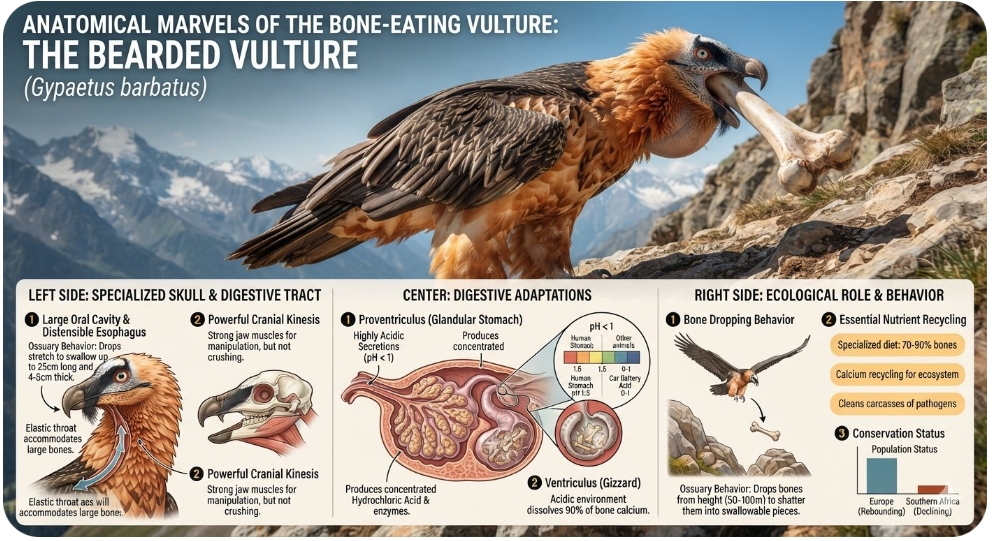
Nature operates through a series of breathtaking marvels, but few are as fascinating as the evolutionary theatre of the bearded vulture. In an astonishing display of avian intelligence and physical adaptation, this creature functions effectively as a rock-eater, soaring high into the alpine skies with massive mammalian skeletons before hurling them downward onto designated stone sheets. These specialised rocky plateaus, known as ossuaries, shatter the dense bones into swallowable fragments, allowing the raptor to feast on a substance that would destroy any other living creature. By transforming solid bone into sustenance, this magnificent bird occupies one of the most extreme and vital ecological niches on Earth, though it is a lifestyle that human activity has severely threatened.
An Evolutionary Masterpiece at Risk
Reaching an impressive wingspan of 2.5 to 3 metres and weighing up to 7 kilograms, this historically renowned lammergeier is the only living vertebrate whose diet consists almost entirely of bones. Over the past two centuries, however, this highly specialised lifestyle has transformed from a masterful evolutionary advantage into a profound vulnerability. The global history of the bearded vulture is a stark narrative of human-driven decimation, shifting from widespread abundance across Eurasia and Africa to localised extinctions, followed by some of the most intensive, long-term conservation triumphs and failures in modern ornithology.
The Strongholds of the Mountain Scavenger
Geographically, the bearded vulture is an obligate mountain dweller, traditionally distributed across high-altitude crags, canyons, and alpine meadows. Its historical and current range spans the major mountain systems of the Old World, including the Pyrenees, the Alps, the Caucasus, the Himalayas, the Tibetan Plateau, and the rugged highlands of East and Southern Africa. They are uniquely adapted to these environments; their highly acidic stomach juices allow them to completely dissolve and digest solid bone within 24 hours. When encountering bones too large to swallow whole, their sophisticated dropping behaviour from heights of 50 to 100 metres ensures no skeletal resource goes to waste.
A History of Unrelenting Persecution
The decline of the species began systematically in the 19th and early 20th centuries, driven by deep-seated human prejudice and erroneous folklore. Accused of being a lamb-carrier that stole livestock and even human infants, the bearded vulture was relentlessly hunted, poisoned, and collected. In the European Alps, the species was entirely extirpated, with the last recorded individual shot in Italy's Aosta Valley in 1913. By the mid-20th century, populations across the Mediterranean Basin, Southeastern Europe, and parts of Asia had fragmented drastically. A seminal long-term population study tracking global raptor dynamics confirmed that by the 1970s, the species had disappeared from over 80% of its historical European range, leaving isolated, highly vulnerable pockets in the Pyrenees and the Balkans.
The Modern Gauntlet of Anthropogenic Threats
In the modern era, the threats facing the bone-eating vulture have evolved from direct persecution to complex anthropogenic hazards. The single greatest driver of contemporary decline is secondary poisoning. Vultures inadvertently ingest lethal doses of veterinary pharmaceuticals left in livestock carcasses, alongside banned agricultural poisons used illegally by farmers to target mammalian predators. Furthermore, the rapid expansion of clean energy and communications infrastructure in mountainous zones has introduced a deadly modern peril: collisions. Due to their immense size and reliance on thermal wind currents, bearded vultures possess limited manoeuvrability, leading to high mortality rates from collisions with high-voltage power lines and wind turbine blades. Compounding these threats is the species' incredibly slow reproductive rate; they reach sexual maturity only at 5 to 7 years of age and typically rear just one chick per breeding cycle, meaning adult mortality severely impacts population sustainability.
Warnings from the Scientific Frontier
The critical nature of these threats has drawn urgent warnings from global conservation authorities. Highlighting the severe impact of secondary poisoning, Dr Richard Cuthbert, a prominent vulture conservation expert, noted during an international raptor assessment that the loss of these apex scavengers creates a catastrophic gap in the ecosystem, as they are nature's ultimate clean-up crew, disposing of skeletal remains that would otherwise linger for decades and potentially harbour pathogenic diseases. Similarly, assessing the modern infrastructural landscape, wildlife biologist Dr Sonja Krüger, who has spent decades studying African populations, warned that the sheer scale of infrastructure development in high-altitude zones acts as an invisible wall, fragmenting habitats and causing unsustainable mortality rates among breeding adults.
The Intervention Blueprint for Salvation
Despite these formidable challenges, the international scientific community has proven that the bearded vulture can be saved through rigorous, collaborative intervention methodologies. The primary blueprint for their salvation relies on a highly coordinated mix of captive breeding, genetic management, and habitat remediation. International monitoring networks manage a complex breeding programme that operates across a vast web of zoos and specialised centres. Captive-bred chicks are reintroduced using the hacking method, which involves placing young, non-flighted birds in artificial nests on cliff faces where they adapt to the wild while being fed remotely to ensure they do not imprint on humans. Additionally, conservationists establish vulture restaurants, which are monitored, safe feeding stations supplied with toxin-free livestock bones to buffer young birds against secondary poisoning during their critical juvenile dispersal phases.
Reclaiming the European Skies
This methodology has yielded a historic, multi-decade conservation triumph in Western Europe. Beginning in 1986, the first captive-bred bearded vultures were released into the Austrian Alps, followed by reintroduction programs in France, Italy, and Switzerland. According to census data, this sustained effort has successfully established a self-sustaining Alpine population boasting approximately 60 to 70 breeding pairs and a total population exceeding 300 individuals. When combined with the robust wild population in the Pyrenees—which holds over 1,000 individuals—Europe has become a global beacon of hope for the species. Reflecting on this remarkable achievement, Dr José Tavares, Director of the Vulture Conservation Foundation, stated that the return of the bearded vulture to the Alps is one of the greatest triumphs of European wildlife conservation, demonstrating that with long-term political will, rigorous science, and transnational cooperation, we can reverse local extinctions.
Fighting Inbreeding with Genetic Tracking
To sustain this European success, scientists rely heavily on state-of-the-art genetic health tracking to prevent the hidden danger of inbreeding depression. Because the entire reintroduced Alpine population stems from a limited pool of captive founders, maintaining genetic diversity is vital for their long-term survival. Conservation geneticists map the DNA of every chick hatched within the captive network and track wild-born fledglings via blood samples collected during field ringing. By building a comprehensive digital pedigree, breeding managers strategically pair individuals across facilities and select specific release sites to inject fresh genetic lineages into isolated wild clusters. This rigorous molecular tracking ensures that the expanding population possesses the immune system resilience and evolutionary adaptability required to withstand future environmental pressures.
The African Crisis and Imminent Extinction
In stark contrast to the managed recovery in Europe, the present global status of the bearded vulture remains highly precarious, classified as Near Threatened on the IUCN Red List, with a total global population estimated between 6,700 and 10,000 individuals. While populations in the Himalayas and the Tibetan Plateau remain relatively stable due to vast, inaccessible terrain, the situation in Southern Africa has reached a critical tipping point. In the Maloti-Drakensberg mountains of Lesotho and South Africa, the regional population has plummeted to fewer than 400 individuals and roughly 100 breeding pairs. Driven by targeted poisoning by poachers—who fear circling vultures will reveal illegal activities—and traditional medicine harvesting, the African population faces imminent localised extinction. Captive breeding initiatives are now racing against time to replicate the European model before the lineage disappears entirely from the African continent.
Law Enforcement on the Frontlines
To combat this aggressive crisis in Southern Africa, local law enforcement agencies and conservation units have fundamentally shifted their tactical approach toward illegal wildlife poisoning. Specialised anti-poaching squads and wildlife rangers are being deployed with canine units trained specifically to detect deadly chemical residues before they can decimate local flocks. Law enforcement frameworks have expanded to treat carcass poisoning not merely as poaching, but as severe environmental crimes, implementing stricter criminal sentences for individuals distributing toxic baits. Concurrently, undercover investigators target the illicit trade networks that supply these poisons, working alongside community educational programs to turn local human populations into frontline guardians who report poisoning incidents before scavenging raptors arrive at a kill site.
The Himalayan Sanctuary of India
A significant and stable portion of the global bearded vulture population is found in India, where the species is primarily restricted to the high-altitude, rugged terrains of the Himalayan region. Classified as Near Threatened within the country, it shares its home with eight other vulture species, four of which are critically endangered. While the bearded vulture in the Indian Himalayas is somewhat buffered against the rapid population crashes seen in lowland species—owing to its unique diet of bone marrow rather than soft meat tissue—it remains deeply vulnerable to the structural threats of habitat degradation, localised poison baits, and the encroaching high-voltage infrastructure sweeping across mountain passes. Occasionally, intense weather systems and juvenile exploration cause individual birds to drift far from their mountain fortresses, resulting in extremely rare vagrant sightings in the arid plains of Rajasthan and Gujarat.
India's Strategic Action Plan
Recognising these mounting pressures, the Government of India has initiated robust measures under a comprehensive Vulture Action Plan to safeguard these critical avian scavengers. Central to this plan is the absolute prohibition of veterinary Non-Steroidal Anti-Inflammatory Drugs like Diclofenac, Aceclofenac, and Ketoprofen, which trigger fatal kidney failure in vultures that feed on treated livestock. Furthermore, India has pioneered the creation of expansive Vulture Safe Zones extending across a 100-kilometre radius around core habitats, ensuring that domestic livestock carcasses left in these regions are entirely free of toxic pharmaceuticals. Combined with the operations of dedicated conservation breeding facilities, such as the Jatayu Conservation Breeding Centre, and the establishment of local vulture restaurants, India is actively working to fortify its northern mountain walls so that the ancient rhythm of the bone-eaters remains unbroken.
Voices from the Indian Conservation Front
The deployment of these structural frameworks across the subcontinent has driven specialised insights from Indian authorities. Evaluating the sheer gravity of losing these scavengers, Dr Vibhu Prakash, a leading raptor authority and former deputy director at the Bombay Natural History Society, explained that since the region has lost more than ninety-nine per cent of its core vulture baseline, each individual surviving bird is critically important. He noted that beyond direct chemical threats, birds face secondary modern perils including collisions with high-altitude power lines, electrocution, and developmental encroachment, making specialised rescue networks and intensive regional management plans absolute requirements. Emphasising the operational urgency of enforcing national mandates, former Director General of the Ministry of Environment, Forest and Climate Change, Soumitra Dasgupta, commented that vultures are a deeply important part of the region's natural heritage. He remarked that modern frameworks must explicitly incorporate stringent scientific updates, prioritising the structural expansion of Vulture Safe Zones and continuous field monitoring to actively address and neutralise evolving threats across the landscape.
The Toxicological Science of Avian Renal Failure
Understanding the molecular reasons why specific Non-Steroidal Anti-Inflammatory Drugs are so catastrophically toxic to vultures is a crucial cornerstone of global protection plans. When a vulture consumes livestock tissue contaminated with trace amounts of drugs like Diclofenac, the compound disrupts the bird's internal metabolic pathways by aggressively inhibiting crucial enzymes. This disruption leads to an immediate drop in blood flow to the kidneys, preventing the organs from processing metabolic waste and forcing a rapid accumulation of uric acid within the bird's bloodstream. The bird quickly succumbs to acute renal failure, causing an internal phenomenon known as visceral gout, where chalky white crystals precipitate across internal organs, resulting in death within forty-eight hours of exposure to a single contaminated skeleton.
Radar Technology and Wind Farm Safety
To actively neutralise the deadly modern threat of infrastructure collisions in wind-energy sectors, conservation networks are integrating automated radar systems paired with high-definition cameras on high-altitude ridges. These stereoscopic radar installations scan the surrounding airspace in real time, using custom machine-learning algorithms to detect the specific, massive flight silhouettes of large raptors like the bearded vulture from several kilometres away. If a bird's flight trajectory enters a high-risk collision sector, the system triggers an automated shutdown-on-demand command that brings the massive wind turbine blades to a safe, complete standstill within seconds. This cutting-edge technological safeguard allows clean energy production to coexist with the preservation of endangered raptors by removing human latency from emergency wildlife protection decisions.
Satellite Telemetry and Spatial Monitoring
Complementing radar infrastructure is the widespread implementation of advanced satellite telemetry, which has revolutionised the tracking of bearded vulture populations worldwide. Conservationists attach lightweight, solar-powered GPS transmitter backpacks to both wild-caught juveniles and captive-bred individuals before their release. These units transmit highly precise spatial telemetry coordinates multiple times a day via global satellite constellations, allowing researchers to monitor real-time flight vectors, maximum flight altitudes, and exact spatial foraging boundaries. This steady stream of telemetry data allows field teams to instantly locate downed or injured birds, map the exact territorial perimeters of active nests, and identify emerging hotspot corridors where new power lines or wind farms pose an immediate ecological risk.
The Looming Threat of Shifting Climates
Beyond these regional efforts, climate change introduces a broader, systemic challenge that is quietly shifting the baseline for mountain ecosystems globally. As global temperatures rise, the treeline in major mountain chains like the Alps and Himalayas is creeping upward into previously open alpine meadows. This structural alteration encroaches directly upon the open, rocky slopes where bearded vultures rely on maximum visibility and unobstructed winds to forage and spot carcasses. Furthermore, shifting thermal wind currents can disrupt the effortless gliding patterns these birds rely on, forcing them to expend more energy to cover their massive home ranges, a strain that threatens their metabolic balance in areas where large wild herbivore populations are already depleted.
Securing the Skies for the Future
The future of the bone-eating vulture ultimately rests on human adaptation to green energy and stricter chemical regulations. While captive breeding can successfully repopulate empty skies, these efforts remain futile if the underlying landscape remains lethal. The long-term survival of the species demands the mandatory insulation of mountain power lines, the implementation of shutdown-on-demand technologies for wind turbines detecting large raptors, and absolute enforcement against illegal poisoning. Ultimately, preserving the bearded vulture is not merely about saving a single, striking bird; it is about protecting a critical ecological anchor that transforms the finality of decay into new life, keeping the most rugged ecosystems of our planet clean, balanced, and whole.



Leave a comment