

TreeTake Network
The Ministry of Environment, Forest and Climate Change has hit a significant roadblock as six peninsular state governments formally registered their opposition to the newly issued seventh draft notification concerning the demarcation of Eco-Sensitive Areas (ESA) across the Western Ghats mountain range. The coordinated pushback from the regional administrations has indefinitely stalled the Union Government’s decade-long regulatory attempt to protect the ecologically fragile biodiversity hotspot.
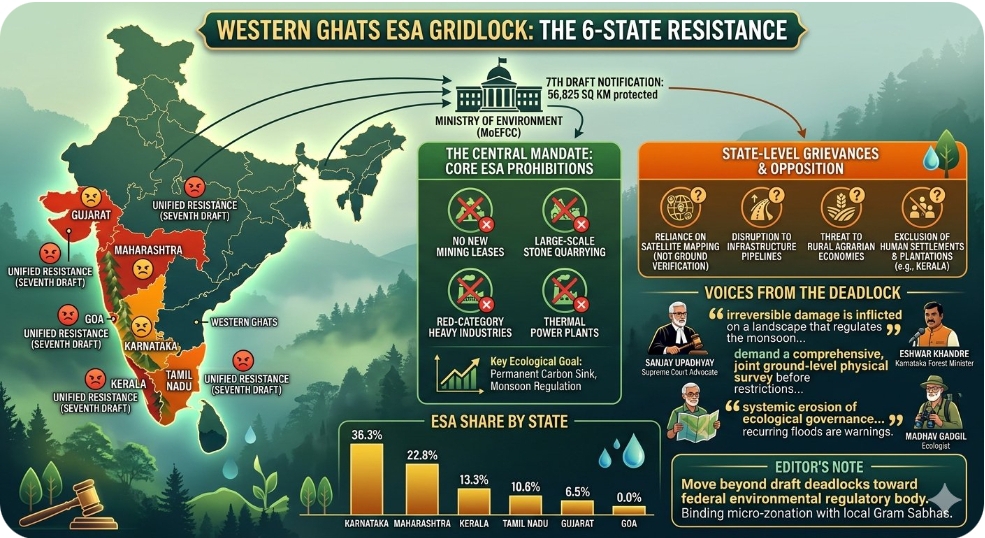
The dispute stems from the central ministry’s absolute mandate to declare 56,825 square kilometres of the global biodiversity corridor across Gujarat, Maharashtra, Goa, Karnataka, Kerala, and Tamil Nadu as an ecologically protected zone. The draft framework seeks to impose a comprehensive prohibition on highly disruptive industrial operations, including new mining leases, large-scale stone quarrying, red-category heavy manufacturing units, and major thermal power plants. However, state secretariats have collectively moved to block the execution, citing severe disruptions to regional infrastructure pipelines and rural agrarian economies.
Territorial Reductions and Sovereign Exemptions
The state of Karnataka remains at the absolute core of the institutional gridlock, accounting for over 20,668 square kilometres—more than 36 per cent—of the total proposed ESA footprint. The state administration has formally rejected the central draft in its entirety, demanding that the Ministry base its ecological boundaries on physical field verifications rather than top-down satellite imagery analysis.
Similarly, the government of Kerala has intensely lobbied the Centre to exclude approximately 1,300 square kilometres of human settlements, structural farmlands, and commercial plantation belts from the final protective zoning map. The state’s alignment follows intense localised political pressure following devastating climate-induced landslides in Wayanad earlier this fiscal year. Regional planners argue that sweeping spatial regulations fail to differentiate between major industrial corporate operations and minor local community livelihood developments.
Institutional Deadlock and Authoritative Demands
The collective resistance has drawn sharp criticism from senior environmental legal practitioners who argue that local administrative bodies are actively prioritising short-term commercial returns over catastrophic macro-ecological decay. Sanjay Upadhyay, a senior advocate at the Supreme Court of India and a leading authority on environmental jurisprudence, issued a stark warning regarding the legal state of the ecosystem:
"The Western Ghats draft notification has been pending for over a decade, and this seventh iteration reveals a complete lack of political will across state lines. By constantly succumbing to local commercial lobbies, state governments are playing with fire. The longer this legal vacuum persists, the more irreversible damage is inflicted on a landscape that regulates the monsoon patterns of the entire Indian peninsula."
Conversely, state policymakers maintain that environmental frameworks cannot be unilaterally engineered from the capital without active sovereign partnership. Highlighting the administrative gridlock from the state's perspective, Karnataka Forest Minister Eshwar Khandre laid out the formal baseline for the state's total rejection:
"We have clearly communicated our stand to the Union Government that Karnataka cannot accept the seventh draft notification in its present form. The current demarcation relies heavily on outdated satellite mapping that completely misrepresents agricultural lands and ancient human habitats as wilderness zones. We demand a comprehensive, joint ground-level physical survey before any statutory restrictions are enforced on our border populations."
Further institutional weight was added by regional environmental boards tracking the continuous reduction of the protective buffer zone. Madhav Gadgil, the renowned ecologist who headed the original Western Ghats Ecology Expert Panel, expressed profound dissatisfaction with the systemic watering down of the original scientific parameters:
"What we are witnessing today is a systematic erosion of ecological governance. The original panel report recommended protecting the entire Western Ghats under varying degrees of community-led conservation. Today, the states are bickering over a heavily diluted fraction of that area. Nature does not recognise state borders or political compromise, and the recurring flash floods and devastating landslides are clear systemic warnings that we ignore at our own peril."
Editor's Note
The multi-state paralysis over the seventh Western Ghats ESA notification underscores a fundamental structural failure in India's cooperative federalism. By treating ecological conservation as a zero-sum conflict between central regulation and state-level development, both tiers of government have effectively left one of the world's most vital carbon sinks entirely unprotected. The state-level demand for endless spatial exclusions to appease real estate, mining, and plantation syndicates ignores the terrifying reality of rapidly compounding climate instabilities. The way forward requires moving beyond deadlocked draft notifications toward an autonomous, federal environmental regulatory body. This institution must execute binding, village-level micro-zonation plans that empower local Gram Sabhas to co-manage buffer zones, effectively aligning state development goals with permanent ecological security.



Leave a comment