

TreeTake Network
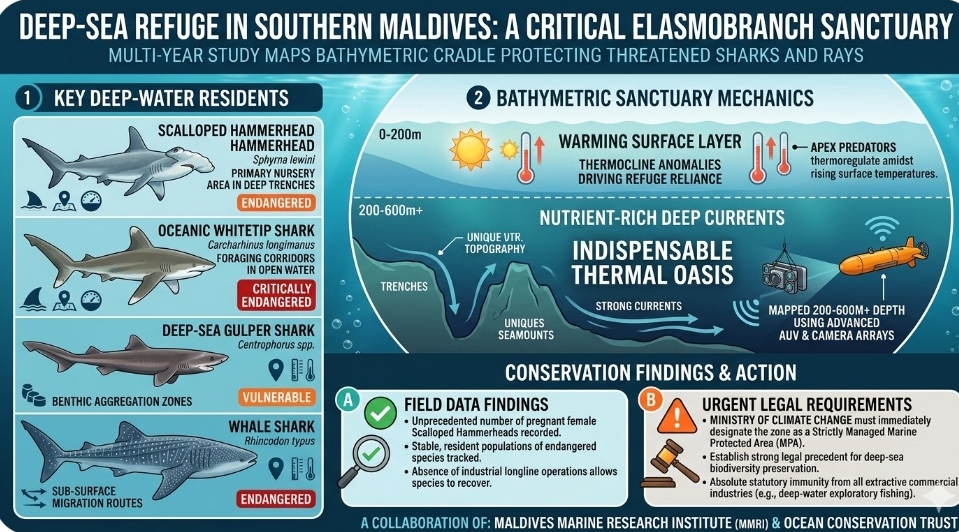
A groundbreaking marine biological study published in the international journal Marine Ecology Progress Series on October 24, 2026, has formally confirmed the presence of a critical deep-sea elasmobranch refuge in the southern atolls of the Maldives. The multi-year research project, led by the Maldives Marine Research Institute (MMRI) in collaboration with the regional Ocean Conservation Trust, has successfully mapped an isolated oceanic sanctuary that supports highly vulnerable populations of deep-water sharks and rays.
Structural safety amidst steep oceanic declines
The discovery comes at a critical juncture for international marine conservation, as global open-ocean shark populations have plummeted by more than 70 per cent over the last half-century due to commercial fishing pressures and habitat degradation. Using advanced autonomous underwater vehicles and deep-towed camera arrays, researchers documented active aggregation zones, nursery grounds, and foraging corridors at depths ranging between 200 and 600 metres beneath the surface. The isolated structural topography of the southern Maldives channels nutrient-rich deep currents, creating an indispensable thermal oasis.
Field biologists tracked stable, resident populations of endangered species within the atoll network, including the scalloped hammerhead (Sphyrna lewini), the oceanic whitetip shark (Carcharhinus longimanus), and several rare species of deep-sea gulper sharks. The absence of industrial longline operations within this territorial zone has allowed these slow-growing, late-maturing apex predators a rare space to recover without immediate threats from commercial fishing gear.
Calls for immediate legal protective zones
During an emergency research briefing held in Malé on October 25, 2026, conservation directors presented these findings directly to the Ministry of Climate Change, Environment and Energy. The research team emphasised that while the remote nature of the deep-sea refuge has acted as a natural buffer, the rapid expansion of deep-water commercial permits and changing thermocline layers driven by climate anomalies could quickly compromise the ecosystem.
Dr Shahaama Sattar, lead marine scientist at the Maldives Marine Research Institute, stated during the briefing: "This atoll forms a unique bathymetric cradle. Our deep-water cameras recorded unprecedented numbers of pregnant female hammerheads using the sub-surface trenches as a nursery space. If we do not seal this zone from commercial exploratory fishing immediately, we risk destroying a primary engine of population replenishment for the entire central Indian Ocean."
Adding to the urgency, Dr Arthur Wilde, Director of the Ocean Conservation Trust, remarked: "The data reveals that these apex predators are relying on these specific deep-sea currents to thermoregulate amidst rising surface temperatures. We are looking at a critical biodiversity fortress that demands absolute statutory immunity from all extractive commercial industries."
Editor's Note
The identification of the deep-sea elasmobranch sanctuary highlights the vital importance of protecting underexplored oceanic zones. To guarantee long-term survival, the Maldivian government must immediately designate this atoll network as a strictly managed Marine Protected Area, establishing a strong legal precedent for deep-sea biodiversity preservation worldwide.



Leave a comment