

Expert Expressions
Dr CP Rajendran is an adjunct professor at the National Institute of Advanced Sciences, Bengaluru, and co-author of the book: The Rumbling Earth – The Story of Indian Earthquakes
Cyclicity, or the rhythmic repetition of events, drives the engine of life on our planet. Cyclicity happens everywhere; some are natural, and some are historically driven. Earth’s evolutionary history was also dotted by natural cycles. In the modern era, however, humans dominating the environmental system can alter these natural cycles, especially the climate.
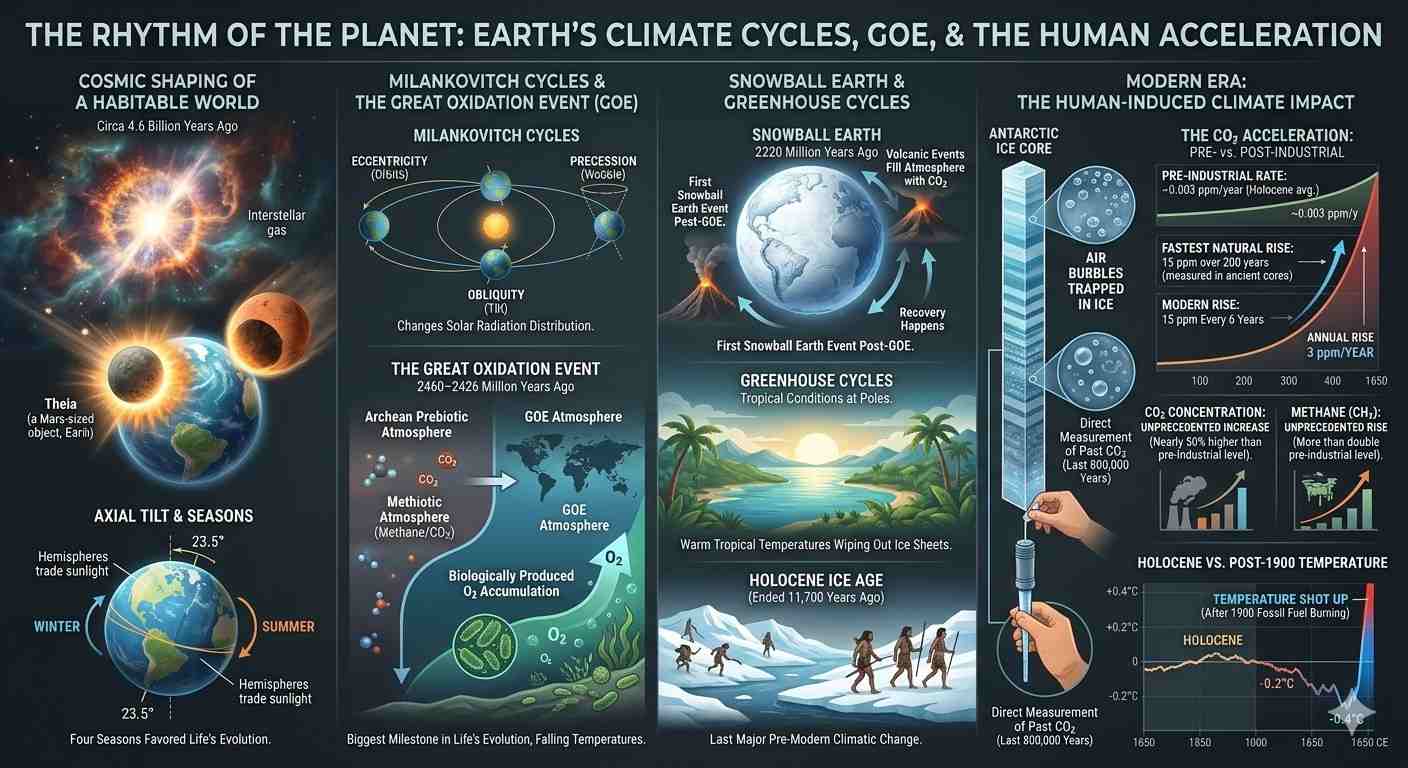
The context of this statement takes us to two serendipitous cosmic events that have shaped the Earth’s climate. First, the collapse of the interstellar gas and dust following the explosion of a nearby star called a supernova, around 4.6 billion years ago. While the Earth was still in its infancy, Theia, a Mars-sized object, is believed to have collided with the Earth, knocking the planet and tilting its axis by exactly 23.5° and allowing the Northern and Southern Hemispheres to trade places in receiving the Sun’s light and warmth directly. So, the Earth developed its four seasons that favoured the evolution of life.
And then there were great climatic changes imposed by the Milankovitch cycles, put forth by Milutin Milenkovic, a Serbian astronomer and geophysicist, whose theory stated that variations in the Earth’s orbit, such as axial tilt (obliquity), eccentricity (shape of Earth’s orbit), and precession (direction that Earth’s spin axis is pointed), cause cyclical changes in the distribution of solar radiation on Earth. Interestingly, one such change resulted in the Great Oxidation Event, the biggest milestone in life’s evolution. The Great Oxidation Event (GOE) began approximately 2460–2426 million years ago during the Earth’s Paleoproterozoic era (2,500 to 1,600 million years ago) when the Earth’s atmosphere and shallow seas first experienced a rise in the concentration of free oxygen.
Geological, isotopic and chemical evidence clearly states that biologically produced molecular oxygen (dioxygen or O2) started accumulating in the Archean prebiotic atmosphere during GOE. The atmosphere of the juvenile Earth did not contain nitrogen or oxygen as we observe today. It was dominated by water vapour, carbon dioxide and methane. GOE increased the oxygen levels in the atmosphere, and the atmospheric temperatures began to fall. The oxygen levels in the atmosphere started to see great jumps, releasing oxygen like never before, or after in Earth’s history.
This led to the Snowball Earth –the academically mentioned period of ice age– with its surface nearly completely frozen. The earliest known Snowball Earth event occurred following the GOE and was around 2,220 million years ago. The planet was still fuming from the inside, and the volcanic explosions added CO2 to the atmosphere, gradually allowing the Earth to come out of its snowball state. As the oxygen content in the atmosphere increased, it created the ozone layer, which could protect the Earth from the harmful ultraviolet rays. The conditions leading to the colonisation by the photosynthetic bacteria – the building blocks of life – were caused by the great climatic change and the GOE.
Greenhouse gases through time
A close look at Earth’s climatic history reveals its complex course, the ice ages interspersed with “greenhouse” cycles when tropical temperatures extend to the poles and wipe out all ice sheets. The Huronian glaciation event, the oldest ice age, occurred from 2.4 to 2.3 billion years ago, with the whole planet frozen over in the first “snowball Earth” and the ice sheets covering the poles, pushing the Earth to extreme cold temperatures.
During the last 800,000 years, the Earth has passed through eight ice ages. Recovery happens when there are volcanic events that fill the atmosphere with CO2. The last ice age occurred about 11,700 years ago when primitive humans travelled vast expanses of ice sheets for food. Known as the Holocene ice age, that event marked the last major pre-modern climatic change. The history of the rise of human societies, and the onset of modern-day climate, starts from the retreat of the Holocene glaciers.
Antarctic ice cores show that the CO2 concentration was stable over the last millennium until the early 19th century, and it started to rise to nearly 50% higher than the pre-Industrial Revolution level. Data from older ice cores show that the magnitude and rate of the recent increase are almost certainly unprecedented over the last 800,000 years. Ice core measurements show that the fastest natural increase measured in atmospheric CO2 in older ice cores is around 15 ppm (parts per million) over about 200 years. By contrast, it is now rising 15 ppm every six years.
Other sources such as isotopic data confirm that the increase is due to emissions from fossil fuel usage and human-induced changes in the natural environment. The ice core record of a major increase in CO2 is invariably accompanied by a rise in temperature, making the human link even more evident. Methane (CH4), another important greenhouse gas, also shows an unprecedented increase, more than double its pre-industrial level. This is mainly due to emissions from agricultural sources and fossil fuel production, which come on top of natural emissions from wetlands and other sources. Methane concentration also tracks the glacial-interglacial changes, probably because fewer wetlands existed in the colder, drier glacial periods.
The Intergovernmental Panel on Climate Change (IPCC) reported that changes in climate and ecosystems due to the continual increase in atmospheric carbon dioxide concentrations caused by human activities are inevitable. Therefore, an understanding of the links between the carbon cycle and climate is important for realistic projections of future climate change. Direct measurements of atmospheric CO2 started only in 1957, giving us only an incomplete picture of long-term carbon cycle dynamics. The air bubbles trapped in the ice cores, and cylinders of ice drilled out of an ice sheet or glacier, are the only source of CO2 from the past. The ice captures tiny bubbles of air from the atmosphere and helps in making direct measurements of the past concentration of atmospheric gases, including carbon dioxide, methane and nitrous oxide.
The rise in atmospheric CO2 throughout the Holocene is quite drastic. It increased at about 0.003 ppm/year with a peak rate of about 0.024 ppm/year in the early Holocene. Post-industrialisation, there was a visible jump and by 2017, the rate exceeded 2 ppm/year. Today, human activity adds almost 3 ppm of CO2 to the atmosphere annually, over 100 times faster than the steepest Holocene rate and 1,000 times faster than the average Holocene rate. There is no denying that compared to the average temperature in 1961-1990, the Holocene temperature trend line shows a rise after the last glaciation, from about -0.2°C to +0.4°C around 5,000 BC, followed by a decline to about -0.4°C in about 1650 CE.
After 1,800, fossil-fuel burning became a growing source of carbon, and after 1900, the temperature shot up, breaking through this trend line. Like the increase in CO2, the rate of temperature increase is also unprecedented during the Holocene. As glaciers melted at the beginning of the era, temperatures rose 0.7°C in about 940 years. Since 1919, Earth’s average temperature has risen 1.2°C, about 1°C every 83 years, over 16 times faster than the early Holocene heating.
Indicators of an unprecedented change
Various global data indicate that the rate at which climatic patterns have changed since the mid-20th century is unprecedented over millennia. It has been documented that although Earth’s climate has changed throughout its history, what is happening now is a rate of change that the past 10,000 years have witnessed. Scientific data from natural sources such as ice cores, rocks, and tree rings, as well as satellite-based observations, all point to signs of a changing climate.
Signs that the planet is warming up are also evident from the records of global temperature rise, retreating ice sheets and rising sea levels; the evidence of a warming planet abounds. The Intergovernmental Panel on Climate Change (IPCC) observes that “Since systematic scientific assessments began in the 1970s, the influence of human activity on the warming of the climate system has evolved from theory to fact”.
Records of global temperature available from 1850 suggest that 2023 was the warmest year; it broke previous records of surface and sea-surface temperatures. “If we continue to use fossil fuels and clear the forests, about 40 billion metric tons of carbon dioxide are likely to reach the atmosphere each year. Another major change is happening in the oceans. It has been observed that since 1969, the ocean temperature has risen by about 0.33 °C. It is the top 100-metre water column that absorbs the increase in temperature.
As the temperature increases, the ice sheets covering Greenland and Antarctica start to retreat. Based on NASA’s estimate, Greenland has lost about 279 billion tons of ice from 1993 to 2019. During the same period, Antarctica lost about 148 billion tons of ice. Mountain glaciers in the mountains like the Alps, Himalayas, Andes, and Rockies are also shrinking. As the glaciers melt, the sea levels start rising. It has been estimated that between 1901 and 2018, sea levels rose by 15 to 25 centimetres. During the last two decades, there has been a twofold increase in the rate of sea-level rise.
Far-reaching impacts of the current climate change
While the rise in temperature and sea level appears to be changes that affect humans sooner and more directly, the shrinking glaciers, heat waves, and water shortage are some of the other consequences. The Intergovernmental Panel gives some critical warnings to specific geographic areas. Thus, western North America may experience a loss of ice sheets and register more heat waves. South America, especially the eastern Amazon, may lose a large part of its rain forests, which would affect biodiversity and lead to species extinction. In the European region, there would be a retreat of ice sheets, a rise in sea level, flash floods, loss of biodiversity and a decrease in agricultural productivity. The African countries would face severe water shortages, and agricultural production would drop, leading to food shortages. Health issues caused by flood and drought conditions will peak.
We started with Milankovitch cycles and seasonality, which is critical to life. The rising global mean temperature drives an earlier onset of spring and a later arrival of autumn. The Antarctic Peninsula is also reported to be greening dramatically, due to higher temperatures. According to a research paper published in Nature Geoscience in October 2024, Antarctica is undergoing a significant change, and the icy terrain is gradually becoming greener. Higher springtime temperatures induce earlier greening and vegetation spread, which would influence ecosystem functions. Climate researchers now have nearly five decades of satellite observations to study the shift in seasons. Based on this data, spring has advanced by approximately 15 days, while autumn has been delayed by a similar amount. Changes in the rhythm of seasons affect our entire ecosystem, as plants are more sensitive to fluctuations in temperature, and this would affect biodiversity.
Even without the current human-driven climate change, Earth would be set for a major climate change sometime in the geologically distant future due to natural planetary variables. But that point, according to the experts, would not arrive for tens of thousands of years. As Michel E. Mann, in his book, The New Climate War, warns, “Our planet has now warmed into the danger zone; we are not yet taking the measures necessary to avert the largest global crisis we have ever faced”. This is reemphasised in much stronger language in another recent paper published in BioScience. “We are on the brink of an irreversible climate disaster. This is a global emergency beyond any doubt. Much of the very fabric of life on Earth is imperilled. We are stepping into a critical and unpredictable new phase of the climate crisis,” reads the introduction.
Our generation has been witnessing such overwhelming changes happening to the climate, and we bear witness to its devastating effects on our society. Meaningful progress can only be achieved by game-changing progress in clean energy production, sustainable life habits, forest management and agriculture, and rapid reduction in human population to avert a possible societal collapse.



Leave a comment