

TreeTake Network
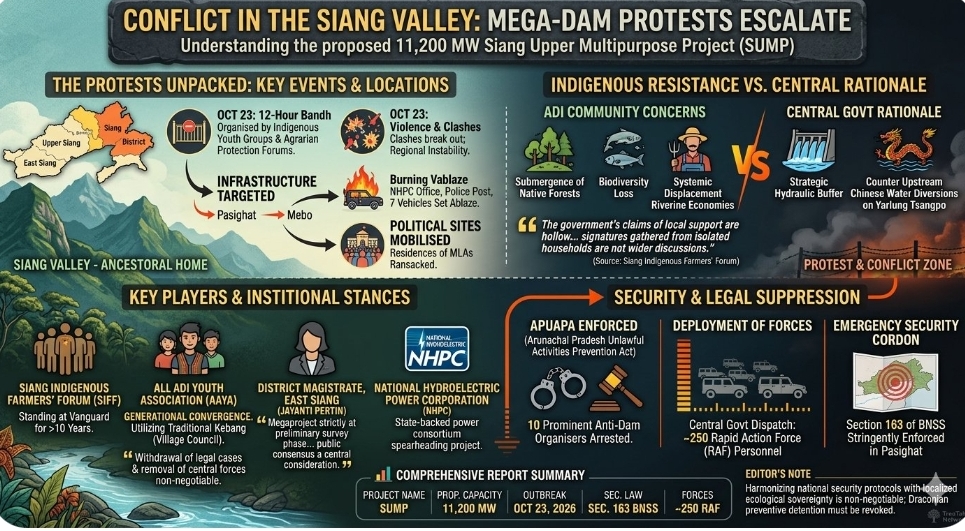
Clashes broke out late on October 23 and persisted into the early hours of the weekend in East Siang district (Pasighat) as massive community-led demonstrations against the proposed 11,200-megawatt Siang Upper Multipurpose Project (SUMP) escalated dramatically. The regional instability prompted the Central Government to dispatch approximately 250 Rapid Action Force personnel to support local police divisions after critical state infrastructure, corporate outposts, and political residences were targeted by demonstrators.
The unrest erupted following a highly coordinated 12-hour bandh organised by indigenous youth groups and traditional agrarian protection forums across parts of East Siang, Upper Siang, and Siang districts, including the strategic sub-divisions of Mebo and Ruksin. Protesters marching from the Mebo sector gathered at the critical Pasighat–Mebo–Mariyang tri-junction, eventually blockading the vital Pasighat–Boleng national highway. The confrontation turned destructive when an office belonging to the National Hydroelectric Power Corporation (NHPC), a regional police post, and seven transport vehicles were set ablaze. Concurrently, crowds marched upon and ransacked the residential compounds of local lawmakers, including MLAs Ninong Ering and Oni Panyang, alongside state political representatives.
Indigenous Land Sovereignty and Geopolitical Friction
The massive infrastructure enterprise, spearheaded by state-backed power consortiums, is designed by the Central Government to function as a strategic hydraulic buffer against heavy upstream damming activities by China on the Yarlung Tsangpo River in Tibet. However, indigenous Adi communities living along the Siang valley vehemently oppose the construction framework, expressing deep existential anxieties over the environmental transformation of their ancestral domains. Local farmers and civil groups point out that the colossal reservoir will permanently submerge native forests, wipe out unique biodiversity hotspots, and systematically displace thousands of families from traditional riverine agricultural economies.
Tensions reached a boiling point after the enforcement of the controversial Arunachal Pradesh Unlawful Activities Prevention Act to arrest ten prominent anti-dam organisers. Despite a high-level administrative meeting on October 13 where Chief Minister Pema Khandu tentatively agreed to systematically withdraw preliminary police First Information Reports and lower local paramilitary footprints, the subsequent retention of key activists sparked accusations of institutional betrayal among the youth leadership.
Multi-Faceted Community Demands and Institutional Stances
Regional community leaders and traditional governance networks maintain that top-down mapping exercises cannot bypass localized sovereign consensus. The Siang Indigenous Farmers’ Forum, which has stood at the vanguard of the territorial resistance for over a decade, issued a direct statement challenging the validity of state-sponsored pre-feasibility reviews:
"People believe a dam cannot stop the 'water bomb' that China might use. The locals fear that permitting surveys now could establish the groundwork for a project that becomes increasingly difficult to oppose later. The government's claims of local support are fundamentally hollow, as signatures gathered from isolated individual households can never be a legitimate substitute for wider discussions with village communities and traditional institutions."
The mobilization has witnessed a powerful generational convergence, with younger members of the Adi community stepping forward to utilize traditional village democratic organs to formalize their veto against the project. Highlighting this framework, a representative from the All Adi Youth Association stressed the breakdown of institutional trust:
"We call for direct, transparent engagement exclusively through traditional kebang institutions. The immediate withdrawal of all legal cases against peaceful protesters and the total removal of external central armed forces from our valley are non-negotiable preconditions for restoring trust between our communities and the state administration."
As emergency security cordons under Section 163 of the Bharatiya Nagarik Suraksha Sanhita remain stringently enforced to prevent public assembly in Pasighat, administrative heads have attempted to calm panic by downplaying the immediacy of structural construction. Highlighting the official position of the state, East Siang District Magistrate Jayanti Pertin confirmed the deployment while reiterating the statutory parameters of the current phase:
"The law and order situation has been brought under control through targeted security deployments, though it remains too early to fully assess the long-term structural impact of the vandalism. The government maintains that the megaproject is strictly at the preliminary survey and environmental assessment stage, and public consensus will remain a central consideration before any physical construction begins."
Editor's Note
The violent escalation in the Siang Valley underscores the precarious structural failure of evaluating strategic geopolitical infrastructure through an exclusively top-down security lens. While New Delhi views the mega-dam as an indispensable hydraulic shield to counter Chinese water dominance upstream, it cannot treat the strategic geography of Arunachal Pradesh as an unpeopled buffer zone. Forcing technical surveys via heavy paramilitary deployment will only harden local resistance, expand the domestic trust deficit, and weaponise environmental anxiety. The way forward requires the immediate revocation of draconian preventive detention acts like the APUAPA and the unconditional integration of traditional kebang village councils into the decision-making pipeline. National security protocols must harmonise with localised ecological sovereignty; otherwise, the state risks destabilising the very border populations vital to its national integrity.



Leave a comment