

TreeTake Network
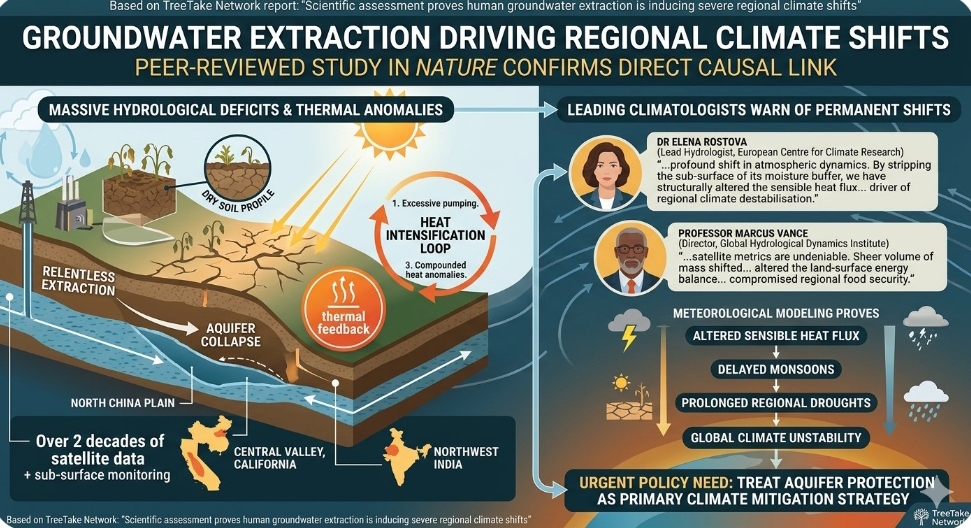
A comprehensive global climate study published in the peer-reviewed science journal titled Nature on October 22, 2026, has established a direct causal link between massive human groundwater depletion and significant regional microclimate alterations. The exhaustive international research project reveals that the relentless extraction of subterranean water systems has reached such extreme volumes that it is actively disrupting local water cycles, creating severe thermal feedback loops, and shifting historic weather baselines across heavily exploited agricultural basins.
Massive hydrological deficits drive thermal anomalies
The international team of hydrologists and climate scientists utilised over two decades of precise satellite data alongside sub-surface monitoring networks to map the global impact of groundwater loss. The findings indicate that key agricultural regions—including the North China Plain, the Central Valley of California, and parts of Northwest India—have depleted their aquifers past critical structural thresholds. When these vast volumes of water are pumped to the surface for crop irrigation, they alter the natural balance of soil moisture and change how solar radiation interacts with the landscape.
As aquifers collapse and soil profiles dry out, the landscape loses its capacity to absorb heat through natural evaporation. This creates a severe drying trend that triggers a dangerous feedback loop: higher ambient air temperatures increase the demand for agricultural irrigation, which forces farmers to extract even more groundwater from collapsing systems, compounding the regional climate instability.
Leading climatologists warn of permanent weather pattern shifts
During an international environmental symposium held in Geneva on October 24, 2026, the study's primary authors presented their data to global policy advisers. The meteorological modelling proves that the localised atmospheric changes induced by aquifer depletion are powerful enough to push historic storm tracks off course, leading to delayed monsoons and prolonged regional droughts.
Dr Elena Rostova, Lead Hydrologist at the European Centre for Climate Research, stated during the panel presentation: "We are observing a profound shift in atmospheric dynamics. By stripping the sub-surface of its moisture buffer, we have structurally altered the sensible heat flux of these regions. The data show that groundwater depletion is no longer just a localised water scarcity issue; it is actively functioning as an unmonitored driver of regional climate destabilisation."
Stressing the immediate policy implications of the research, Professor Marcus Vance, Director of the Global Hydrological Dynamics Institute, noted: "The satellite metrics are undeniable. The sheer volume of mass shifted from subterranean aquifers to the upper atmosphere has altered the land-surface energy balance to a degree that compromises regional food security. If we do not implement strict legal extraction caps immediately, these artificial thermal baselines will become permanent."
Editor's Note
This groundbreaking assessment reveals that groundwater reserves are critical components of atmospheric stability rather than simple resource pools. Global environmental policies must immediately evolve to treat aquifer protection as a primary climate mitigation strategy, integrating strict extraction limits into broader international framework agreements.



Leave a comment