

TreeTake Network
A catastrophic No. 3 alarm industrial fire broke out today, October 26, at Hong Kong's newly operational 31.3 billion Hong Kong dollar waste-to-energy incinerator complex, situated on a twelve-hectare artificial reclamation island off the coast of Shek Kwu Chau. The incident triggered a massive maritime emergency response, forcing nearly a thousand technical staff and construction labourers to flee the offshore platform by boat as colossal clouds of toxic black smoke blanked out the southwestern shipping channels.
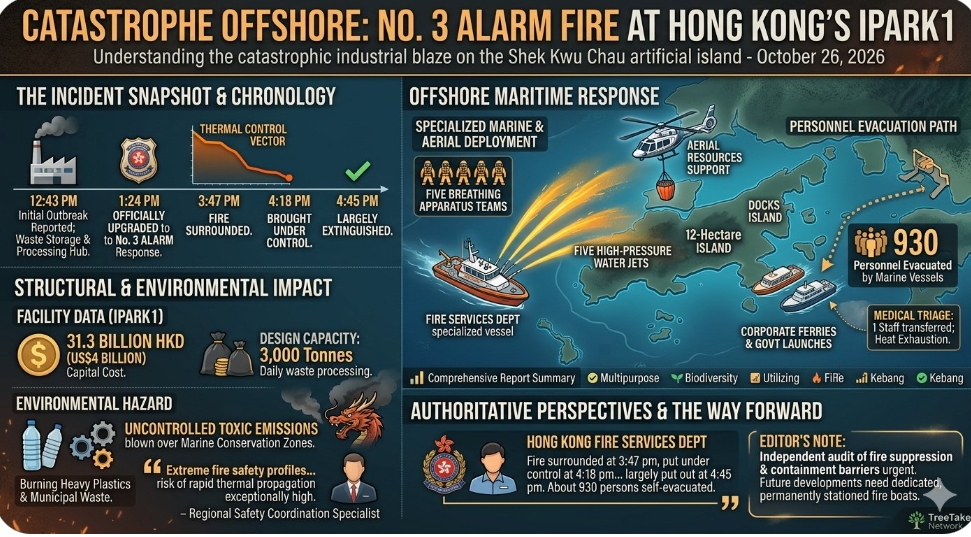
According to logs from the Hong Kong Fire Services Department, the initial outbreak was reported at exactly 12:43 pm local time within the structural parameters of the Integrated Waste Management Facilities Phase I, commonly known as I·PARK1. Recognising the severe structural hazards posed by combustible waste stockpiles, high-temperature processing chambers, and the complete isolation of the offshore artificial island, fire command officially upgraded the incident to a No. 3 alarm response at 1:24 pm to mobilise specialised marine and aerial resources.
Marine Containment and Offshore Deployment
The offshore location presented unprecedented logistical hurdles for emergency units. The Fire Services Department deployed fire boats alongside specialised response vessels, utilising five high-pressure water jets and mobilising five distinct breathing apparatus teams to surround the core infrastructure corridor. Maritime coordination teams successfully orchestrated the emergency evacuation of 930 personnel from the island's docks using corporate transport ferries and government launches.
Emergency medical units confirmed that while no fatalities occurred, one on-site facility staff member suffered acute physical exhaustion from intense ambient heat exposure and was immediately transferred by vessel to the Pamela Youde Nethersole Eastern Hospital for clinical treatment. Firefighters officially surrounded the flames at 3:47 pm, brought the core thermal vectors under control by 4:18 pm, and largely extinguished the final internal hotspots by 4:45 pm.
Structural Integrity and Environmental Repercussions
The facility represents the crown jewel of Hong Kong's long-term municipal waste strategy, designed to incinerate up to 3,000 tonnes of domestic waste daily to phase out total reliance on expanding mainland landfills by 2035. However, today's industrial failure has ignited severe criticism from regional atmospheric monitoring networks regarding the immediate toxicity of the unmitigated emissions blown over the surrounding marine conservation zones.
An official statement released immediately following the containment operations by the Hong Kong Fire Services Department detailed the scale of the deployment:
"A fire broke out at the Integrated Waste Management Facilities Phase I on an artificial island off Shek Kwu Chau at 12:43 pm today, October 26, and was upgraded to a No. 3 alarm at 1:24 pm. The fire was surrounded at 3:47 pm, put under control at 4:18 pm, and largely put out at 4:45 pm. Firemen used five jets and mobilised five breathing apparatus teams to fight the blaze. About 930 persons were self-evacuated to places of safety."
Environmental watchdogs and regional structural engineering analysts express deep concerns that the concentration of heavy plastics and unsorted municipal waste inside the processing hubs means the resultant smoke plume carried significant chemical toxins. Highlighting these structural and environmental anxieties, a regional safety coordination specialist tracking the offshore infrastructure sector noted the unique operational vulnerabilities:
"Offshore artificial islands housing hyper-dense waste-to-energy infrastructure present extreme fire safety profiles. When an ignition event occurs inside an automated sorting or processing bay containing massive volumes of municipal solid waste, the risk of rapid thermal propagation is exceptionally high. The priority must be determining whether the automated exhaust scrubbers and filtration units were structurally compromised during the initial blast, which would mean highly toxic particulates bypassed the facility's strict environmental safeguards."
Editor's Note
The industrial fire at the Shek Kwu Chau incinerator facility exposes the fragile vulnerability of concentrating critical waste-to-energy infrastructure on isolated artificial islands. While shifting waste management to offshore platforms solves the political problem of urban land scarcity, it creates a high-risk operational environment where emergency logistics are entirely dependent on maritime conditions. Furthermore, when high-temperature waste processing suffers a major safety breach, the resulting atmospheric emissions pose an immediate threat to adjacent marine reserves and coastal communities. The way forward requires immediately suspending operations at I·PARK1 to conduct an independent audit of its automated fire suppression systems and structural containment barriers. Future eco-island developments must integrate independent, automated zoning barriers and dedicated, permanently stationed fire boats to prevent localised mechanical failures from escalating into regional environmental disasters.



Leave a comment